Express Entry Guide · Updated October 2026
Healthcare Category in Express Entry: Who Qualifies and How the Rounds Work (Real Cases)
Nurses, aides, technologists, pharmacists and social workers can be invited at scores that would never clear a general round. Here is the test, and where people misread it.
The healthcare category has been one of the most useful doors in Express Entry for people with clinical or care experience. Category-based rounds invite candidates who meet a specific test, ranked by score among themselves, so the cut-off can be very different from a general round.
The test is short, and most of the mistakes people make come from older versions of it that still circulate on forums: a six-month requirement that is now twelve, an occupation list that has changed, and a belief that the category replaces the ordinary eligibility rules. It does not.
We read IRCC’s category-based selection page (modified June 22, 2026), including the full occupation list, and five public forum threads from 2023 and 2024. Where a thread describes an older rule, we say so. This is general information, not legal or licensing advice.
Quick answer: who qualifies for the healthcare category?
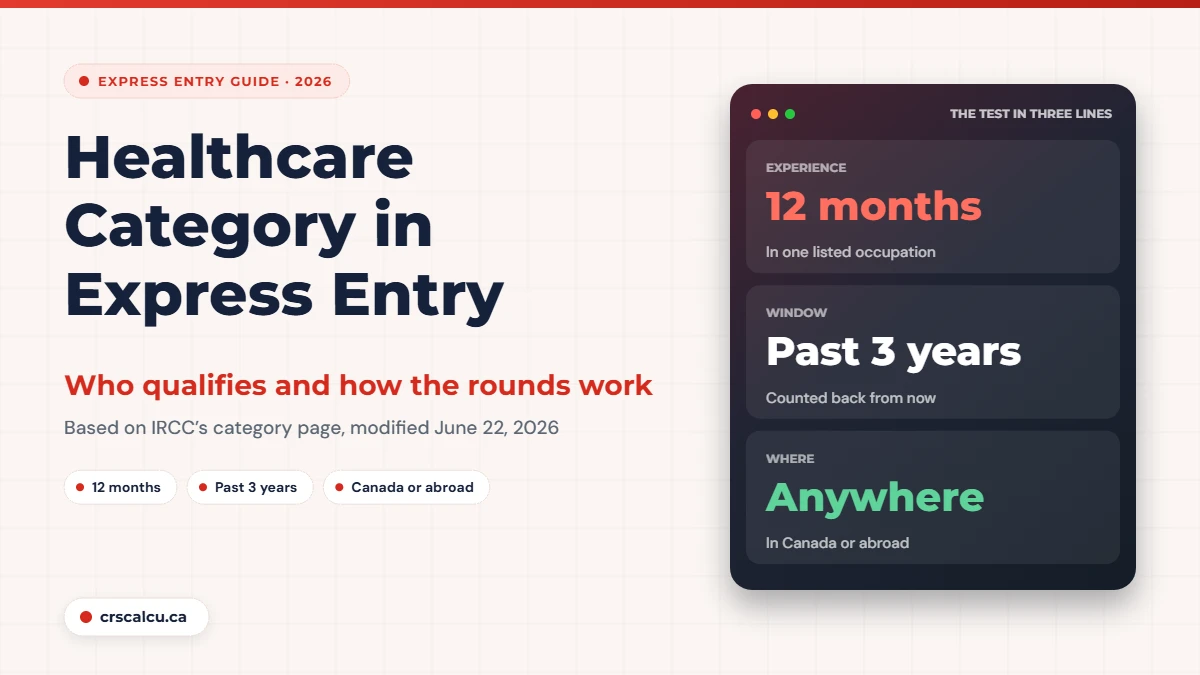
You qualify if you are already eligible for an Express Entry program and have, within the past 3 years, at least 12 months of full-time work experience (or an equal amount of part-time) in one occupation on IRCC’s healthcare and social services list. The experience can be in Canada or abroad and does not have to be continuous. There is nothing extra to apply for: the system identifies eligible candidates from the work history in their profile. Check your base score with our CRS calculator, then find your code in the NOC and TEER finder.
Key takeaways
How the healthcare category works
IRCC’s category-based selection page (modified June 22, 2026) explains the mechanism. Alongside general and program-specific rounds, IRCC holds rounds for candidates who fit a category. To be invited in one, you must first meet the minimum requirements of an Express Entry program. Then you must meet the category’s own test. Among candidates who pass both, the highest CRS scores are invited.
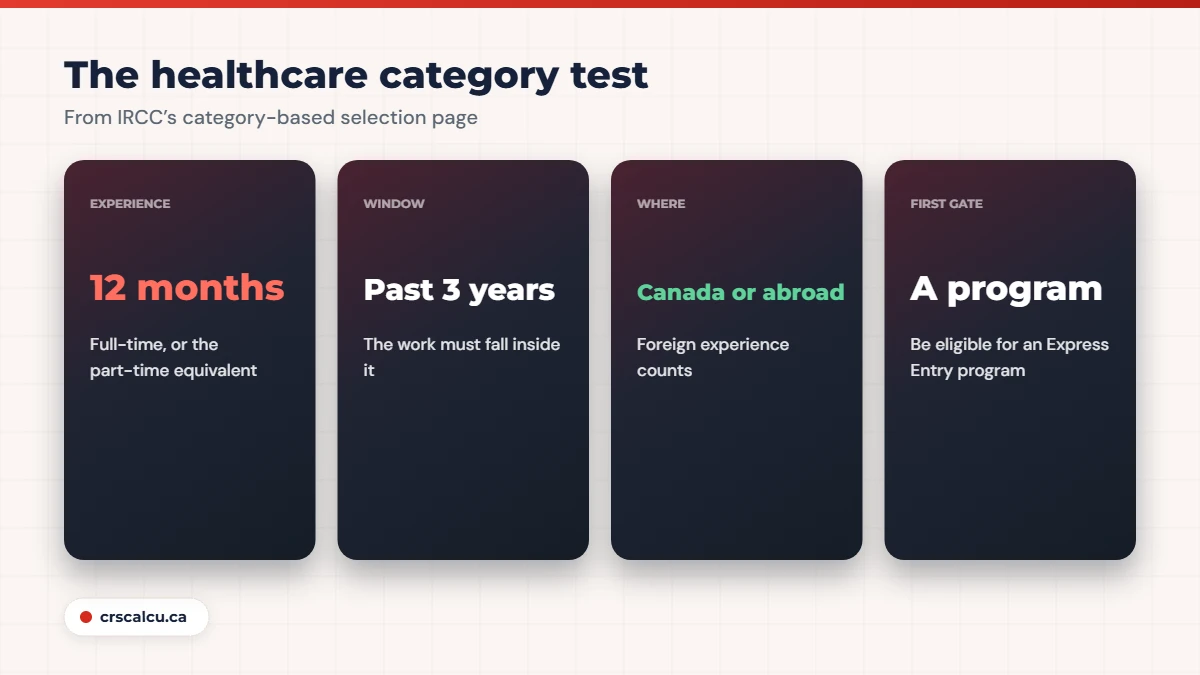
For the occupation categories, healthcare and social services included, the page’s test is at least 12 months of full-time work experience, or an equal amount of part-time experience, in a single listed occupation, within the past 3 years. It says the experience does not need to be continuous and can have been gained in Canada or abroad. There is no separate category application; eligibility is read from the profile.
Our general guide to these rounds is in category-based draws, and recent results are on the latest draw cut-offs page.
Which occupations are in the healthcare category
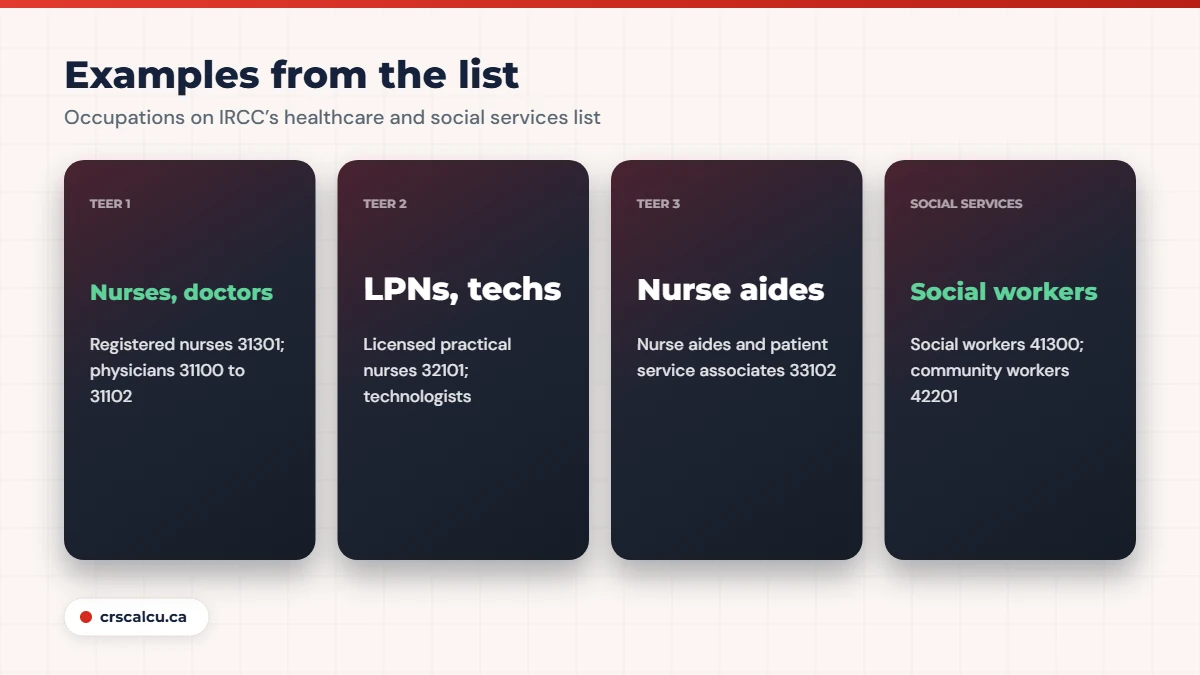
The list on IRCC’s page is long. We have grouped it for reading; the codes are the five-digit NOC codes IRCC shows.
Group | Occupations (NOC code) | TEER |
|---|---|---|
Physicians | Specialists in clinical and laboratory medicine (31100), specialists in surgery (31101), general practitioners and family physicians (31102) | 1 |
Nursing | Nursing coordinators and supervisors (31300), registered nurses and registered psychiatric nurses (31301), nurse practitioners (31302) | 1 |
Nursing and care | Licensed practical nurses (32101); nurse aides, orderlies and patient service associates (33102) | 2 and 3 |
Pharmacy | Pharmacists (31120), pharmacy technicians (32124), pharmacy technical assistants and pharmacy assistants (33103) | 1 to 3 |
Dental and vision | Dentists (31110), optometrists (31111), dental hygienists and dental therapists (32111) | 1 and 2 |
Therapy | Physiotherapists (31202), occupational therapists (31203), audiologists and speech-language pathologists (31112), psychologists (31200), chiropractors (31201), massage therapists (32201) | 1 and 2 |
Laboratory and imaging | Medical laboratory technologists (32120), medical radiation technologists (32121), medical sonographers (32122), cardiology technologists (32123), medical laboratory assistants (33101) | 2 and 3 |
Emergency and respiratory | Paramedical occupations (32102), respiratory therapists and related (32103) | 2 |
Social services | Social workers (41300), therapists in counselling (41301), social and community service workers (42201) | 1 and 2 |
Grouped by us from IRCC’s category-based selection page (modified June 22, 2026). The page lists further occupations, including veterinarians (31103), dietitians and nutritionists (31121), physician assistants and midwives (31303) and animal health technologists (32104). Always check the live list.
The list is not fixed. IRCC has changed the categories and their occupations since they were introduced, and an occupation’s presence in an old forum post proves nothing about today.
Real case: a pharmacist looking at the assistant code (May 2024)
Someone qualified as a pharmacist asked whether they could enter under the pharmacy assistant occupation, because pharmacists were not on the eligible list at the time. A forum member replied that the occupation code has to match your actual education and work experience, and that you cannot pick a neighbouring code because it is on a list. They went on to say that pharmacists had been left off because of supply, and doubted any province had a stream for them. No outcome was reported.
Two points. The advice about matching the code to your real duties is correct and matters for every category; we cover the consequences in wrong NOC code in Express Entry. And the premise has since changed: pharmacists (31120) are on the list we read in 2026. Check the list as it stands when you enter the pool.
Real case: personal support worker (January 2024)
A personal support worker in Ontario asked which skill level the job falls under and whether it counts for healthcare rounds. A reply placed the work under nurse aides, orderlies and patient service associates (33102), which is TEER 3, and noted that this occupation has been part of the healthcare category. The same reply drew a distinction with home caregiver roles in TEER 4, which do not qualify for Express Entry at all. In later posts members said the duties you actually perform decide the code, not the job title or the type of facility.
The 12 months and the 3 years
Two numbers define the test, and both have tripped people up.
The first is 12 months. Earlier versions of the category rules asked for six, and threads from 2023 and 2024 still say so. IRCC’s page today says at least 12 months of full-time work, or the part-time equivalent, in a listed occupation.
The second is the 3-year window. It looks back from now, and it keeps moving.
Real case: experience from 2019 to 2021 (December 2023)
A candidate with 478 points had worked in a listed healthcare occupation from July 2019 to November 2021 and asked how the “past 3 years” is counted, hoping to stay eligible until about May 2024. Experienced members explained that the window is measured back from the invitation and again when the application is submitted, so the qualifying experience has to fall inside it at both moments. They also noted that full-time means at least 30 hours a week and that part-time work is counted by total hours. The thread was written when the requirement was six months. No outcome was reported.
Our arithmetic for today’s rule: if your last day in a listed occupation was November 30, 2023 and you had worked there for years, the most recent 12 months of that work stay fully inside the 3-year window until about the end of November 2025. After that, each month that passes removes a month from what counts. Someone who left clinical work to study or to take a non-listed job has a deadline, even if nobody has told them so. To count hours properly, see 1,560 hours.
It does not have to be your current job
IRCC’s page asks for experience in a listed occupation. It does not say that occupation must be your primary one or your current one.
Real case: invited in a healthcare round with a different current job (November 2024)
A candidate was invited in a healthcare round. Their current job in Canada was as a healthcare manager, under a code that was not among the targeted occupations, but they had earlier experience abroad in an occupation that was. A reply suggested the invitation came from that earlier experience in their work history. The poster was unsure whether to proceed, because they were also waiting on a provincial nomination and their profile was due to expire in February 2025. No outcome was reported.
That case fits the wording of the rule. It also shows why every job in your work history should carry the right code, including old ones abroad; see foreign work experience in Express Entry. If you are invited this way, the experience still has to be proven with letters, as set out in reference letter for Express Entry.
The category does not replace the basic rules
Real case: a dentist shown as ineligible (June 2024)
A dentist with one year of experience, working abroad, built a profile hoping for a healthcare round. By their own calculation they had 68 points on the Federal Skilled Worker grid, one above the pass mark, yet the system showed them as not eligible. Members asked about language results, the credential assessment and settlement funds, which the poster said were in order. The most experienced reply said that one or more answers in the profile must be making it ineligible and that the only way to find it was to go through every question again. No resolution was reported.
Dentists (31110) are on the list. That did not help, because the profile had not passed the first gate. A category round only reaches candidates who are in the pool as eligible under one of the three programs. For an applicant abroad that usually means the Federal Skilled Worker Program: one continuous year of skilled work, CLB 7, a credential assessment, 67 points and settlement funds. Test the grid in our FSW points calculator and see Express Entry from outside Canada.
Physicians: a second, narrower category
IRCC’s page also lists a category for physicians with Canadian work experience, covering the three physician codes (31100, 31101 and 31102). Its test is the same 12 months within the past 3 years, but the work must have been done in Canada.
Licensing is a separate question
The category page we read sets a work experience test. We did not find a requirement on it to hold a Canadian licence in order to be invited. Being able to practise a regulated profession in Canada is another matter, decided by provincial regulators, and it is outside what this post covers.
Checking whether you qualify
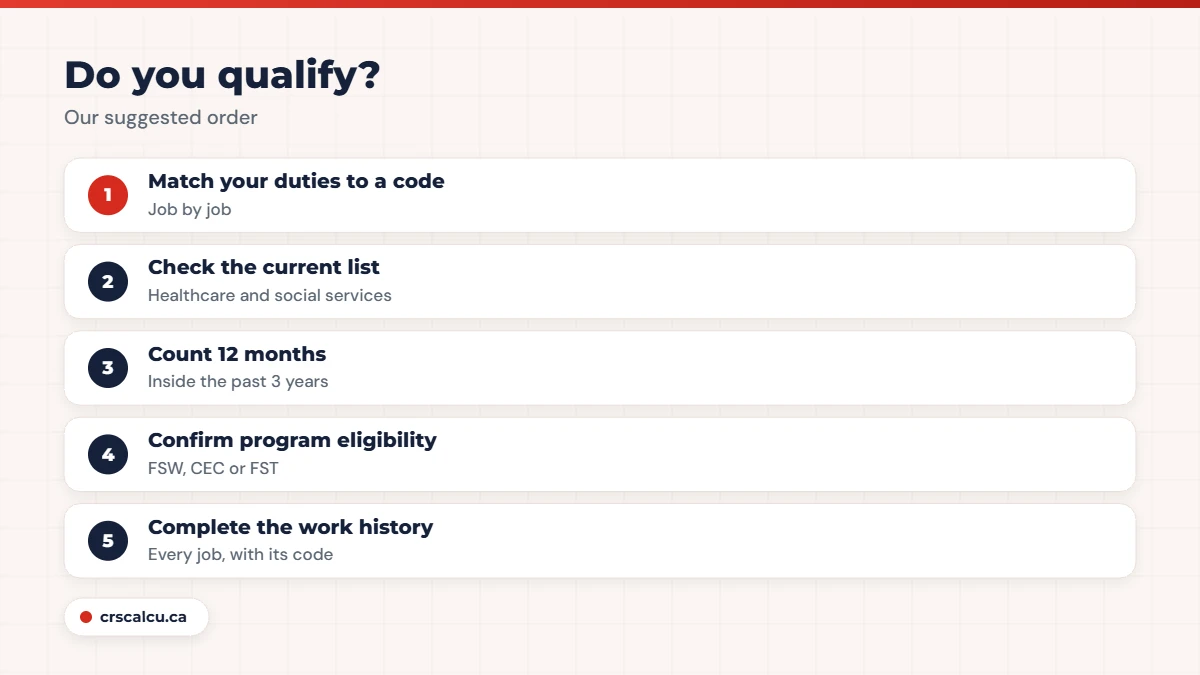
Our suggested order
Five mistakes people make with the healthcare category
Avoid these
What IRCC does not say
IRCC does not announce in advance when a category round will be held, how many invitations it will issue or what the cut-off will be. The page we read does not address licensing. And if you believe you qualified and were not invited, there is no review process described; see no ITA in Express Entry for how to check the usual reasons.
Frequently Asked Questions
What is the healthcare category in Express Entry?
It is one of IRCC’s category-based selection categories, called healthcare and social services occupations. Rounds for it invite eligible candidates with at least 12 months of recent experience in a listed occupation, ranked by CRS score.
How much experience do I need?
At least 12 months of full-time work, or an equal amount of part-time work, in one listed occupation within the past 3 years. It does not need to be continuous.
Does experience outside Canada count?
Yes for healthcare and social services occupations: IRCC’s page says the experience can be in Canada or abroad. The separate physicians category requires Canadian experience.
Do I need to apply for the category?
No. There is no separate application. The system identifies eligible candidates from the work history in their Express Entry profile.
Are personal support workers included?
Nurse aides, orderlies and patient service associates (33102) are on the list we read. Whether your job falls under that code depends on your actual duties.
Do I need a Canadian licence to be invited?
We did not find a licensing requirement on IRCC’s category page, which sets a work experience test. Practising a regulated profession in Canada is governed by provincial regulators.
Check your score for a category round
Calculate your CRS, then compare it with healthcare round cut-offs.
Final Thoughts
The healthcare category rewards recent, real experience in a listed occupation, wherever it was gained. Get the code right, count 12 months inside the last 3 years, make sure the profile is eligible in the ordinary way, and let the work history speak for itself.
If your duties straddle two codes, if your listed experience is about to fall out of the window, or if your profile shows as ineligible and you cannot see why, a licensed immigration consultant or an immigration lawyer can check it with you.