Express Entry Guide · Updated October 2026
Medical Inadmissibility in Express Entry: Excessive Demand, the Threshold and Your Reply (Real Cases)
A health condition does not disqualify you by itself. A specific test does, and you get a chance to answer before any decision is made.

Medical inadmissibility is the part of the immigration medical exam that people fear without quite knowing what it is. They have a chronic condition, or a child with one, or a medication they take every day, and they wonder whether it is worth applying at all.
The rule is more specific than the fear. There are three grounds, only one of which involves cost. That one has a published dollar threshold, which has risen sharply in recent years. And before IRCC refuses anyone on medical grounds it sends a letter setting out its concerns and gives time to respond. People do respond successfully.
We read IRCC’s pages on medical inadmissibility and on mitigation plans (both modified July 23, 2026) and its Express Entry pages, plus five public forum threads from 2016 to 2020. Dollar figures in older cases are as the posters reported them. This is general information. It is not medical or legal advice.
Quick answer: what is medical inadmissibility?
IRCC’s page gives three possible reasons: danger to public health, danger to public safety, and excessive demand on health or social services. Excessive demand means the services your condition needs would negatively affect wait times in Canada or would likely cost more than the excessive demand cost threshold, which the page puts at $144,390 over 5 years, or $28,878 per year, for 2026. If IRCC thinks you may be inadmissible, it sends a procedural fairness letter and you have 90 days to respond. Having a diagnosis is not the test. To see the rest of your picture, use our CRS calculator.
Key takeaways
The three grounds of medical inadmissibility
IRCC’s medical inadmissibility page (modified July 23, 2026) says there are three possible reasons a person can be refused on health grounds: danger to public health, danger to public safety, and excessive demand on health or social services.
Ground | What it is about | Our comment |
|---|---|---|
Danger to public health | Conditions that could endanger other people in Canada | Usually about certain infectious diseases and how they are being treated |
Danger to public safety | A risk of sudden incapacity or of unpredictable or violent behaviour | Assessed from the medical exam results |
Excessive demand | Demand on publicly funded health or social services | The only ground with a dollar threshold |
Our summary of IRCC’s medical inadmissibility page (modified July 23, 2026). The third column is our comment, not IRCC text.
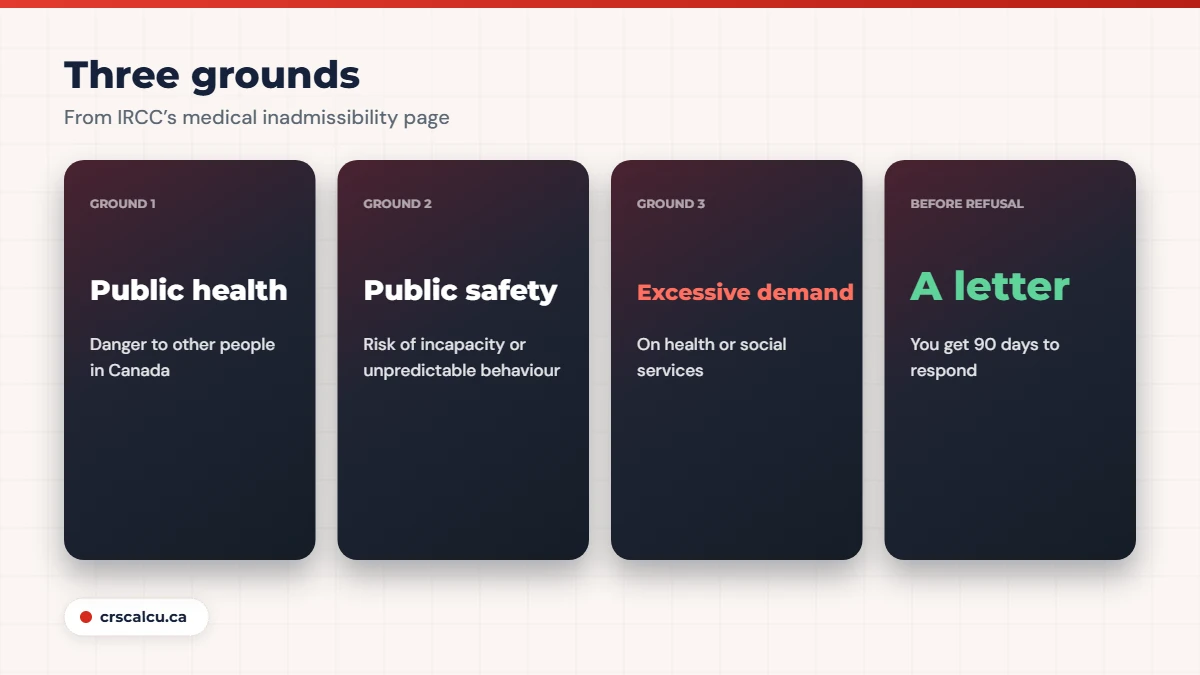
Most questions from Express Entry applicants are about the third ground, so most of this post is too.
Excessive demand and the cost threshold
IRCC’s page says your condition may cause excessive demand in either of two situations. The first is where the health or social services needed to treat it would negatively affect wait times for services in Canada. The second is where the services needed to treat and manage it would likely cost more than the excessive demand cost threshold.
For 2026 the page gives the threshold as $144,390 over 5 years, or $28,878 per year.
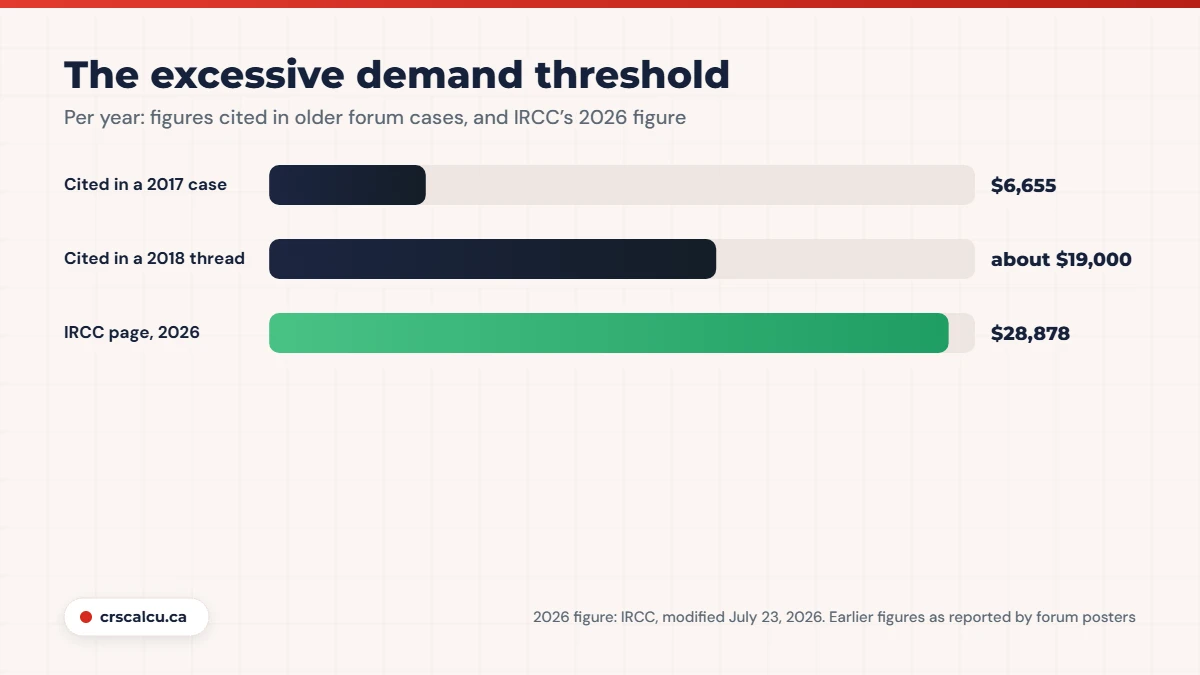
That number has moved a great deal, and old forum threads can frighten people with figures that no longer apply. A case from 2017 quotes a threshold of $6,655 a year. A thread from 2018 describes it as having just been tripled to about $19,000. The figure on IRCC’s page today is higher again.
Our arithmetic, as an illustration only: a treatment costing $12,000 a year comes to $60,000 over five years, well under $144,390. One costing $35,000 a year comes to $175,000, which is over. Real assessments look at the services a specific person is expected to need, not at a diagnosis in the abstract, and they are made by medical officers, not by applicants with a calculator.
Real case: “what is their limit?” (January 2016)
A prospective applicant found the published criteria too vague to act on and asked for examples of conditions that lead to refusal. Replies explained the excessive demand threshold as it then stood and stressed that decisions rest on an individual assessment of what a particular person is expected to need, taking account of their circumstances. Members said that common, well-controlled conditions do not usually cause a problem, while conditions needing extensive, costly ongoing treatment draw more attention, and that people had succeeded by showing how their costs would be covered. Professionals in the thread advised anyone with a serious condition to consult an immigration lawyer before applying. The poster said they would.
Who the excessive demand rule does not apply to
IRCC’s page says the excessive demand rules do not apply to refugees and their dependants, protected persons, and certain people being sponsored by family, such as dependent children, spouses and common-law partners. Express Entry applicants and their accompanying family are not on that list, so the rule applies to them.
The procedural fairness letter
IRCC does not refuse on medical grounds without warning. Its page says that if it believes you may be inadmissible, it sends a letter explaining why, and that you can respond with information and documents within 90 days from the date of the letter. You can ask for an extension, and you may use a representative but do not have to.
Real case: medication priced above the old threshold (December 2017)
A Canadian Experience Class applicant with a chronic inflammatory condition received a fairness letter. IRCC had estimated the cost of their medication at about $20,800 a year, against a threshold then quoted at $6,655. Forum members advised asking their doctor whether a less expensive treatment was appropriate, getting written confirmation from their group insurer that it would cover most of the medication cost on a continuing basis, and not relying on savings or family money, which create no obligation. Several urged hiring a lawyer experienced in these cases. In February 2019 the applicant came back to report that they had retained a lawyer and had become a permanent resident in February 2018, and that the insurer’s confirmation that it covered 80 per cent of the medication had been central to the reply.
Two things are worth noticing. The applicant answered the letter with documents, not arguments. And the sums in that case would look different today: $20,800 a year is below the 2026 per-year figure on IRCC’s page.
Real case: a note in the file, no letter yet (February 2020)
An applicant with an inflammatory bowel condition, who had applied in May 2019, obtained their file notes and found the medical marked as ready to be assessed, with a comment that the condition might reasonably be expected to cause excessive demand. They had had surgery in 2016, a year of biologic medication, and had been in remission without medication since. They asked whether a fairness letter was coming and whether a lawyer would help. A senior member said a letter is what to expect when IRCC is considering refusal on this ground, and that the outcome turns on showing you will not create excessive demand, not on having a lawyer as such. Another member described a similar case on biologic treatment that was approved after about 13 months. A later post mentioned another applicant who passed the medical assessment.
Mitigation plans
IRCC’s mitigation plans page (modified July 23, 2026) describes a plan as an explanation of what you will do to make sure you do not cause excessive demand. You can submit one only if IRCC invites you to in the fairness letter. It has to show how the services you need will be provided, how you will pay for them, and what your financial situation will be for the whole period you need them, and it comes with a signed declaration of ability and willingness.
The page is clear about its limits. You cannot opt out of publicly funded health services, with the exception of outpatient prescription medication in some provinces and territories. So a plan can address medication, for instance through employer insurance, or social services you would pay for privately. It cannot promise to pay privately for hospital or physician care that the public system provides.
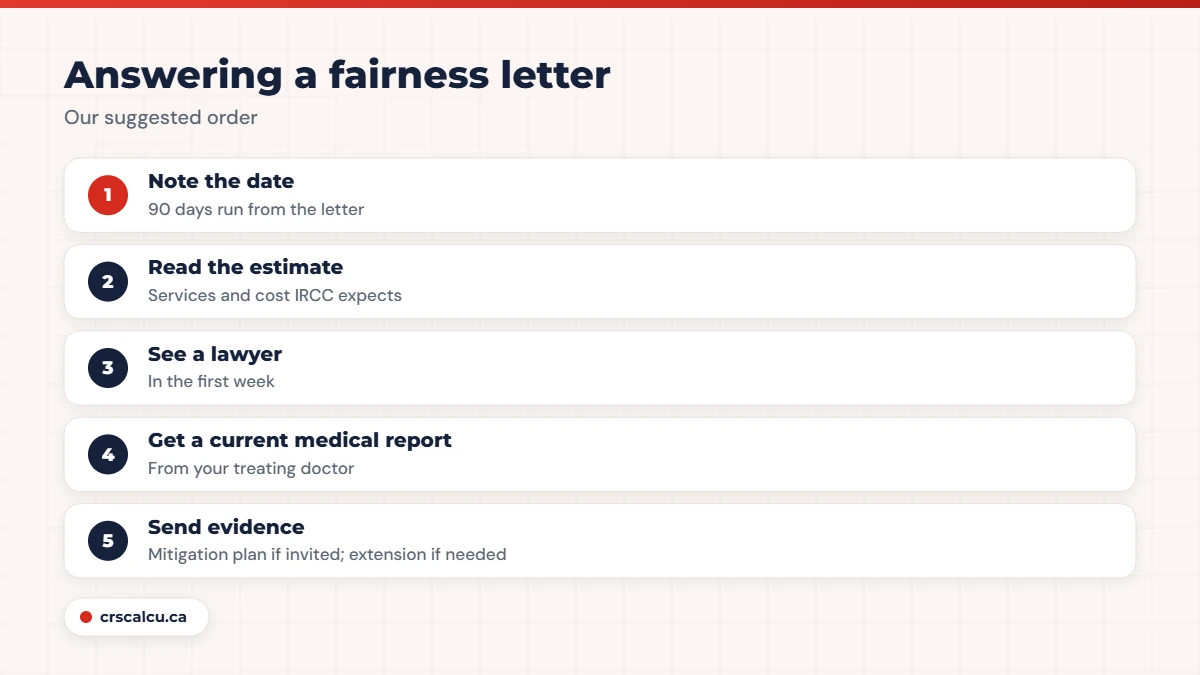
If you receive a fairness letter (our suggested order)
When the exam leads to more tests
Not every follow-up is about inadmissibility. Often the medical office simply wants more information.
Real case: extra tests and a tight deadline (July 2018)
After an upfront medical exam, an applicant was asked by the medical branch for further tests for tuberculosis, including a culture that takes about eight weeks to produce a result. The clinic was reluctant to arrange it, the deadline looked impossible given how long the culture takes, and the applicant could not reach anyone by phone. Members advised arranging the tests, having the results sent through the examining physician, and asking for more time with proof of the appointment. Another applicant in the thread described the same request being completed and uploaded within two weeks, after which their file moved on.
A request for more tests is a request, not a finding. Respond to it promptly and keep proof of what you did. If a pregnancy affects what can be tested, see pregnant during Express Entry.
Should you apply at all?
Real case: a long-managed condition and a rule that had just changed (August 2018)
Someone living with HIV for eight years, on treatment with strong test results, asked whether Express Entry was realistic. Early replies warned that the exam includes testing and that a fairness letter about excessive demand was possible. A later reply pointed out that the cost threshold had recently been raised substantially, and argued that the yearly cost of standard treatment could fall under it for someone with no other complications. A contributor with a medical background agreed that a well-controlled case might not be found inadmissible under the revised rule. The poster thanked them and did not report an outcome.
That thread captures the shift. Under the old threshold, many stable, treatable conditions ran into the rule on medication cost alone. Under the higher one, fewer do. Whether yours does is a question for a doctor and a lawyer with your records in front of them, but the starting assumption should not be that a diagnosis ends your chances.
Family members
IRCC’s Express Entry application page says your family members must have a medical exam even if they are not coming with you, and the Help Centre adds that an inadmissible dependant may make you inadmissible. The health of a spouse or child is therefore part of your application whether or not they travel. We explain the rule in non-accompanying spouse. After you apply, IRCC’s Update your application page lists significant changes in health among the things to report.
Five mistakes people make with medical inadmissibility
Avoid these
What IRCC does not say
IRCC’s pages do not list conditions that are or are not acceptable, and they could not, since each case is assessed individually. They do not publish the cost figures used for particular treatments on the pages we read, or how often fairness letters end in approval. Medical inadmissibility is separate from the other grounds of inadmissibility; for those, see criminal record and Express Entry. For the rest of the process abroad, see Express Entry from outside Canada, and for scores, what CRS score you need and the latest draw cut-offs.
Frequently Asked Questions
What is medical inadmissibility in Express Entry?
It is a finding that an applicant, or a family member, cannot be admitted on health grounds. IRCC’s page gives three possible reasons: danger to public health, danger to public safety, and excessive demand on health or social services.
What is the excessive demand threshold for 2026?
IRCC’s page gives $144,390 over 5 years, or $28,878 per year.
Will I be refused because I have a chronic condition?
Not because of the diagnosis itself. The excessive demand test looks at the services you are expected to need, their effect on wait times and whether their cost is likely to exceed the threshold.
What happens if IRCC thinks I am inadmissible?
It sends a procedural fairness letter explaining its concerns. You have 90 days from the date of the letter to respond with information and documents, and you can ask for an extension.
What is a mitigation plan?
A plan, submitted only when IRCC invites one, showing how the services you need will be provided and paid for. IRCC says you cannot opt out of publicly funded health services, except outpatient prescription medication in some provinces and territories.
Does my spouse’s or child’s health matter if they are not coming?
Yes. IRCC says family members must have a medical exam even if they are not coming, and an inadmissible dependant may make you inadmissible.
Check the rest of your application
The medical is one stage. See where your score stands for the stage before it.
Final Thoughts
Medical inadmissibility is a defined test with a published threshold and a right of reply, not a verdict on anyone with a health history. If you are concerned, find out what services your condition is expected to need and what they cost, compare that with the current figure, and be ready to answer a fairness letter with documents if one comes.
If you or a family member has a condition that needs significant ongoing treatment, speak to an immigration lawyer experienced in excessive demand cases before you apply, and to your doctor about a current report. We cannot assess a medical situation and this post does not try to.