Express Entry Guide · Updated October 2026
Criminal Record and Express Entry: Inadmissibility, Disclosure and Your Options (Real Cases)
An old conviction, a charge that was dropped, an arrest you would sooner forget. Here is what IRCC’s pages say, and why hiding it is the worst option.
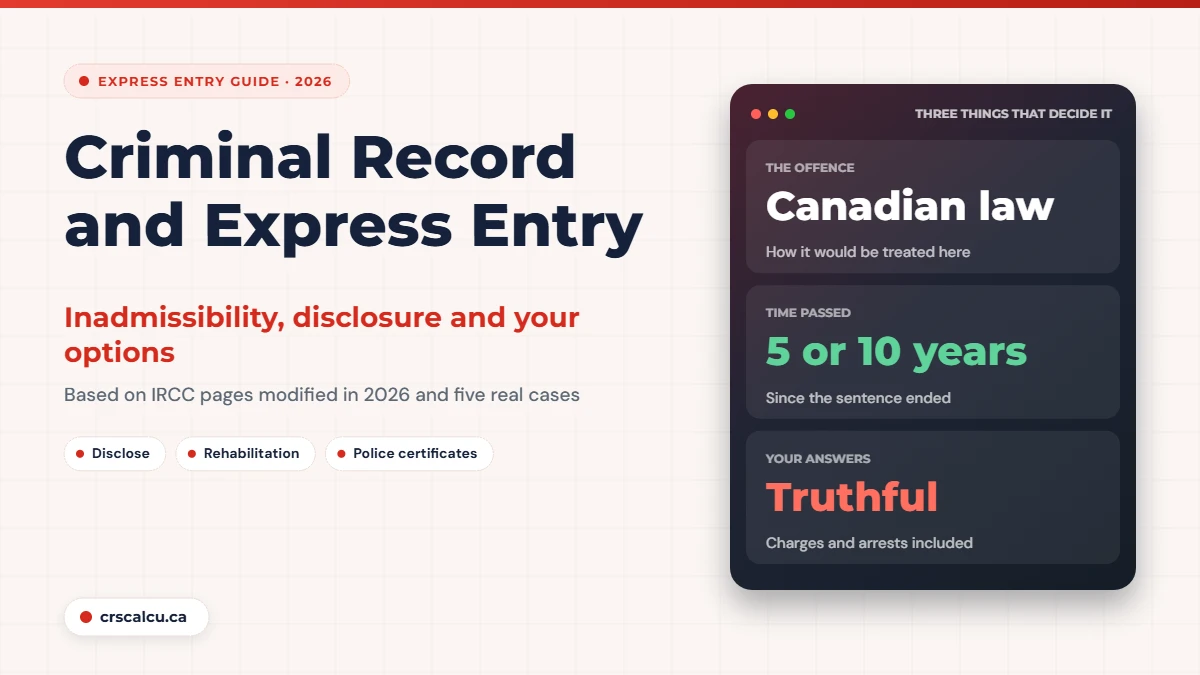
A criminal record is the subject people least want to raise and most need to get right. Express Entry asks about it directly, backs the question with police certificates, and treats a wrong answer as a separate and serious problem. At the same time, a record is not automatically the end. Canadian immigration law has specific routes for people whose offences are behind them.
Which route applies, if any, depends on details no article can settle: what the offence would be under Canadian law, the sentence, how long ago it ended and whether there was more than one. Our aim here is narrower. We set out what IRCC’s pages say, what the forms and certificates will surface, and what happened to five people who asked about it in public.
We read IRCC’s pages on overcoming criminal convictions, deemed rehabilitation and impaired driving (all modified July 23, 2026), its Express Entry police certificates page and two Help Centre answers, plus five public forum threads from 2015 to 2021. This is general information. It is not legal advice, and this is a subject on which you should get some.
Quick answer: can you apply for Express Entry with a criminal record?
You can apply, and you must answer the background questions truthfully. Whether you are approved depends on whether you are criminally inadmissible, which IRCC says can result from having committed or been convicted of a crime. IRCC’s page lists four ways to overcome that: being deemed rehabilitated after enough time, applying for individual rehabilitation at least five years after your sentence ended, a record suspension or discharge, or, for temporary entry only, a temporary resident permit. Police certificates are required for you and adult family members. If you want to see your score while you sort this out, use our CRS calculator.
Key takeaways
What makes someone criminally inadmissible
IRCC’s page on overcoming criminal convictions (modified July 23, 2026) says that under Canada’s immigration law, a person who has committed or been convicted of a crime may be criminally inadmissible. Its examples range from theft and assault to manslaughter, dangerous driving, impaired driving and drug trafficking. The page also says that if you were convicted when you were under 18, you may still be able to enter Canada.
Two phrases in that sentence matter. “Committed or been convicted” is wider than a conviction. And what counts is how the act would be treated under Canadian law, which is why the name of the offence where it happened does not settle the question.
For an Express Entry applicant there is a family dimension as well. IRCC’s Help Centre says all dependants must pass background checks whether or not they are coming with you, and that an inadmissible dependant may make you inadmissible. We cover that rule in non-accompanying spouse.
Four ways to overcome a criminal record
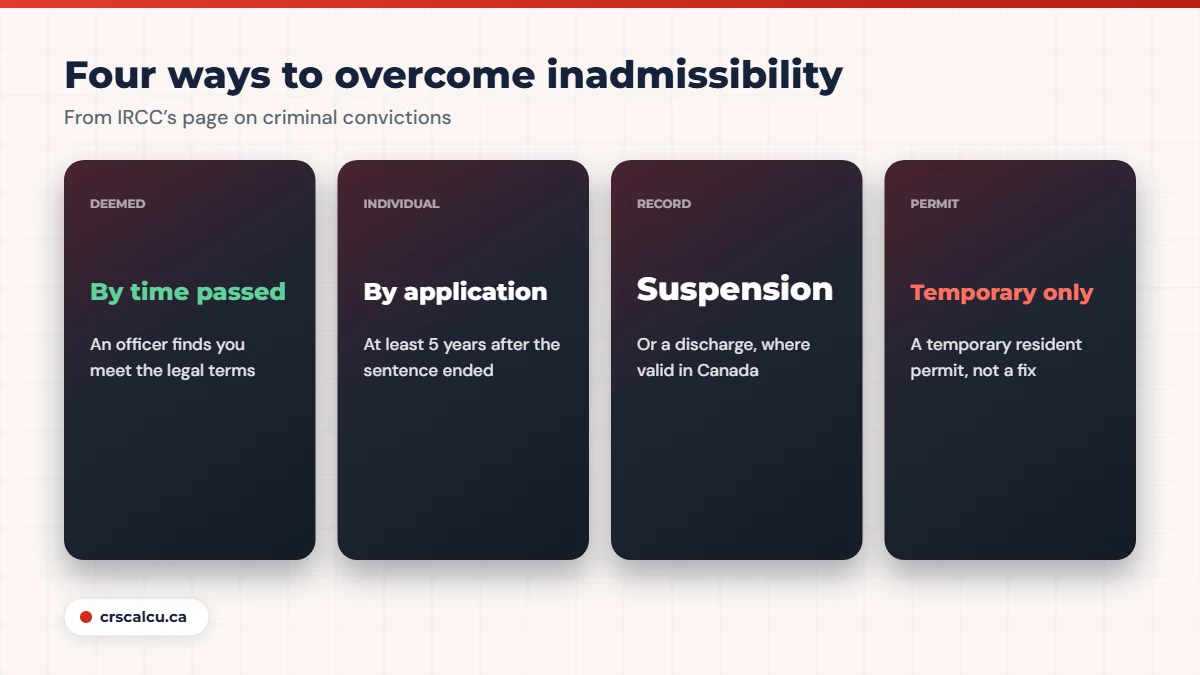
Route | What IRCC says | Useful for permanent residence? |
|---|---|---|
Deemed rehabilitation | You convince an officer that you meet the legal terms, based on the offence and the time passed | Yes, if you meet the terms |
Individual rehabilitation | You apply and are approved; at least 5 years since the sentence ended; you show you are not likely to commit new crimes | Yes, once approved |
Record suspension or discharge | A Canadian record suspension through the Parole Board, or a foreign one that is valid in Canada | Yes, where it applies |
Temporary resident permit | Lets you enter or stay in Canada temporarily | No; it is temporary |
Our summary of IRCC’s page on overcoming criminal convictions (modified July 23, 2026). The third column is our reading.
Deemed rehabilitation
IRCC’s deemed rehabilitation page (modified July 23, 2026) says whether you qualify depends on the crime, on whether enough time has passed since you completed the sentence, and on whether you committed one crime or more. The crime must be one that would be punishable in Canada by a maximum prison term of less than 10 years. The page mentions 10 years for one indictable offence and five years for two or more summary convictions. Nothing is applied for; an officer assesses it.
Individual rehabilitation
The Help Centre (modified April 17, 2026) says you can apply for individual rehabilitation if you were convicted outside Canada and your sentence ended at least five years ago, or if you committed a crime outside Canada more than five years ago without being charged. The five years run from the end of the whole sentence. Its example: if the sentence included three years of probation, you wait five years from the end of the probation.

Real case: rehabilitation approved after 20 months (January 2015)
A person with two convictions from the mid-1990s, one for property damage and one for impaired driving, had been found inadmissible in 1999. Years later they decided to apply for criminal rehabilitation. They began collecting documents in 2012, gathering court records from several jurisdictions and a national background check, and filed in March 2013 after one false start over photographs. Approval came in December 2014, about 20 months later. A reply pointed out that deemed rehabilitation after 10 years had not been open to them because they had more than one conviction. Later posters in the thread reported mixed experiences, including one refusal after a long wait.
That account is about entering Canada, not Express Entry, but it shows the scale of the exercise: documents from every court involved, more than a year of processing, and no certainty. The costs they mention are from 2013; check IRCC’s current fee list.
Impaired driving
IRCC’s impaired driving page (modified July 23, 2026) says that if you have been convicted of driving while impaired by alcohol or drugs, including cannabis, you may be inadmissible for serious criminality, and that this treatment dates from December 18, 2018. For convictions before that date the assessment may differ. The page’s options are to become admissible again through rehabilitation or a record suspension, depending on where the conviction occurred, or to seek a temporary resident permit for temporary entry. The practical effect is that a recent impaired driving conviction should not be assumed to fade with time the way a minor offence might.
What the forms and the certificates will show
Express Entry does not rely on your word alone. IRCC’s police certificates page (modified June 22, 2026) requires certificates for you and your family members aged 18 or older, for every country where the person stayed six months or more in a row during the last 10 years. You do not need them for time spent in Canada or for any period before the age of 18. A certificate for the country where you live now must be issued no more than six months before you apply; for other countries it must be issued after the last time you stayed there for six months or more.
With only 60 days to apply after an invitation, IRCC suggests requesting certificates early. If one cannot be obtained in time, the page allows a letter of explanation with proof that you made your best effort, such as a receipt or confirmation of the request.
The application also asks background questions that are broader than “have you been convicted”. In the threads we read, applicants call these the statutory questions, and they cover charges and arrests as well.
Real case: a charge withdrawn, a visa once refused (February 2017)
An invited applicant was unsure how to answer three background questions. Years earlier they had been charged with assault after a domestic dispute and briefly held by police; the charge was withdrawn after a year. A later visa renewal had been refused for missing documents and then approved on a second attempt. A reply advised answering yes to the question about criminal charges and yes to the one about visa refusals, and said they were not sure about the detention question and that the poster should ask an immigration lawyer. No outcome was reported.
Real case: a record that said two things at once (August 2015)
An Express Entry applicant found that a police record from an incident in Canada showed both a conviction entry and “charge withdrawn” as the result. Members pointed out that both cannot be true and that the record probably reflected an arrest, not a conviction. They suggested asking the police service whether the arrest record and fingerprints could be destroyed where no conviction resulted, and, failing that, answering the questions honestly and attaching a letter of explanation with court documents showing the withdrawal. In February 2020 another poster said they had disclosed withdrawn charges with court papers and were waiting to hear. No outcome was reported.
In both cases the advice was to disclose and document. A withdrawn charge is not a conviction, and the way to show that is the court record, not silence.
Expunged, sealed and “cleared” records
People often believe that a record cleared in the country where it arose no longer exists for Canadian purposes. IRCC’s page says a foreign record suspension has to be valid in Canada to count, which means the question is not closed by the foreign order alone.
Real case: an expunged charge left off the application (October 2021)
An applicant who had applied through Express Entry in August 2020 had been charged with impaired driving in the United States in 2015. The charge was later reduced to a lesser driving offence and resolved, and the record was expunged in 2018. Believing the expungement had erased it, they answered no to the criminal history questions. They then learned that such records can remain visible to border and immigration systems. A veteran member told them to send a web form correcting the answers at once, since they should have answered yes even for an expunged record, and to see an immigration lawyer about whether the offence made them inadmissible under Canadian law. The member warned that IRCC would not hold the file while a rehabilitation application ran. The poster asked for lawyer recommendations. No outcome was reported.
Whether that person was inadmissible at all was an open question. What was certain was the wrong answer on the form. IRCC’s create-profile page (modified September 24, 2026) warns that false information or omitted details can lead to refusal, a finding of inadmissibility and a five-year bar, and that risk is separate from, and can be worse than, the offence itself. If you have already submitted something inaccurate, correct it; do not wait to be asked.
Charges that arise or are still pending
IRCC’s Update your application page (modified September 3, 2026) lists new criminal charges or convictions among the changes you must report after applying.
Real case: passport request with charges pending (August 2019)
An applicant who had disclosed pending charges of domestic assault and uttering threats received the passport request while the case was still before the court, with a hearing set for January 2020. They asked whether they could go ahead and land. Early replies noted that a charge is not a conviction. Later replies were more cautious: do not conceal that the charges are still pending, tell IRCC if anything changes, and expect the border officer to see the charges at landing. Members thought the safest course was to have the charges withdrawn, dismissed or otherwise resolved first. The poster later reported that the matter ended with a peace bond. No final word on the permanent residence was posted.
An unresolved charge is a live fact that can change the outcome, and it has to be kept current with IRCC until you become a permanent resident.
If you have a record: before you enter the pool

Our suggested order
If the timing does not work, for example because rehabilitation has to be approved first, it can be better to wait than to accept an invitation you cannot use; see declining an ITA. Our update Express Entry profile post explains how to correct a profile, and Express Entry from outside Canada covers the other documents an overseas applicant needs. Recent scores are on the latest draw cut-offs page.
Five mistakes people make with a criminal record
Avoid these
What IRCC does not say
IRCC’s pages do not tell you how your particular offence translates into Canadian law; that is a legal assessment. They do not give a processing time for rehabilitation on the pages we read, and they do not say that an Express Entry file will wait for one. They also do not list every country’s equivalent of a record suspension. On all of these, a lawyer’s opinion is the only reliable source.
Frequently Asked Questions
Can I get permanent residence through Express Entry with a criminal record?
It depends on whether you are criminally inadmissible and whether you have overcome it. IRCC lists deemed rehabilitation, individual rehabilitation and a record suspension or discharge as ways to become admissible again.
Do I have to declare a charge that was dropped?
The background questions cover charges and arrests, not only convictions. In the cases we read, applicants were advised to answer truthfully and attach court documents showing the outcome.
My record was expunged. Do I still declare it?
A forum reply in a 2021 case said yes, and IRCC’s page says a foreign record suspension must be valid in Canada to count. Get legal advice on your record and do not answer no on the assumption that it has vanished.
How long until I am deemed rehabilitated?
IRCC says it depends on the offence, the time since the sentence was completed and the number of offences. It mentions 10 years for one indictable offence where the Canadian maximum penalty is under 10 years.
Is an impaired driving conviction a problem?
IRCC says impaired driving may make you inadmissible for serious criminality, and has been treated that way since December 18, 2018. Rehabilitation or a record suspension are the routes it lists.
Which police certificates do I need?
For you and family members aged 18 or older, from every country where the person stayed six months or more in a row in the last 10 years, other than Canada and not for time before age 18.
Check your score while you get advice
Knowing whether you are near an invitation tells you how urgent the legal question is.
Final Thoughts
A criminal record does not put Express Entry out of reach for everyone, and it does not go away because it is old, minor or cleared somewhere else. The two things within your control are the same in every case: find out, with a lawyer, exactly where you stand under Canadian law, and tell IRCC the truth with the documents to support it.
This is one of the few topics where we would say do not rely on a forum or on us. Speak to an immigration lawyer before you create a profile or answer an invitation.