Express Entry Guide · Updated October 2026
Dual Intent in Canada: Study or Work Now, Permanent Residence Later (Real Cases)
You want a study permit now and permanent residence later. That is allowed. What matters is how an officer reads the first application.
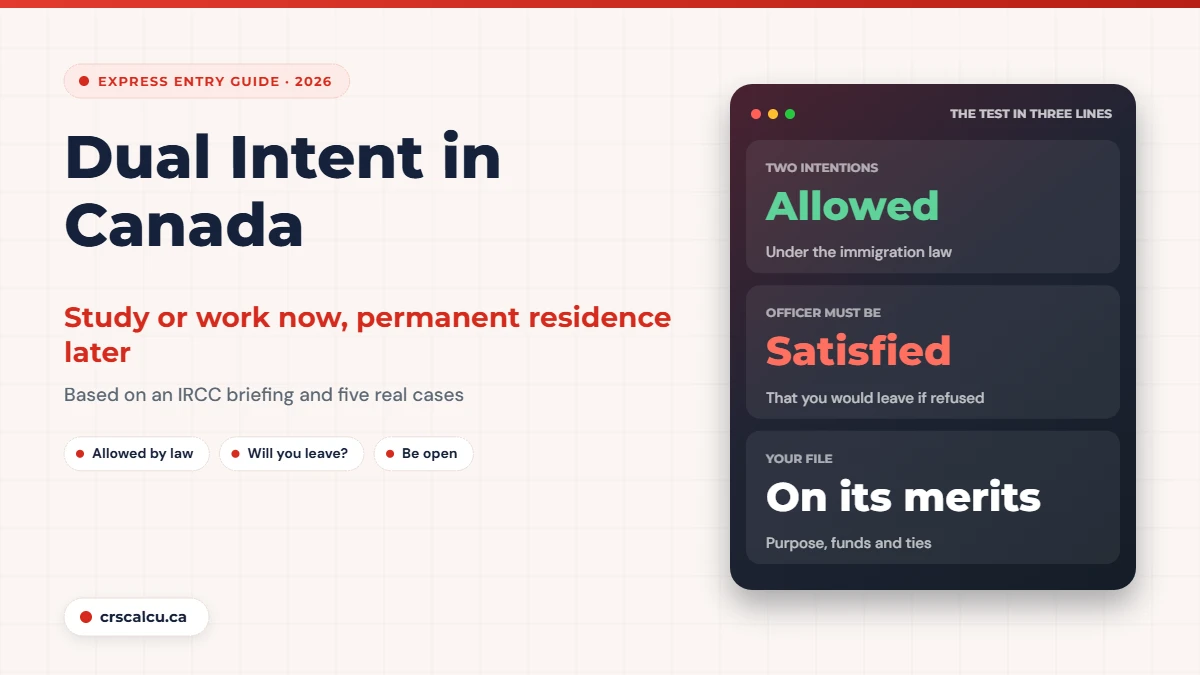
Dual intent is the idea that worries almost everyone who applies for a study permit, a work permit or a visitor visa while also planning to immigrate. The temporary application seems to demand a promise to go home. The Express Entry profile says the opposite. People conclude that one must sink the other, and some go as far as hiding one from the officer deciding the other.
They do not need to. Canadian immigration law expressly allows a person to hold both intentions. The test is not whether you hope to stay permanently. It is whether you would leave at the end of your temporary stay if permanent residence did not come through.
We read an IRCC briefing that sets out how officers assess this (modified March 31, 2021), IRCC’s pages on Express Entry and work permits (modified in 2026), and five public forum threads from 2011 to 2021. This is general information, not legal advice.
Quick answer: what is dual intent?
Dual intent means applying for temporary status in Canada, as a student, worker or visitor, while also intending to become a permanent resident. An IRCC briefing explains that officers assess this under subsection 22(2) of the Immigration and Refugee Protection Act and must be satisfied that you would leave Canada at the end of your authorized stay if your application for permanent residence was refused. Having an Express Entry profile or a pending application is therefore not a reason for refusal by itself. It is also not a shield: the temporary application still has to stand on its merits. Check your permanent residence side with our CRS calculator.
Key takeaways
What dual intent means in Canadian law
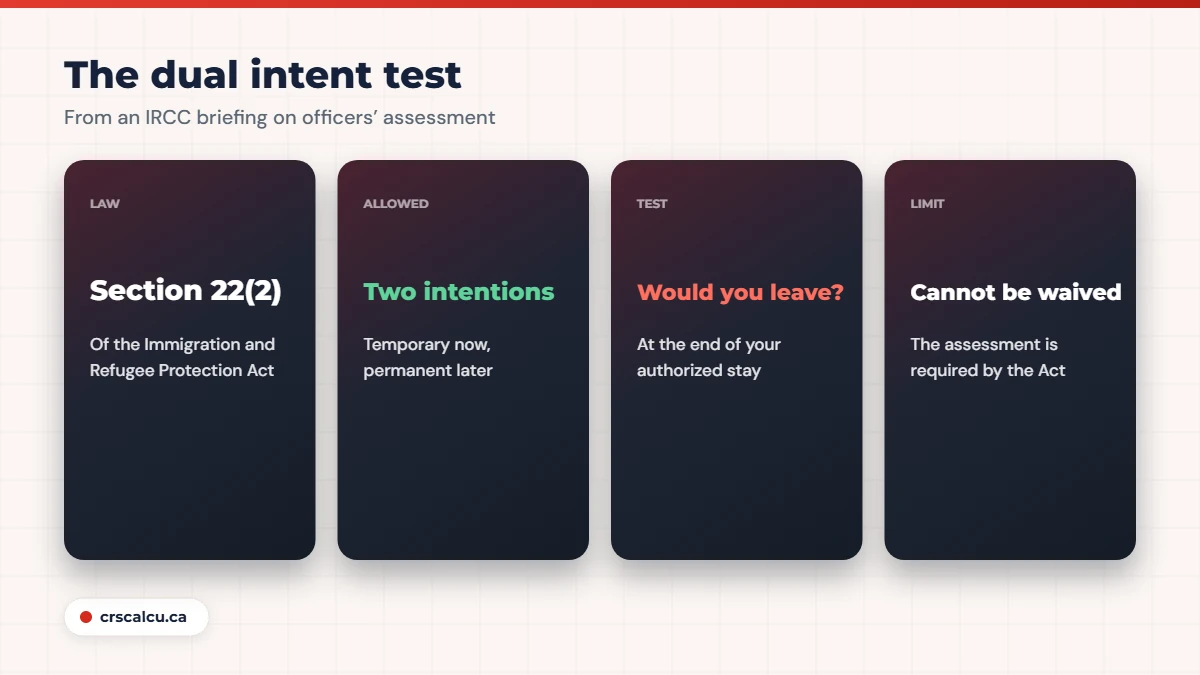
An IRCC briefing prepared for a parliamentary committee, published on its site and last modified on March 31, 2021, gives the legal basis. Officers assess applicants with both temporary and permanent plans under subsection 22(2) of the Immigration and Refugee Protection Act and section 179 of the regulations. In doing so, the briefing says, they must be satisfied that the applicant would leave Canada at the end of their authorized temporary stay if their application for permanent residence was refused.
It makes two further points worth knowing. The need to assess this is in the Act and cannot be overcome by program delivery instructions, so no policy change can remove the test. And the department had updated its guidance to officers with factors to consider, written at that time with sponsored spouses and partners in mind, such as how far the permanent residence application had progressed.
Dual intent is allowed. Having only one intent is the problem
A member in one of the threads we read put it in a line we cannot improve on much: two intents are not a reason for refusal; one intent is. What gets a temporary application refused is the officer’s conclusion that the applicant means only to stay, whatever happens, and is using the temporary permit as a way in.
What the file shows | Reads as | Our comment |
|---|---|---|
Genuine study plan, funds, ties at home, and an Express Entry profile | Two intentions | Permitted, if the officer is satisfied you would leave |
Study plan that makes little sense for your career, thin funds, and an Express Entry profile | One intention: to stay | The profile is not the problem; the weak study case is |
Strong temporary case, profile hidden, later discovered | A credibility problem | Hiding it creates the doubt the law does not |
Our illustration of the test described in the IRCC briefing (modified March 31, 2021). IRCC does not publish this table, and each officer decides on the documents in front of them.
The briefing itself acknowledges that outcomes vary, noting that approval rates differ from one country to another. The law is the same everywhere. The evidence officers see, and how they weigh it, is not.
Study permits and Express Entry
This is where the question comes up most.
Real case: an invitation and a university place at once (March 2017)
An applicant abroad had an invitation to apply for permanent residence and an offer from a Canadian university whose term would begin before the permanent residence file could be finished. They needed a study permit in the meantime and feared that stating an intention to return home would clash with the other application. One early reply claimed that each application would cause the other to be refused. Others corrected that, pointing to dual intent. A moderator explained that it is permitted, said the applicant need not dwell on it in the statement of purpose but should show ties and finances, and noted that one medical exam could serve both applications if still valid. Later replies thought disclosing the invitation would add to the applicant’s credibility. No outcome was reported.
Real case: study permit and Express Entry together (March 2015)
Someone asked on behalf of a relative who had an admission to a postgraduate diploma and also qualified for the Federal Skilled Worker Program: could both applications be made at once? Views split. Some advised picking one route. Others warned that a study permit applicant has to convince the officer they are not coming to stay. A respected member then explained dual intent: the officer is not concerned with whether you eventually live in Canada permanently, but with whether you would overstay unlawfully if permanent residence did not happen. That member saw no harm in applying for both. No outcome was reported.
Real case: a weak permanent residence profile and a study plan (August 2021)
A candidate with an Express Entry profile and a provincial expression of interest dating from 2018, both with low scores, planned to apply for a study permit for a postgraduate diploma and worried the existing profiles would trigger a refusal. Opinions differed. One member called dual intent a red flag for temporary applications from some countries. Another argued that two intents are never the reason; a refusal comes when the officer sees only one, to immigrate, with study as the pretext. Members agreed that applicants from certain countries face closer scrutiny and need stronger files. The poster decided to go ahead with the study permit. No outcome was reported.
Taken together, the threads say what the law says. Your profile does not sink a study permit. A study plan that only makes sense as a path to immigration might. If the program fits your background, you can pay for it, and you have reasons to go home if things do not work out, the profile is just one more fact.
It also helps to be realistic about what study adds. We set out the points and the costs in study in Canada for CRS points and what counts afterwards in Express Entry for international students.
Workers already in Canada
For people working in Canada on a permit, dual intent is so normal that the system is built around it. The Canadian Experience Class exists for temporary workers who become permanent residents. IRCC’s bridging open work permit is issued specifically to people who have applied for permanent residence and need to keep working while it is decided. Nobody in that position is expected to pretend they plan to leave.
What still applies is the rule underneath: your temporary status has its own conditions and its own end date, and a pending permanent residence application does not extend it. See bridging open work permit, PGWP expiring and our guide to TR to PR pathways.
Real case: a doctoral student and a provincial nomination (March 2019)
A doctoral student in Canada had been in the Express Entry pool with a low score when a province nominated them, so they now held a study permit and were applying for permanent residence at once. They asked whether they needed to send a letter explaining their dual intent. An experienced member said no: dual intent simply means the study permit will not be refused because of the permanent residence application. The poster replied that they had read official guidance and consulted an immigration lawyer, who recommended including an explanatory letter anyway. No outcome was reported.
Both positions are defensible, and IRCC’s pages do not require a letter. A short, factual explanation costs nothing and removes any impression that something was left unsaid. For how a nomination fits in, see provincial nomination in Express Entry.
Visitors
The same test governs visitor visas, where it is often harder to meet because a visitor has no program or job anchoring the stay. We cover that case in visitor visa during Express Entry.
Real case: why are people afraid of it? (May 2011)
In an older thread, a visa-exempt applicant with a family-class permanent residence file in process asked why forum members were so wary of visiting during processing, when the law allows it for those who keep ties at home and would leave if required. Several members reported entering as visitors without trouble. One described the opposite: a person who arrived having shipped their household goods ahead was refused entry. Members drew the line there: do not move your belongings or arrive with everything you own before you have status. They also observed that applicants who need a visa in advance had a harder time than those who can travel visa-free, despite the law being the same for both.
That thread predates Express Entry and concerns a different program, but the lesson about conduct carries over. Dual intent is judged on what you do as well as what you say.
Should you mention your permanent residence plans?
Answer the questions on the form you are completing. If it asks whether you have applied for any other Canadian visa or status, an application for permanent residence is one, and you say so. An Express Entry profile is not an application, as IRCC’s own pages describe the pool, but if a question is wide enough to cover it, include it. IRCC’s create-profile page warns that false information or omitted details can lead to refusal, inadmissibility and a five-year bar, and that applies to every application you make.
Beyond the forms, you decide how much to explain. The cases above show experienced members leaning toward openness: an invitation disclosed, a short letter attached. Nothing we read suggests that candour about lawful plans has cost anyone.
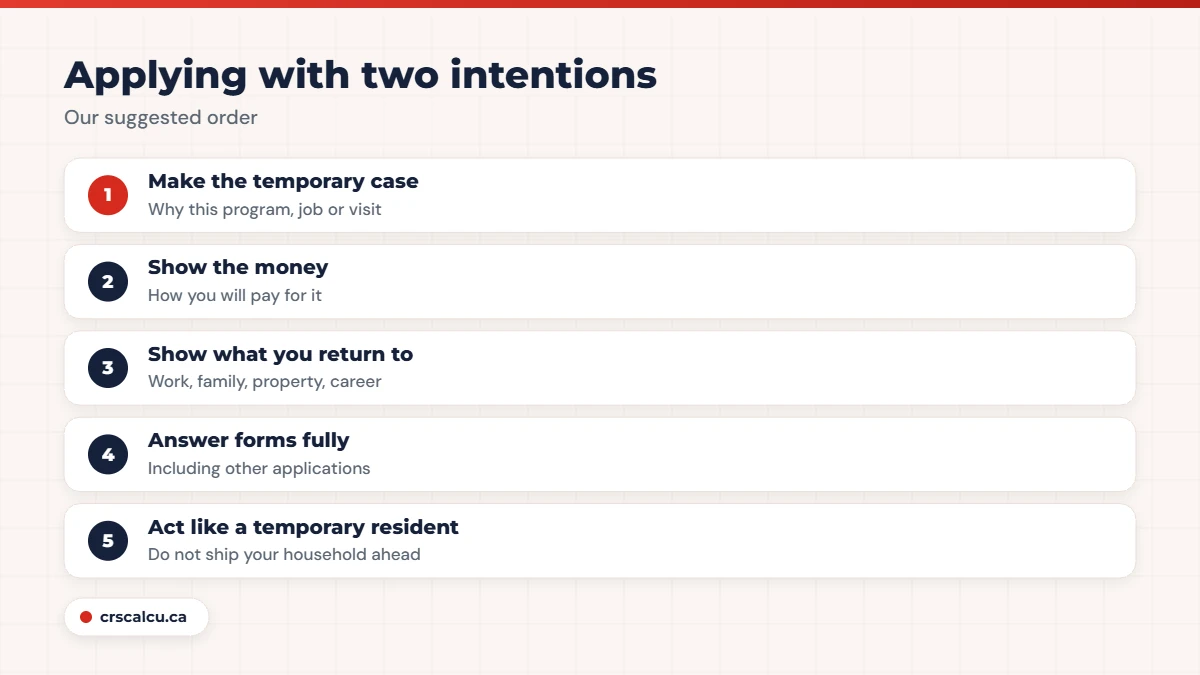
Preparing a temporary application when you also plan to immigrate (our suggested order)
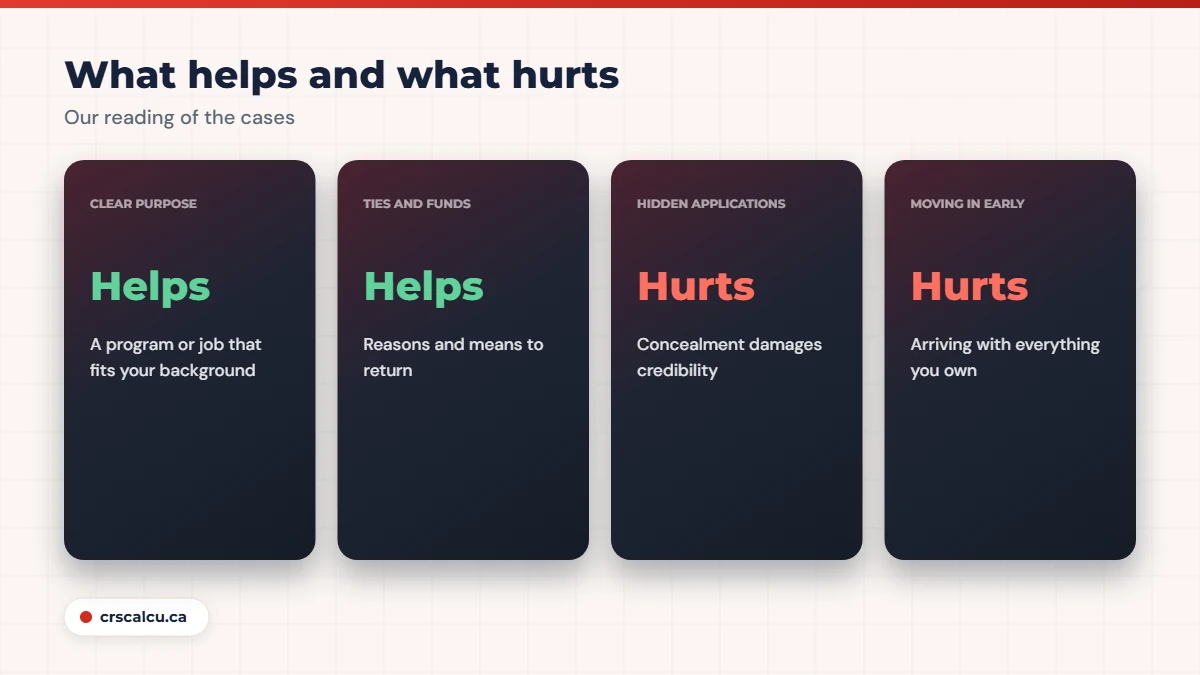
Five mistakes people make with dual intent
Avoid these
What IRCC does not say
The briefing gives the test and does not list the documents that satisfy it. IRCC does not publish, on the pages we read, how a profile in the pool is weighed against a pending application, or approval figures for applicants in this position. And no page tells you that a letter explaining dual intent is required or forbidden. If you are abroad and weighing a study permit against a direct application, see Express Entry from outside Canada and the latest draw cut-offs.
Frequently Asked Questions
What does dual intent mean in Canadian immigration?
It means having both a temporary purpose, such as study, work or a visit, and an intention to become a permanent resident. The law allows it, provided an officer is satisfied you would leave at the end of your authorized stay if permanent residence were refused.
Will my Express Entry profile get my study permit refused?
Not by itself. An IRCC briefing says the test is whether you would leave at the end of your stay. A study plan that only makes sense as a path to immigration is a bigger risk than the profile.
Should I write a letter explaining my dual intent?
IRCC’s pages do not require one. Some applicants include a short factual note on legal advice; others do not. Whatever you choose, answer the form questions fully.
Is dual intent a risk for people already working in Canada?
It is the normal situation. The Canadian Experience Class and the bridging open work permit both exist for temporary workers moving to permanent residence. Your permit’s conditions and end date still apply.
Does a pending permanent residence application let me stay longer?
No. Your temporary status ends on its own date unless you extend it or obtain another permit.
Can an officer still refuse me?
Yes. Dual intent removes one objection. The officer must still be satisfied on purpose, funds and whether you would leave when required.
Know your permanent residence odds first
How you plan the temporary step depends on how far you are from an invitation.
Final Thoughts
Dual intent is the law recognizing something obvious: people come to Canada to study or work and decide, or already hope, to stay. You are allowed to hope. The officer’s question is whether you would respect the limits of the status you are asking for, and the answer is in your plan, your ties and your conduct.
If you have been refused a temporary visa before, or your case involves a pending permanent residence application and a new permit at once, speak to a licensed immigration consultant or an immigration lawyer before you apply.