Express Entry Guide · Updated October 2026
Dependent Children in Express Entry: Who Counts, the Age Lock-In, Step-Children and Children Not Coming (Real Cases)
A child who is 21, a step-child living with grandparents, a baby born in Canada. Each one is handled differently, and one rule covers them all: declare everyone.
Dependent children in Express Entry do not add a single point to your score, and they are still the part of the application where the costliest mistakes happen. The rules decide who can become a permanent resident with you, who can be sponsored later, and in some cases whether your own application can be approved at all.
Most families fit the simple case: one or two young children, all coming. The difficult questions come from real life. A daughter who turns 22 next spring. A son from a first marriage who lives with his other parent. A teenager who refuses a medical exam. A baby with a Canadian birth certificate who is not an immigrant at all.
We read IRCC’s page on who can be included as a dependent child, its pages on undeclared family members, medical exams and updating an application, along with four public forum threads from 2015 to 2024 about step-children, children staying behind and children born in Canada.
Quick answer: who counts as a dependent child in Express Entry?
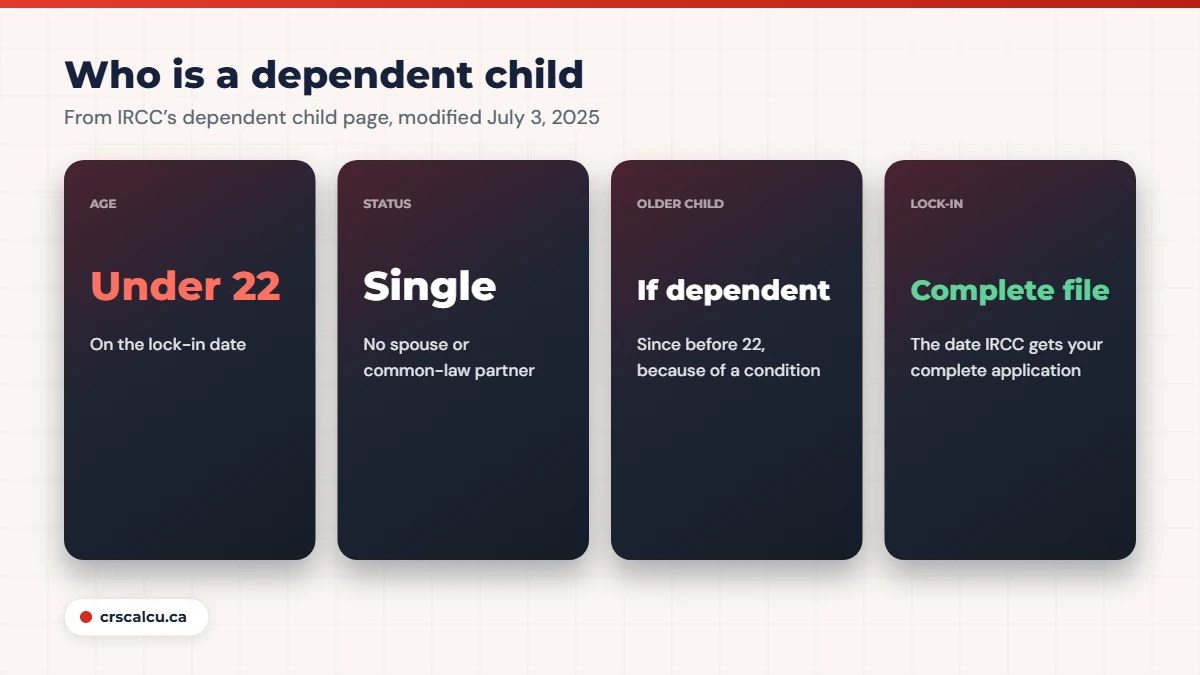
IRCC’s page (modified July 3, 2025) says children qualify as dependants if they are under 22 and do not have a spouse or partner. Older children qualify only if they have depended on their parents since before 22 because of a physical or mental condition. For the three Express Entry programs, a child’s age is locked in on the date IRCC gets your complete application. You must declare all your family members, coming or not, and IRCC’s Help Centre says all dependants must have a medical exam either way. See the medical exam guide.
Key takeaways
Who counts among dependent children in Express Entry
IRCC’s definition has two parts.
Situation | What IRCC says |
|---|---|
Under 22 | Qualifies if the child does not have a spouse or partner |
22 or older | Qualifies only if they have depended on their parents for financial support since before 22 and cannot support themselves because of a mental or physical condition |
Age during processing | IRCC uses the child’s age on the lock-in date |
Marriage during processing | The child must still not be a spouse or common-law partner; otherwise they become ineligible |
Lock-in date, Express Entry programs | The date IRCC gets your complete application for permanent residence |
Our summary of “Who you can include as a dependent child on an immigration application” (modified July 3, 2025).
Applicants are asked to list their own children and their spouse or partner’s children, including those from earlier relationships. The 2018 forum case below turned on exactly that.
The age lock-in
A child who is 21 when IRCC receives your complete application is assessed as 21 for the rest of processing, even if a birthday passes. A child who has already turned 22 on that date is not a dependent child, however soon after their birthday you apply.
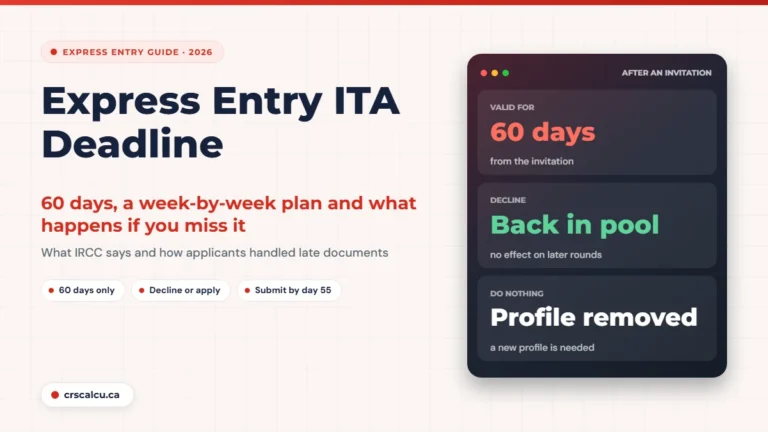
This makes the date you submit important for some families. An invitation gives you 60 days. If a child turns 22 on day 40, submitting a complete application on day 35 keeps them in, and submitting on day 45 does not. “Complete” matters too: an application that is rejected as incomplete does not fix the date. See Express Entry ITA deadline and AOR in Express Entry.
For candidates nominated by a province, IRCC’s page gives a different lock-in date: the date the province received the nomination application.
The lock-in freezes age only. IRCC says the child must still have no spouse or partner when the application is assessed, and that a change in marital status during processing makes them ineligible.
Our example: a birthday inside the 60 days
This is our own illustration. A family is invited on March 1. Their daughter turns 22 on April 10. The invitation runs until April 30.
Our example: two submission dates
The family in the first version had to have everything ready in five weeks instead of eight: police certificates, medical exams, translations and funds. The price of being a few days late was one family member. If your child is within a year of 22, start collecting documents before the invitation arrives, and treat the birthday, not day 60, as your deadline.
Declare every child, coming or not
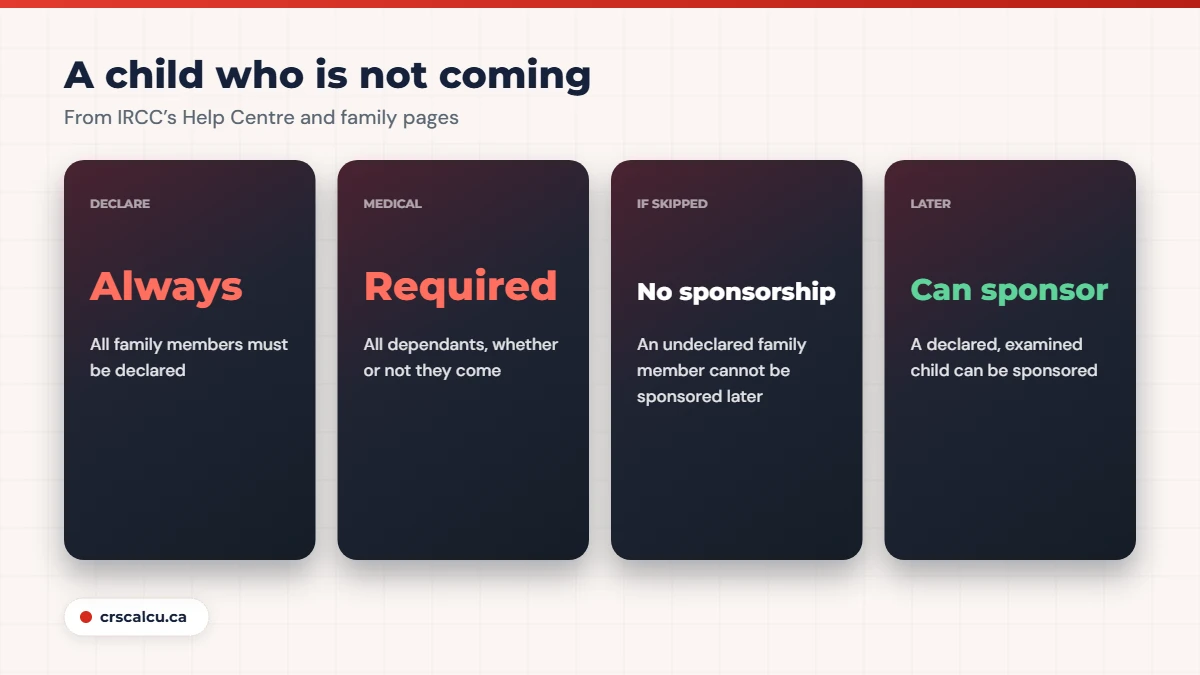
IRCC’s page on undeclared family members (modified September 11, 2026) states the rule in one sentence: when you apply for permanent residence, you must declare all your family members, even if they are not coming with you to Canada.
The reason is what happens later. A family member who was not declared and examined when you immigrated generally cannot be sponsored by you afterwards. A temporary public policy softened this for certain groups, and that page says it ended on September 10, 2026. Express Entry applicants should treat the rule as absolute.
Real case: “can I leave them off to gain 14 points?” (June 2024)
A candidate in Canada asked whether to list their spouse and their Canadian-born child as not accompanying, which would raise their score by 14 points. Members said that declaring family members as non-accompanying is normal and is not misrepresentation, as long as they are declared. The cost is that the spouse does not become a permanent resident with you and has to be sponsored afterwards, which they estimated at about a year. They stressed that every dependant must be declared in the application, because someone who is not declared can never be sponsored.
Listing a family member as non-accompanying and leaving them out are completely different things. The first is a choice with a known price. The second closes a door for good. The scoring side is in non-accompanying spouse.
Children who are not coming still need a medical exam
IRCC’s Help Centre (modified September 1, 2026) answers this directly. All of your dependants must have a medical exam by an approved panel physician, regardless of whether they are coming with you to Canada. It adds that having inadmissible dependants might make you inadmissible for permanent residence.
Real case: a step-child staying with grandparents (October 2018)
A principal applicant’s spouse had a nine-year-old from a previous marriage who lived with grandparents and would not be moving. A senior member explained that the child still had to be included and medically examined, and could be listed as non-accompanying. Had the child been coming, either written permission from the other parent or proof of full custody would have been needed. For a child staying behind, the member said, a passport and the medical were enough, and who looks after the child is not IRCC’s concern. They added that once the spouse became a permanent resident, she could sponsor the child later.
Real case: a teenager who would not attend the exam (June 2015)
This case was under a caregiver program, not Express Entry, but the rule is the same. An applicant’s teenage child abroad refused to take the medical exam. Members said applications are not normally approved when a dependant has not been examined. In exceptional cases applicants had gone ahead by proving they had tried and could not obtain the exam, and by signing a sworn statement accepting that the child could never be sponsored. Results varied: one person was approved in five months with custody papers and a declaration, others were asked repeatedly for evidence of their efforts.
The second case shows how seriously the exam requirement is taken, and how narrow the exception is. If a child’s other parent will not cooperate, get advice early and keep a record of every attempt.
Step-children, custody and consent
When a child from an earlier relationship is coming with you, IRCC needs to know that the move is lawful. Applicants are asked for custody documents or the other parent’s consent, and the personalized checklist after an invitation shows what applies to you. In the 2018 thread, a member explained the purpose as preventing children from being taken abroad against the other parent’s rights.
Documents families were asked for
A child born in Canada
A child born in Canada is normally a Canadian citizen, so they are not immigrating with you. They are still part of your family and belong on your forms.
Real case: do we pay fees for a Canadian child? (June 2020)
A couple with a child born in Canada asked whether to include the child in their profile and whether they would have to pay permanent residence fees for a citizen. A senior member said the child should be listed on the family information form and that a birth certificate was sufficient proof. Later posters found the system then showed the child as not accompanying, which confused them. The advice was to disclose every family member, upload the birth certificate, and not pay permanent residence fees for a child who is already a citizen.
What children change: funds and fees
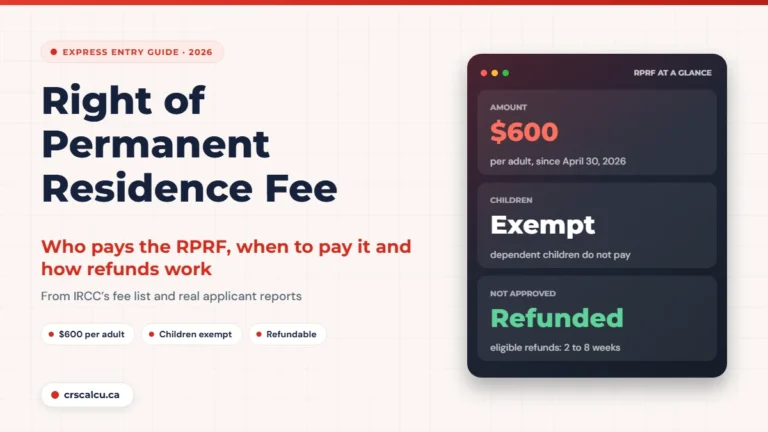
Children do not earn ranking points. They do change two numbers.
The practical effects
If your family changes after you apply
IRCC’s “Update your application” page (modified September 3, 2026) lists a new child, by birth or adoption, among the changes you must report, along with marriage, separation or divorce, and says to include proof. The report goes through the IRCC web form. The next post in this series covers a baby born after the invitation.
Five mistakes parents make with dependent children in Express Entry
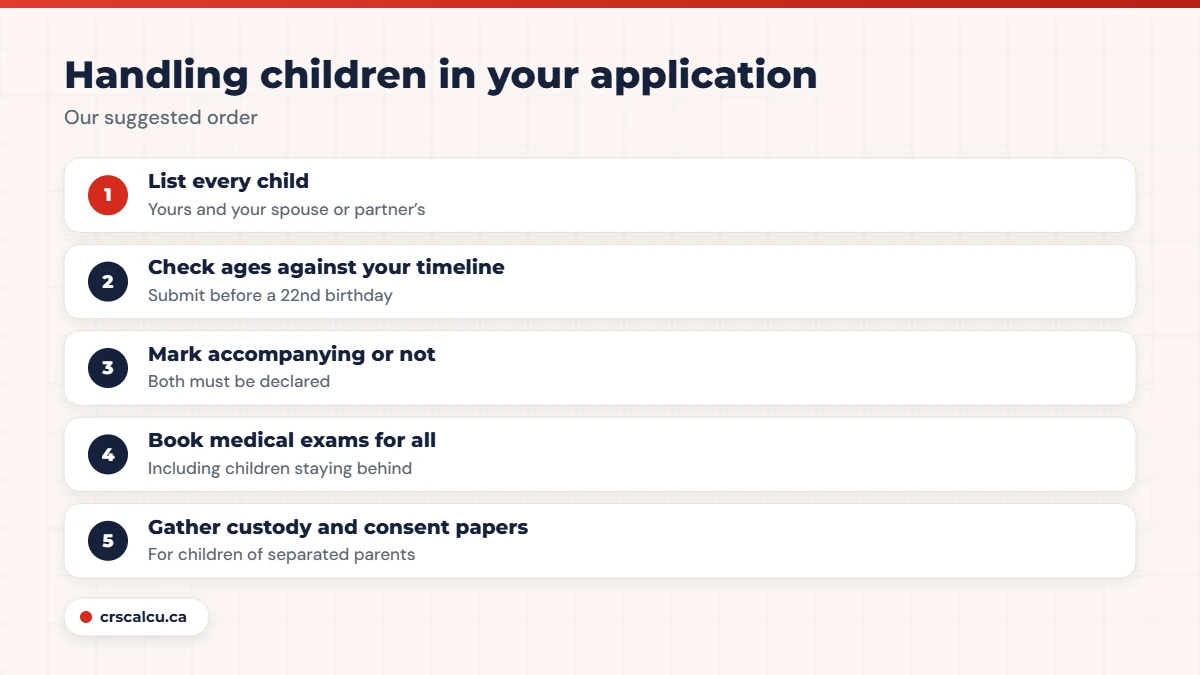
Five mistakes from the rules and the threads
Children do not move your score, but your spouse’s details can. Check your total in the CRS calculator and compare it with the latest draw cut-offs.
Frequently Asked Questions
Who counts as dependent children in Express Entry?
Children under 22 who do not have a spouse or partner, and children 22 or older who have depended on their parents since before 22 because of a mental or physical condition. This includes your spouse or partner’s children.
On what date is my child’s age fixed?
For the Federal Skilled Worker Program, Federal Skilled Trades Program and Canadian Experience Class, IRCC says the lock-in date is the date it gets your complete application for permanent residence.
Do I have to declare a child who is not coming with me?
Yes. IRCC says you must declare all your family members, even if they are not coming to Canada. A family member who is not declared and examined generally cannot be sponsored later.
Does a non-accompanying child need a medical exam?
Yes. IRCC’s Help Centre says all your dependants must have a medical exam, whether or not they are coming with you.
Do children add CRS points?
No. Children do not earn points. They do increase the settlement funds you must show and add a fee for each child.
My child was born in Canada. Do I include them?
List them as a family member. A child born in Canada is normally a citizen, so forum members advised uploading the birth certificate and not paying permanent residence fees for that child.
Family details settled? Check your score
See how your points, with or without an accompanying spouse, compare with recent Express Entry cut-offs.
Final Thoughts
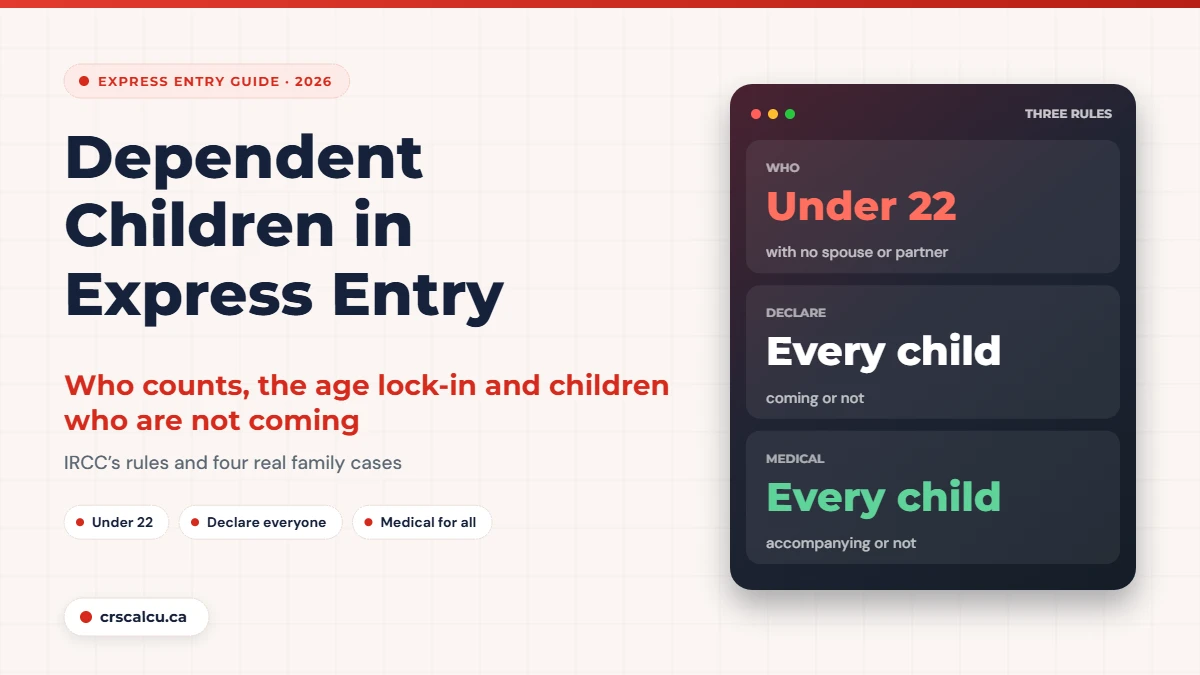
Dependent children in Express Entry come down to three rules. A child is a dependant if they are under 22 and single on the day IRCC receives your complete application. Every child must be declared, whether or not they are coming. And every child must have a medical exam. Get those right and the rest is paperwork.
If a child is close to 22, lives with another parent, cannot or will not attend a medical exam, or is the subject of a custody dispute, speak to a licensed consultant or lawyer before you submit. These are the situations where a decision made now cannot be undone later.