Express Entry Guide · Updated October 2026
Immigration Representative for Express Entry: Do You Need One, and How to Check (Real Cases)
Hiring help is your choice. Who you may pay, what they cannot do for you, and who answers for the application are not.
Whether to hire an immigration representative for Express Entry is a fair question with no single answer. Plenty of applicants complete the whole process themselves. Others have a complication, or no time, or no confidence, and are better off with a professional. What nobody should do is hand the process to someone they have not checked and stop paying attention.
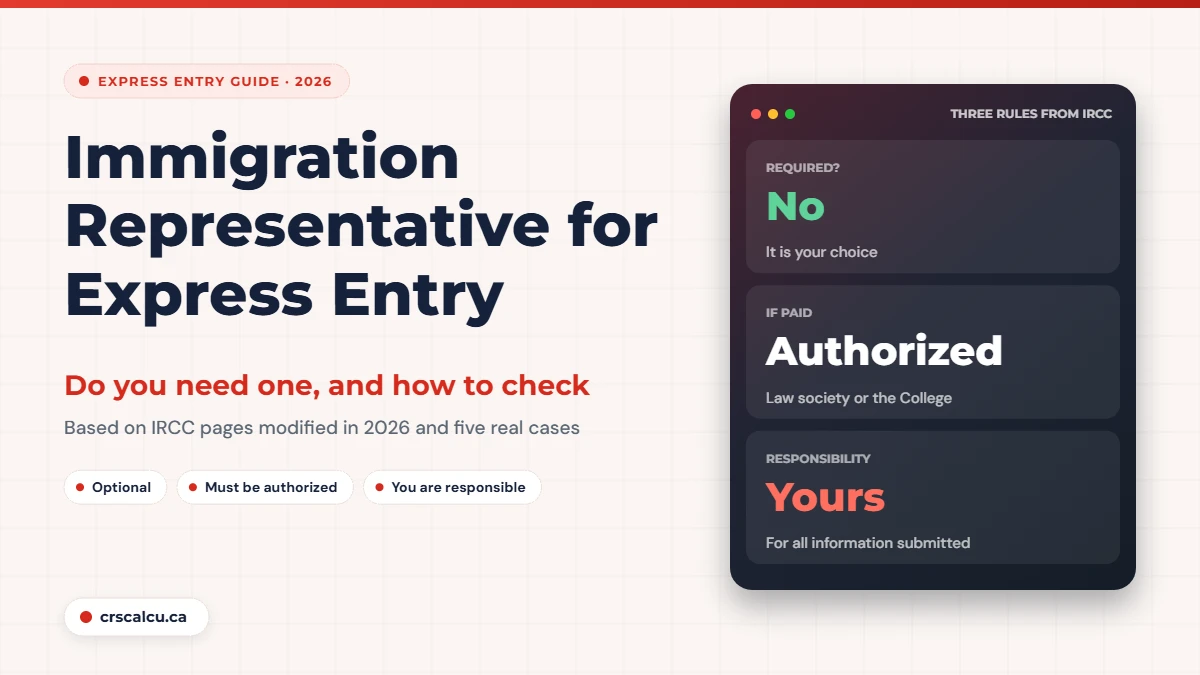
IRCC’s position is plain. Using a representative is optional and brings no advantage in processing. If you pay one, they must belong to one of a few regulated bodies. And whoever fills in the forms, you are responsible for every word. The worst cases we read all involve an applicant who lost sight of at least one of those three points.
We read IRCC’s pages on representatives and on checking authorization (modified in 2026) and its Express Entry pages, plus five public forum threads from 2015 to 2023. We have left out the names of people and firms. This is general information, not legal advice.
Quick answer: do you need a representative for Express Entry?
No. IRCC’s page says it is your choice, that using a representative will not draw special attention to your application and does not mean it will be approved. If you do pay someone, they must be authorized: a lawyer or paralegal who is a member of a Canadian law society, a Quebec notary, or a consultant who is a member in good standing of the College of Immigration and Citizenship Consultants. Either way, IRCC says you are responsible for all the information in your application. You can check most of your own numbers first with our CRS calculator.
Key takeaways
Immigration representative for Express Entry: what IRCC says
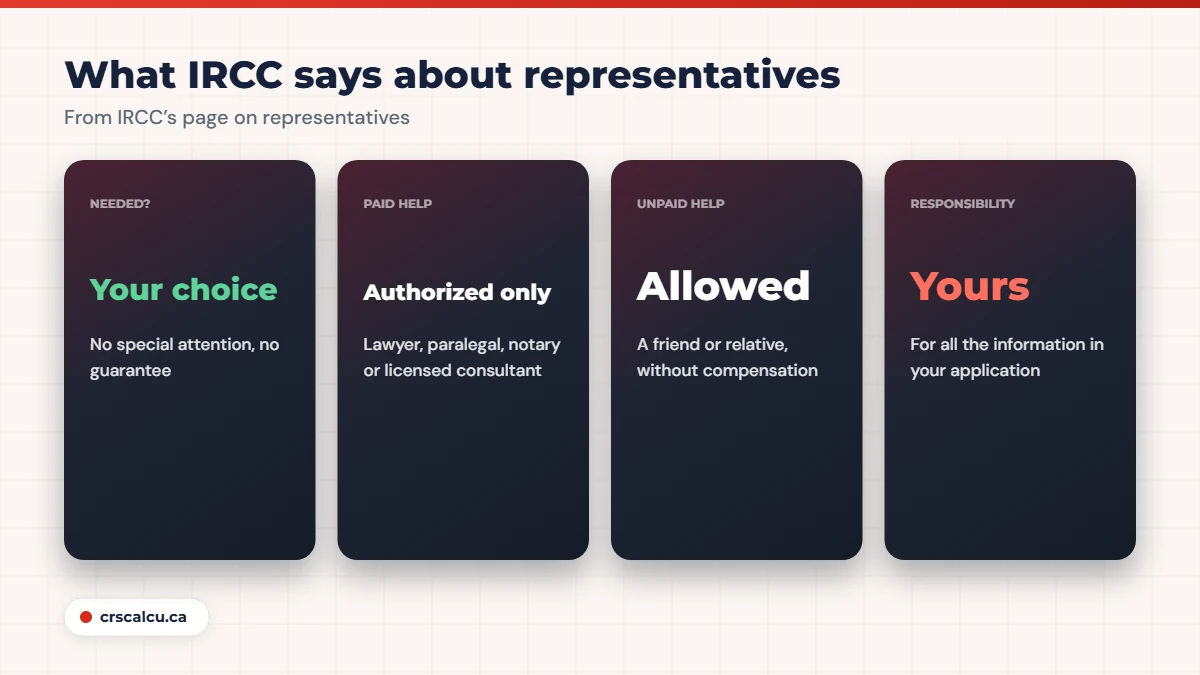
IRCC’s page on representatives (modified August 18, 2026) answers the first question directly: it is your choice, using one will not draw special attention to your application, and it does not mean the application will be approved. The forms and guides are free, and the page’s premise is that an applicant can complete them.
The page then separates two kinds of representative. A paid representative is anyone you pay or compensate in any way in exchange for their services, and they must be authorized. An unpaid representative, such as a family member or friend who helps without compensation, does not. To add, change or cancel a representative you use the Use of a Representative form, IMM 5476.
And it sets out the point that matters most: you are responsible for all the information in your application, even if your representative completes it for you.
Who is authorized to be paid
Type | Who they are | Where to check |
|---|---|---|
Lawyers and paralegals | Members of a Canadian provincial or territorial law society | That law society’s directory |
Quebec notaries | Members of the Chambre des notaires du Québec | The Chambre’s directory |
Consultants | Members in good standing of the College of Immigration and Citizenship Consultants | The College’s public register |
Our summary of IRCC’s pages on representatives (modified August 18, 2026) and on checking authorization (modified June 4, 2026).
That is the whole list. A travel agent, an education agent, a recruiter, a “visa consultancy” abroad or a helpful stranger online is not on it unless the individual also holds one of those memberships. IRCC’s page says that using an unauthorized paid representative can lead to your application being rejected.
How to check that a representative is authorized
IRCC’s page on checking authorization (modified June 4, 2026) tells you to look the person up in the register of the body they claim to belong to: the College of Immigration and Citizenship Consultants for consultants, the relevant law society for lawyers and paralegals, the Chambre des notaires for Quebec notaries. If they are not members in good standing, it says, you should not use their services.
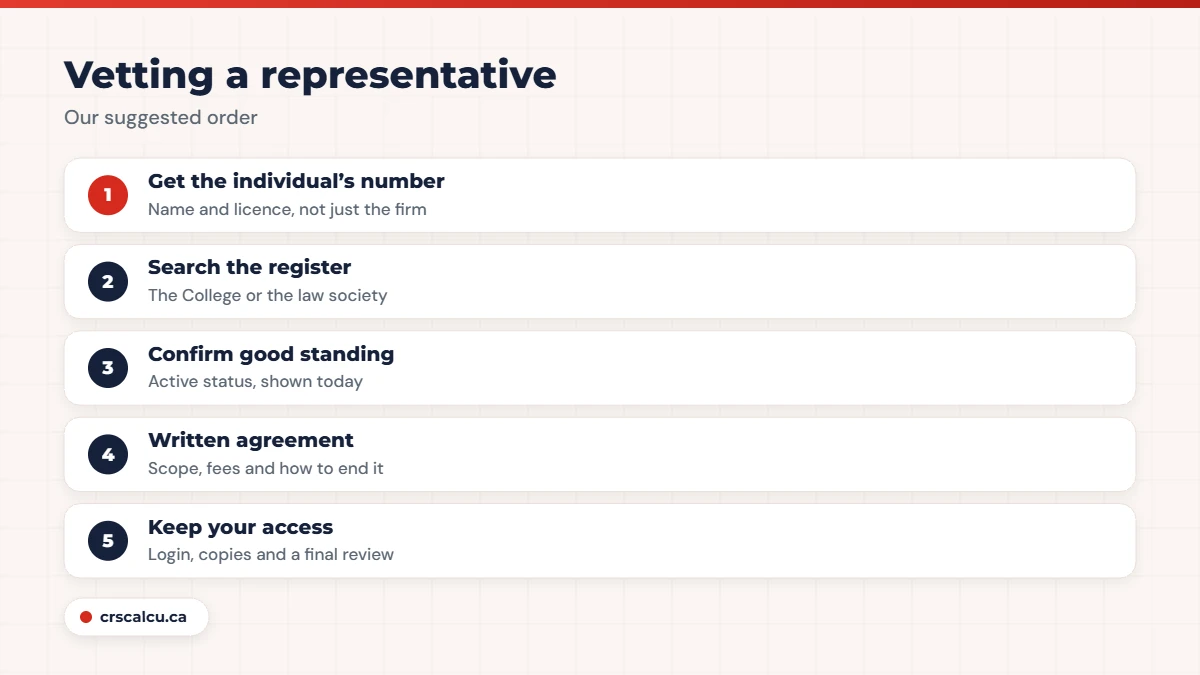
Vetting a representative (our suggested order)
A firm can employ many people. The licence belongs to a person, and that person should be the one named on your representative form.
You stay responsible for the application
This is where delegation goes wrong. An applicant signs, trusts and stops reading, and the profile or application says things that are not true.
Real case: invented scores in the profile (October 2016)
An applicant discovered that the consultant they had hired had submitted an Express Entry profile containing language scores they had never obtained and a Canadian credential they did not have. Their real test results, sent weeks earlier, had not been entered. A payment for a credential assessment had not been used for two months, and the consultant had promised permanent residence within six months. The applicant feared a ban for misrepresentation. Forum members told them to change the account password immediately, obtain the assessment reference numbers directly, correct the profile themselves, and report the consultant to the regulator. The poster, who did have access to the profile, said they would follow those steps. No final outcome was reported.
Real case: refused for misrepresentation after a consultant’s filing (July 2017 to December 2018)
An applicant abroad hired a consultant who first let their profile expire, missing favourable rounds, and then, after a new profile was invited, sat on the documents and fees for weeks while promising to submit “tomorrow”. Members suggested complaining to the regulator and applying independently, and securing direct access to the account. The application was finally submitted a week before the deadline. In December 2018 the applicant returned to say it had been refused for misrepresentation, citing wrong occupation codes and gaps in the travel history. They had since created a new profile on their own and were worried about how the earlier file would affect them.
In both cases the false or careless entries were made by someone else. In both, the consequences landed on the applicant. IRCC’s create-profile page (modified September 24, 2026) warns that false information or omitted details can lead to refusal, a finding of inadmissibility and a five-year bar, and it makes no exception for information a representative typed. Occupation codes are a frequent source of trouble; see wrong NOC code in Express Entry. For how to correct a profile, see update Express Entry profile.
Keep control of your account
Real case: the agency would not hand over the profile (May 2023)
An applicant used an agency to create their Express Entry profile and received a provincial notification of interest. Finding the agency uncooperative during document preparation, they ended the arrangement, and the agency then refused to give them access to the profile, saying it had been created through the agency’s own representative account. The applicant’s language results were due to expire in about 40 days. A moderator said the way to end a representative’s access is to file the representative form with IRCC, and warned that this takes time. Another member suggested finding the individual’s registration number and reporting them to the regulator. Others doubted the applicant’s description of how the login worked. No resolution was reported.
Real case: screenshots instead of a login (September 2015)
An applicant who had hired a consultant early on, before they understood the process, became frustrated. They had improved their language results, which by their own calculation should have added 10 points, but the consultant said the score had not changed, was slow to update the profile, and sent only screenshots, never the login. They felt they now knew more than the consultant and worried about being tied to a profile they could not see. Members advised ending the arrangement, asking for the credentials to verify what had been submitted, and running the profile themselves. Another poster said they had dropped their own consultant early for similar reasons.
An applicant who cannot sign in cannot verify anything. The earlier of those two cases was resolved by walking away; the later one could not be, because the profile carried a time-limited provincial opportunity. If a representative has opened a profile you cannot reach, read two Express Entry profiles before you create another: IRCC allows only one at a time, and a duplicate adds a new problem to the one you already have.
What to hold yourself, whoever you hire
When you can do it yourself, and when to get help
Real case: 99 per cent of the work already done (February 2019)
A candidate with CLB 9 results, credential assessments, reference letters and financial records in hand, and a calculated score of 470, asked whether to hire a lawyer to create the profile. Every reply said to proceed alone. One experienced member put it this way: a lawyer is needed when your background is complicated in ways that have legal implications. Another observed that the candidate had already done nearly all the work. No update followed.
That is a reasonable rule of thumb, and it is the forum’s, not IRCC’s. A profile built on clean facts, with one employer history, valid tests and no admissibility questions, is within most people’s reach; our post on how we calculate your score and the reference letter guide cover the parts people find hardest.
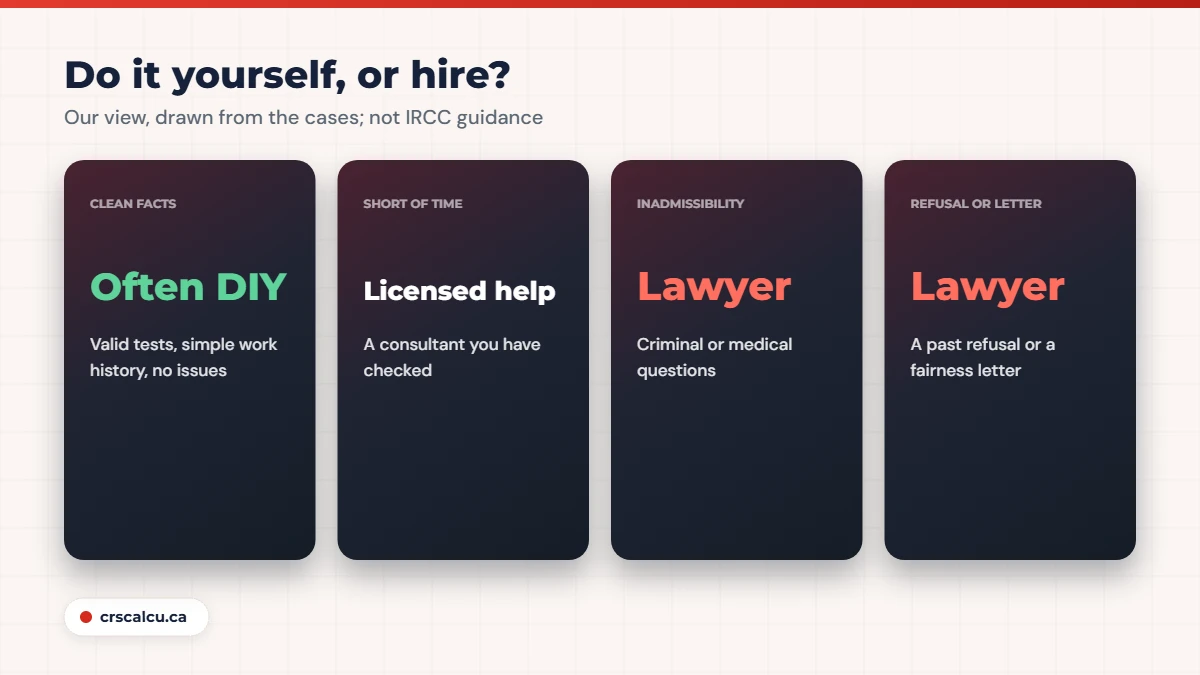
Professional help earns its fee where the facts are not clean. A past conviction or charge is one such case; see criminal record and Express Entry. A health condition that may raise excessive demand is another; see medical inadmissibility in Express Entry. So are a previous refusal, a procedural fairness letter, a tangled work history, or an earlier application that contained errors. For those, a lawyer or a licensed consultant with relevant experience is worth more than any forum, this site included.
Ending the relationship
IRCC’s page says the same form, IMM 5476, is used to cancel a representative. Until you do, the person on file may continue to receive correspondence about your application. If things have gone wrong, file the form, change every password you control, ask in writing for your documents and for confirmation of what has been submitted in your name, and, where the person is regulated, complain to their regulator. In job change after ITA we describe a case where an applicant had to correct a form their representative had filled in inaccurately.
Five mistakes people make with an immigration representative for Express Entry
Avoid these
What IRCC does not say
IRCC’s pages do not say what a representative should charge, do not recommend any firm, and do not describe, on the pages we read, how quickly a cancellation takes effect. They also do not say how an earlier application spoiled by a representative’s errors will be viewed later. For round results while you decide, see the latest draw cut-offs.
Frequently Asked Questions
Do I need an immigration representative for Express Entry?
No. IRCC says it is your choice, and that using one neither draws special attention to your application nor means it will be approved.
Who is allowed to charge me for immigration help?
Lawyers and paralegals who are members of a Canadian law society, Quebec notaries, and consultants who are members in good standing of the College of Immigration and Citizenship Consultants.
How do I check a consultant’s licence?
Search the College of Immigration and Citizenship Consultants’ public register for the individual. For lawyers and paralegals, search the relevant law society’s directory.
Am I responsible if my representative makes a mistake?
IRCC says you are responsible for all the information in your application, even if your representative completes it for you.
Can a friend or relative help me for free?
Yes. IRCC calls that an unpaid representative, and they do not need to be authorized. If you compensate them in any way, they count as paid.
How do I remove a representative?
Use the Use of a Representative form, IMM 5476, which IRCC says is for adding, changing or cancelling a representative.
Start with your own numbers
Whether you hire help or not, know your score before the first conversation.
Final Thoughts
An immigration representative for Express Entry is a service you may buy, not a requirement and not a guarantee. If you buy it, buy it from someone you have looked up, in writing, and keep your own access and your own copies. If your case is simple, you may not need it at all.
Where your case involves inadmissibility, a refusal or a fairness letter, do get professional advice, from a lawyer or a licensed consultant whose standing you have checked yourself.