Express Entry Guide · Updated October 2026
Express Entry Fees in 2026: What You Pay IRCC, When You Pay It and What Is Refunded (Real Cases)
Three government fees, a few bills from other providers, and one pile of money that is not a fee at all. Here is what IRCC charges in 2026, when it charges it, and what comes back if things go wrong.
Express Entry fees look simple on the official list and still catch people out. The list shows one number with the right of permanent residence fee and another without it. Biometrics sit in a different section. And the costs that arrive first, such as the language test and the credential assessment, are not on the list at all, because IRCC does not charge them.
The questions applicants ask are practical. Do I pay everything on day one or hold part back? What if the fee goes up while my file is in process? My card was declined two days before the deadline, now what?
We read the IRCC fee list, the Express Entry application pages, the refund pages and the Help Centre answers on payments as they stood on October 5, 2026, along with public forum threads from 2017 to 2022. Every dollar amount below comes from an official page, and every example total is our own arithmetic, labelled as such.
Quick answer: how much are the fees for Express Entry in 2026?
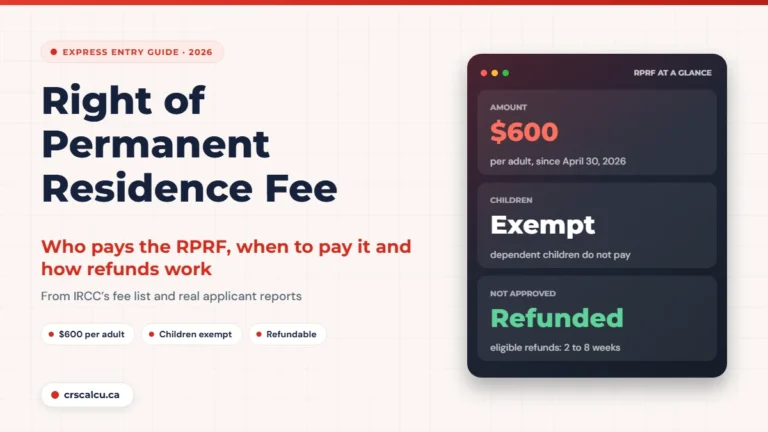
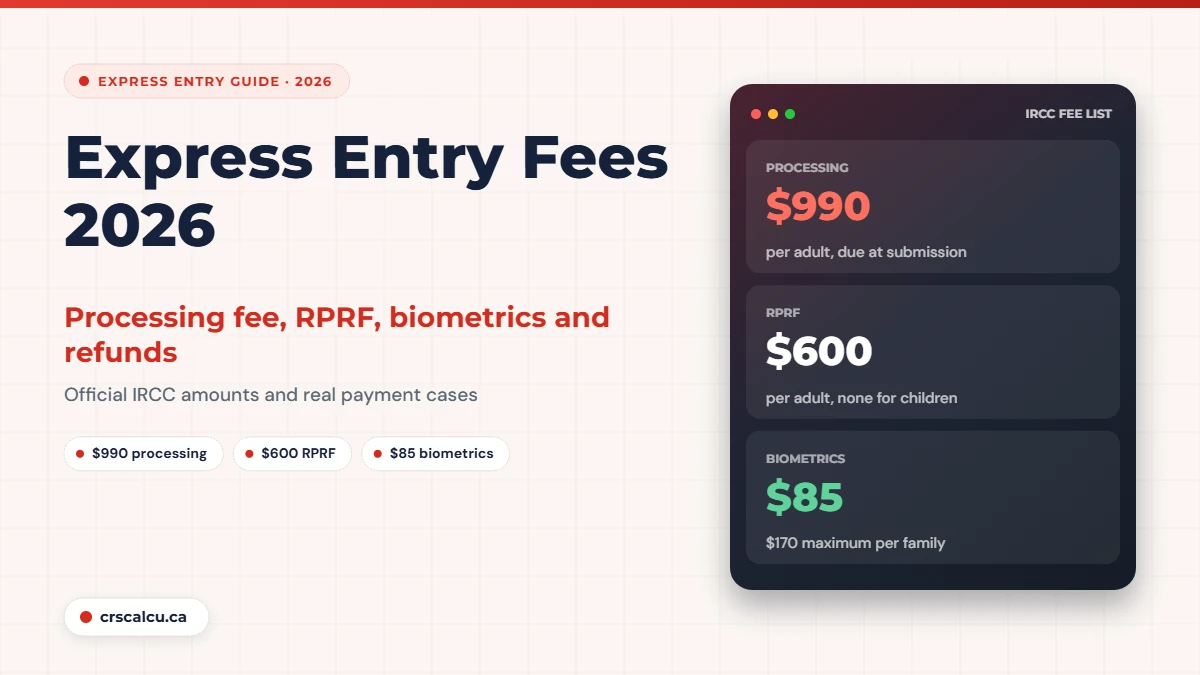
The IRCC fee list (modified September 21, 2026) shows $1,590 per adult, which is a $990 processing fee plus the $600 right of permanent residence fee, and $270 per dependent child. Biometrics cost $85 per person, to a maximum of $170 per family. At a minimum you pay the processing fees when you submit, and the rest before approval. Settlement money is separate and is not a fee: see our proof of funds guide.
Key takeaways
Express Entry fees in 2026: the official numbers
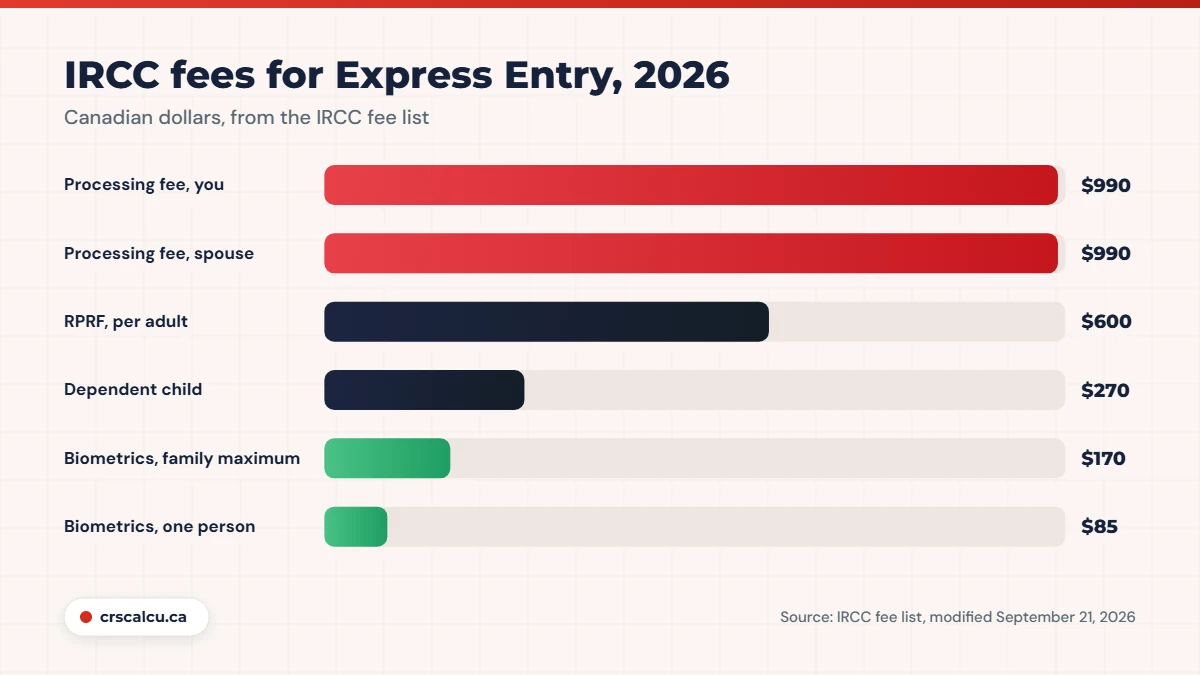
One page sets the amounts: the IRCC fee list, under “Economic immigration (including Express Entry)”, modified September 21, 2026. Amounts are in Canadian dollars. The list shows each adult two ways, $1,590 with the right of permanent residence fee and $990 without it. We split that into its parts below.
Fee | Who pays it | Amount (CAD) |
|---|---|---|
Processing fee | Principal applicant | $990 |
Processing fee | Spouse or common-law partner | $990 |
Right of permanent residence fee | Each adult; not dependent children | $600 |
Dependent child | Each child | $270 |
Biometrics, per individual | One person | $85 |
Biometrics, per family | 2 or more eligible people | $170 maximum |
Our summary of the IRCC fee list (modified September 21, 2026). Check it again on the day you pay.
The fee list shows no charge for creating a profile or waiting in the pool. The bill from IRCC starts when you submit an application after an invitation, so you can calculate your CRS score and compare it with the latest draw cut-offs first.
These amounts are recent. The fee changes page (modified April 30, 2026) says that on April 30, 2026 the right of permanent residence fee went from $575 to $600, and the processing fee for a federal high skilled principal applicant from $950 to $990.
When each fee is paid
The Express Entry application page (modified June 22, 2026) says the system will show you the processing fee for you and your family members, the right of permanent residence fee and the biometrics fee. Then comes the sentence that matters: at a minimum, you must pay your processing fees when you submit. IRCC adds that paying everything then avoids delays.
The “After you apply” page (modified August 4, 2026) fills in the rest. In most cases you pay the biometrics fee when you submit. If the application is complete, IRCC sends a letter asking for biometrics, and you have 30 days from the date on it. Near the end, you pay the right of permanent residence fee if you have not already. IRCC cannot approve the application until all fees are paid.
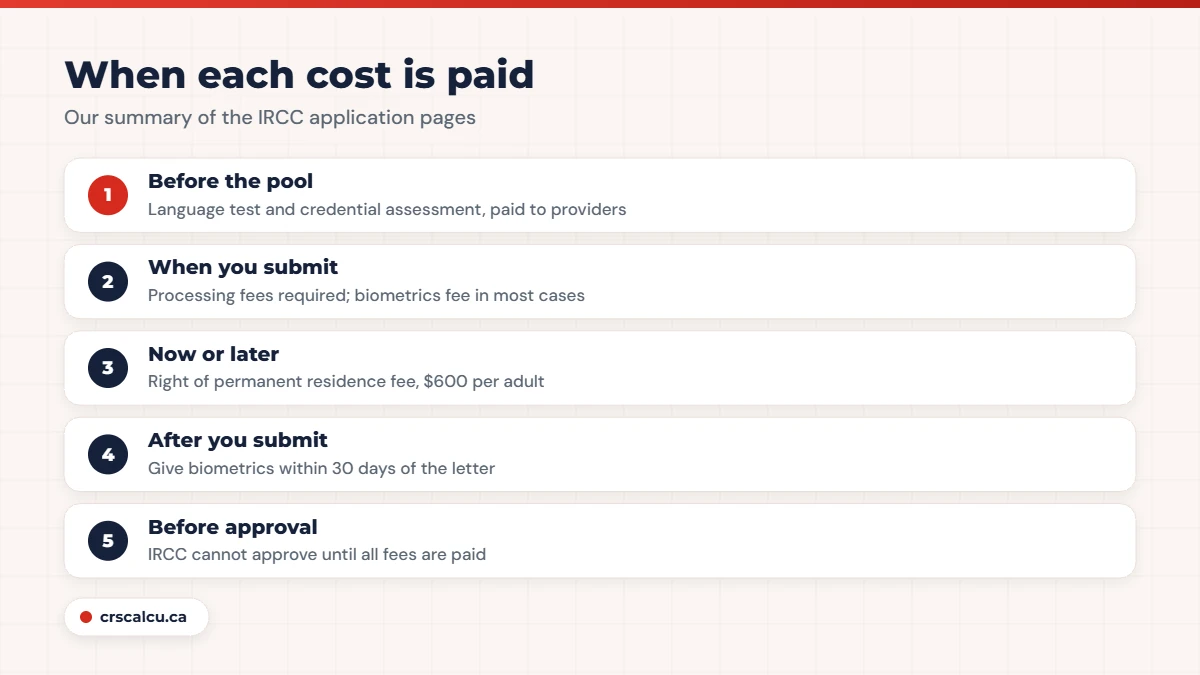
Your invitation is valid for 60 days only, and payment is the last step of submitting. That is why a payment problem on the final day hurts.
Right of permanent residence fee: pay it now or later?
This is the most common forum question about Express Entry fees, and the official pages pull two ways. The fee list says that for most permanent residence applications you pay the RPRF when the application is approved. The Express Entry page says to avoid delays by paying everything at submission. Later is allowed; earlier is encouraged.
Real case: could not afford both fees at once (February 2019)
An applicant with an invitation wrote that money was tight and asked what would happen if the RPRF waited. Replies agreed the processing fee had to be paid at submission and that the RPRF was the one part that could wait. One member said IRCC simply asks for it when it is ready to finish the file. Another said paying upfront tends to be smoother. No final outcome was reported in the thread.
What those replies left out is a line now on the fee changes page: if you applied without paying the right of permanent residence fee, you must pay the new amount. So deferring is a small bet. You keep $600 per adult for a few months and accept that the fee could be higher when IRCC asks. The page lists permanent residence fee increases on April 30, 2024 and April 30, 2026.
On the other side, the RPRF is the one fee IRCC returns if the application is withdrawn or refused, so paying early does not put it at risk. Pay it upfront if you can, defer it if you must.
Real case: paid in 2021, fee rose before the passport request (July 2022)
An applicant who applied in August 2021, and paid the RPRF at that point, received a passport request in July 2022. The letter mentioned the fee, and they noticed it had risen since their payment. Did they owe the difference? Members pointed to the letter’s wording, which asked for the fee only if it had not yet been paid, and said the original receipt was enough. The poster accepted that and paid nothing more.
What the totals look like: three examples
These are our own sums from the official amounts above. They assume everyone gives biometrics and the family applies together, so the $170 maximum applies.
Household | All paid at submission | Minimum at submission | RPRF left for later |
|---|---|---|---|
Single applicant | $1,675 | $1,075 | $600 |
Couple | $3,350 | $2,150 | $1,200 |
Couple with one child | $3,620 | $2,420 | $1,200 |
Our example, calculated from the IRCC fee list (modified September 21, 2026). Single: $990 + $600 + $85. Couple: 2 x $1,590 + $170. Couple with one child: 2 x $1,590 + $270 + $170. The minimum column leaves out the RPRF.
These totals are government fees only. Settlement funds are a different thing: money you show, not money you pay. The amounts and exemptions are in our proof of funds guide.
How to pay online, and why cards get declined
The Express Entry page says you pay through your IRCC secure account with a debit or credit card. The Help Centre answer “Why is my online payment being refused?” (modified September 1, 2026) lists what is accepted: Visa, MasterCard, American Express and JCB credit cards, Visa Debit, Debit MasterCard, and UnionPay with some restrictions. It also gives the usual reasons a payment fails.
Before you press pay
IRCC’s Pay your fees online page (modified September 11, 2026), about its separate online payment service, adds that the card need not be in your name, that a prepaid card should be kept at least 18 months in case of a refund, and that a receipt is emailed.
Real case: card declined two days before the deadline (April 2017)
An applicant paid with a credit card issued in the United States, two days before their deadline. The bank flagged the charge as possible fraud and declined it. Even after they confirmed it with the bank, the account sat on a “processing payment” status with no way to retry. The status reset after roughly two hours, the same card then worked, and an acknowledgment of receipt arrived within minutes.
A July 2017 thread describes the same lock with only hours left; the option to pay came back after about an hour and the poster got through. IRCC does not publish a rule for a payment that fails at the very end of the 60 days, so do not be there. If time is short for other reasons, read about declining an invitation.
Paying twice is the other classic. In an October 2017 thread about a citizenship fee, not an Express Entry file, the page showed errors, the poster tried a second card, and both were charged with no receipt. Members suggested checking email and the list of previous payments first. No refund result was posted.
What IRCC refunds, and when
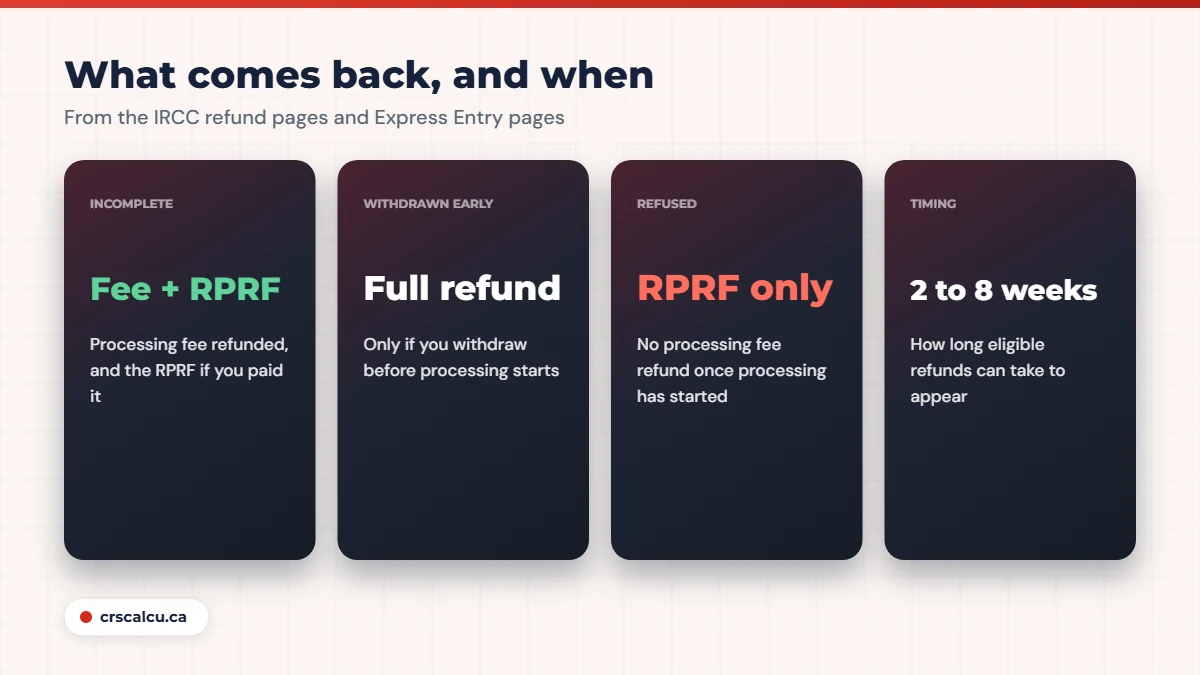
Refund rules sit on the “Ask for a refund” page (modified November 15, 2024) and in two Help Centre answers, on withdrawn and refused applications. The Express Entry pages cover incomplete ones.
What happened | What IRCC says it refunds |
|---|---|
Rejected as incomplete | Processing fee, and the RPRF if you paid it |
Withdrawn before processing starts | A full refund |
Withdrawn after processing starts | The RPRF only |
Refused | The RPRF only |
Our summary of the IRCC refund page, the two Help Centre answers (modified September 1, 2026 and April 17, 2026) and the Express Entry application page.
On refusals the Help Centre is blunt: in most cases, no refund once processing has started. On timing, the refund page says eligible refunds can take between 2 and 8 weeks to appear in your account.
Two gaps we could not close. The refund page does not define the moment processing starts. And neither Express Entry page says whether the biometrics fee comes back when an application is rejected as incomplete; they name the processing fee and the RPRF only.
If the fees go up while your file is in process
The fee changes page is brief. In most cases IRCC will not reject an application because you paid the old fee, as long as it was complete and sent before the change, and it will tell you how to pay the difference. An unpaid RPRF is charged at the new amount.
Real case: the system charged the old fee after an increase (May 2020)
Fees rose at the end of April 2020, but applicants who submitted in the first days of May found the system still charging the old amounts. One poster who submitted on May 4 had underpaid both the processing fee and the RPRF. The advice was to pay the difference through the online payment service and send the receipt by web form with a short explanation. One applicant reported a confirmation of receipt about three days later.
If you ever send a top-up receipt like that, our letter of explanation guide shows the format.
The costs that are not IRCC fees
This is the part of the budget people forget, and we will not print a price for it. None of the official pages we read gives one. The money goes to other organizations and varies by provider and country.
Cost | Paid to | What the official page says |
|---|---|---|
Language test | An approved testing agency | You schedule the test and pay the costs. No amount given. |
Credential assessment (ECA) | A designated organization | Costs may vary by organization. No amount given. |
Medical exam | The panel physician | You pay all fees at the appointment. Not refunded after a refusal. |
Police certificates | The issuing authority | No cost information. |
Translations | A certified translator | No cost information. |
Our summary of the IRCC language test and credential assessment pages (modified June 22, 2026), the medical exam page (modified August 4, 2026) and the police certificates page (modified February 19, 2026).
Expiry dates can turn one bill into two. Those pages say language results must be less than 2 years old and the credential assessment less than 5 years old, and that medical results are valid for 12 months. Our CLB calculator shows what your scores are worth, and our ECA validity guide covers the five-year rule.
For the rest, get a quote from the provider you will use. Our guides cover the medical exam, police certificates and certified translations, and the document checklist lists everything you upload.
Five payment mistakes to avoid
Most problems with Express Entry fees are about timing and assumptions, not the amounts.
Five mistakes from the threads and the rules
Frequently Asked Questions
How much are Express Entry fees in 2026?
The IRCC fee list (modified September 21, 2026) shows $1,590 each for the principal applicant and a spouse or partner, made up of a $990 processing fee and the $600 right of permanent residence fee, plus $270 per dependent child. Biometrics are $85 per person, to a maximum of $170 per family.
Can I pay the right of permanent residence fee later?
Yes. The Express Entry page says you must at least pay the processing fees when you submit, and that the right of permanent residence fee can be paid after you apply. IRCC cannot approve the application until all fees are paid, and if the fee has gone up by then you pay the new amount.
Will I owe more if fees increase after I submit?
The fee changes page says IRCC in most cases will not reject a complete application sent before the change, and will tell you how to pay any difference. An RPRF you have not paid yet is charged at the new amount.
Do I get a refund if my application is refused?
Not of the processing fee. The Help Centre says fees cannot be refunded once processing starts. The right of permanent residence fee is refunded if you paid it. Eligible refunds can take 2 to 8 weeks.
My card was declined when I tried to submit. What now?
Check the reasons IRCC lists: details that do not match your bank’s records, a card type that is not accepted, 3-D Secure not active, or the billing country not selected first. In two 2017 forum cases the payment option locked for one to two hours after a declined attempt and then came back.
Are settlement funds part of the fees?
No. Settlement funds are money you prove you have, not money you pay to IRCC. They are a separate requirement with their own amounts and exemptions.
Before you budget, check that the numbers work
The IRCC fee list shows no charge for a profile. Run your details through the calculator and see where you stand against recent cut-offs before you pay for tests and assessments.
Final Thoughts
Express Entry fees come down to three lines on the IRCC fee list: a processing fee you must pay at submission, a biometrics fee you pay then in most cases, and a right of permanent residence fee you can pay now or later. Pay early enough that a declined card is an annoyance and not an emergency, keep every receipt, and check the fee list on the day you pay.
If you were charged twice and cannot get an answer, or are weighing whether to withdraw a file that is already in process, the money at stake depends on the details of your case. That is the point to speak to a licensed immigration consultant or lawyer.