Express Entry Guide · Updated October 2026
Self-Employed Work Experience in Express Entry: Where It Counts, Where It Does Not and How to Prove It (Real Cases)
Freelancers, contractors and business owners hit the same wall: the same year of work can be worth points in one place and nothing in another. Here is the map.
Self-employed work experience is the most misunderstood kind in Express Entry. A consultant with five years of invoices, a rideshare driver, a developer on contract to a foreign company, a shop owner: all of them did real, paid, skilled work, and all of them get different answers depending on which rule you are reading.
That is because Express Entry looks at your work at least twice. First it asks whether you meet the minimum requirements of a program. Then it scores your profile. Self-employment is treated differently at each step and differently again depending on whether the work was done in Canada or abroad. People who miss that distinction either leave points on the table or claim experience that does not qualify.
We read IRCC’s eligibility pages for the Canadian Experience Class and the Federal Skilled Worker Program, the Comprehensive Ranking System criteria and a Help Centre answer, along with four public forum threads from 2016 to 2024 in which self-employed applicants worked out what counted and how to document it.
Quick answer: does self-employed work experience count in Express Entry?
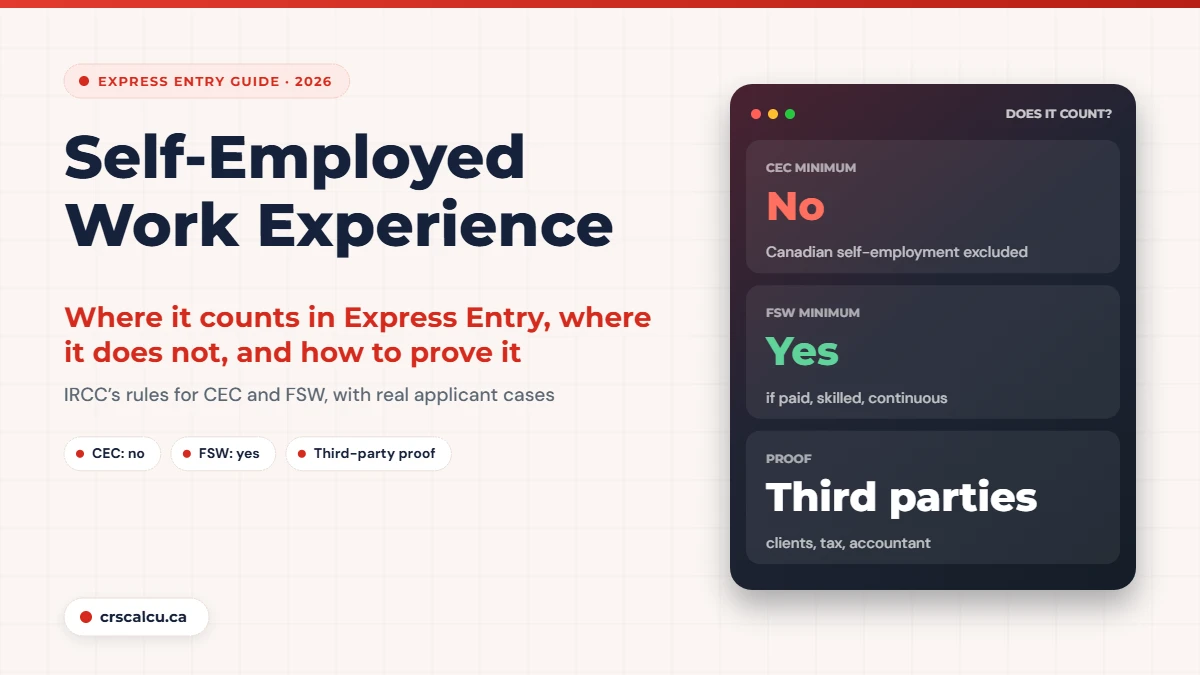
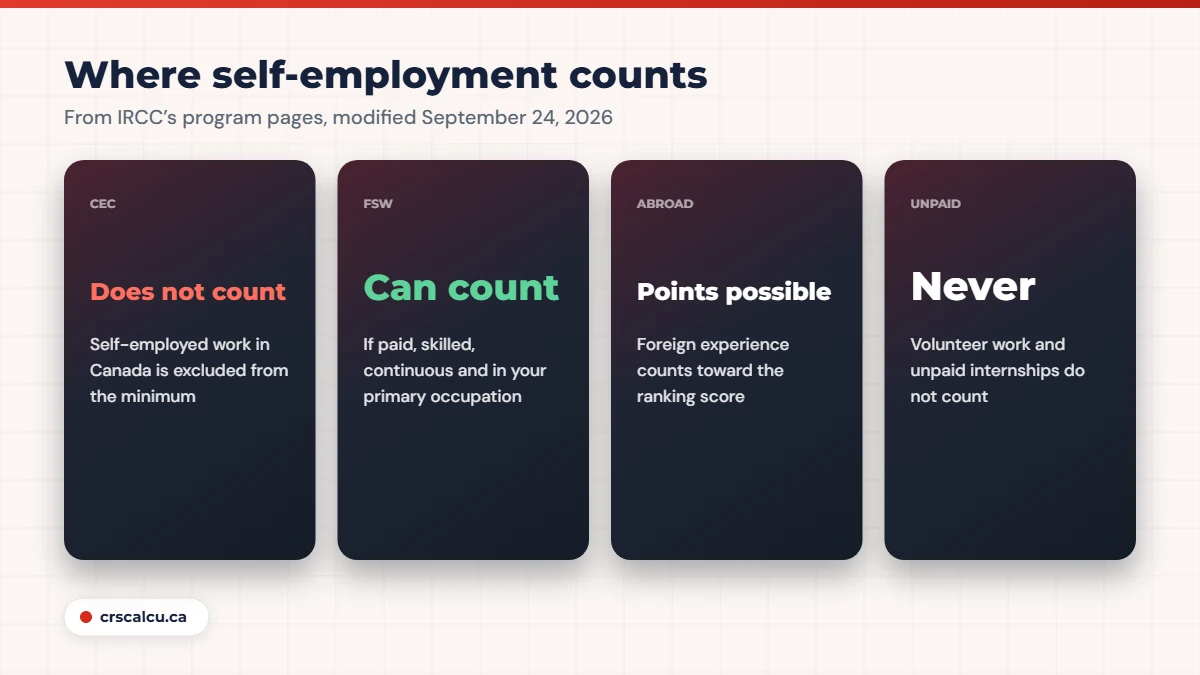
It depends where. IRCC’s Canadian Experience Class page (modified September 24, 2026) says self-employed work does not count toward that program’s one year of Canadian experience, apart from a temporary policy for certain physicians. The Federal Skilled Worker Program page lists work done while self-employed among experience that can count, if it is paid, skilled and continuous. Self-employment outside Canada can also earn foreign work experience points. The hard part is proof, because nobody else can write your reference letter.
Key takeaways
Why self-employed work experience is treated in two ways
Think of Express Entry as two gates. The first is program eligibility: do you meet the minimum requirements of the Canadian Experience Class, the Federal Skilled Worker Program or the Federal Skilled Trades Program? The second is your Comprehensive Ranking System score, which decides whether you are invited.
A period of work can pass one gate and not the other. A forum member put it well in a 2016 thread: the application runs on two tracks, one for eligibility and one for points. Self-employment is where the tracks split most often.
Where | Does it count? | Source |
|---|---|---|
Canadian Experience Class minimum (work in Canada) | No, except certain physicians under a temporary policy | IRCC: Canadian Experience Class page |
Federal Skilled Worker minimum (in Canada or abroad) | Yes, if paid, skilled and continuous | IRCC: Federal Skilled Worker Program page |
Foreign work experience points | Yes, according to forum advice and one approved case | Forum threads, 2016 and 2020 |
Unpaid or volunteer work of any kind | No | Both IRCC pages |
Our summary of IRCC’s program pages (both modified September 24, 2026) and the forum threads discussed below.
Canadian Experience Class: why it does not count
The Canadian Experience Class asks for at least one year of skilled work in Canada, or 1,560 hours, in the three years before you apply. IRCC’s page lists what cannot be used toward it: work done while you were a full-time student, co-op work terms, volunteer work and unpaid internships, work done when you were not authorized to work, and self-employed work. The single exception on the page is a temporary policy for certain physicians.
The page also says the work must be gained in Canada while you held temporary resident status, and that if you worked remotely you must have been physically in Canada and working for a Canadian employer. We cover the hours in 1,560 hours for Express Entry and the program in our Canadian Experience Class guide.
Real case: the agency paid them as self-employed (April 2020)
A newcomer who started work in June 2019 through a recruiting agency discovered at tax time that their income had been reported as self-employment income, not employment income, even though they received pay stubs. They asked whether this would affect a Canadian Experience Class application. Members said they appeared to have been treated as a subcontractor, and that the program requires a year of Canadian skilled work that was not obtained while self-employed. The suggested alternatives were the Federal Skilled Worker Program, or staying in the pool in case a province nominated them. No outcome was reported.
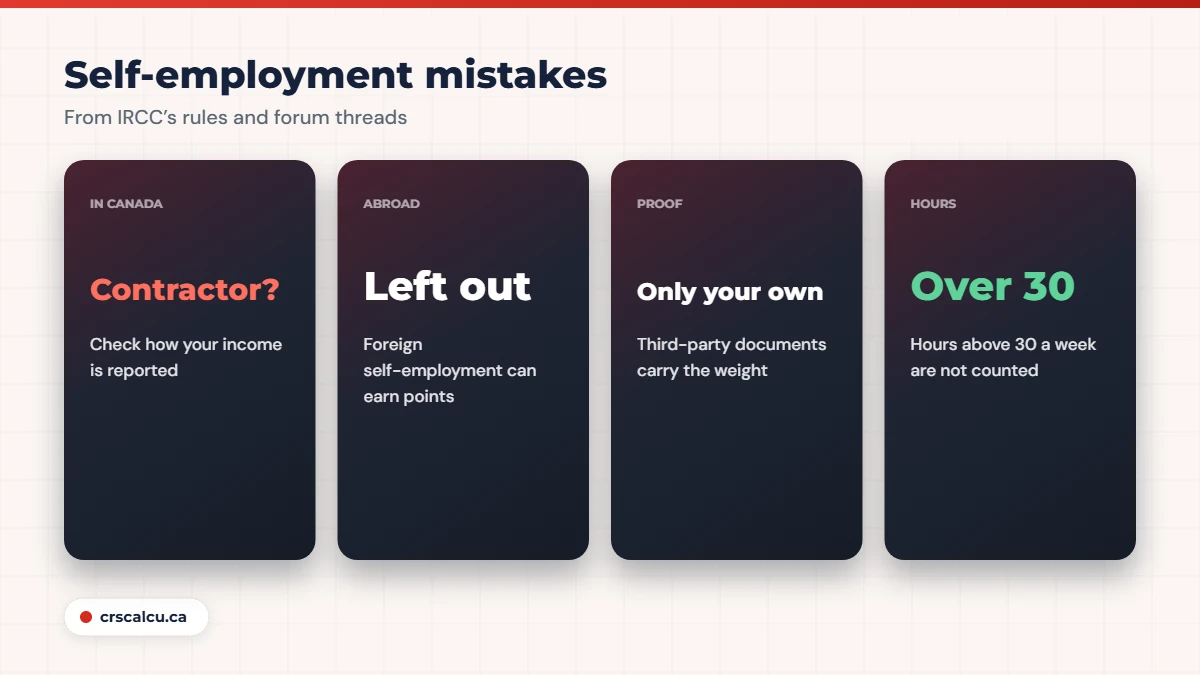
This case is the one to learn from if you work in Canada. What matters is not what you call yourself but how the relationship is set up and reported. Check your contract and your tax slips in the first month of a job, not at the end of the year. If the occupation code is also in doubt, see wrong NOC code.
Federal Skilled Worker Program: where it can count
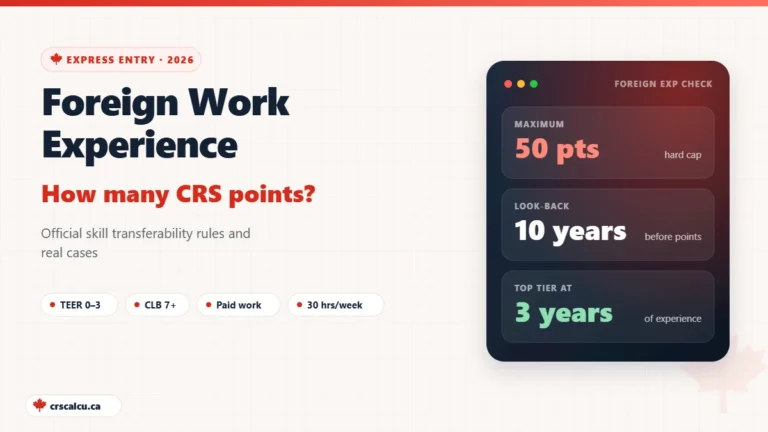
The Federal Skilled Worker Program is built for people with experience abroad, and it is more accommodating. IRCC’s page says the work must be in TEER 0, 1, 2 or 3, in the same occupation as the one you use for your application, gained within the last ten years in Canada or abroad, paid, and at least one year continuous or 1,560 hours. It says hours above 30 a week are not counted. And it includes work done while being self-employed in the experience that can count.
You then need 67 points on the program’s own grid; our FSW points calculator works that out. The language minimum is Canadian Language Benchmark 7 in all four abilities, and you need a Canadian credential or an assessed foreign one.
Foreign self-employment and your CRS score
For ranking, work outside Canada feeds the skill transferability part of the score, in combination with your language results and any Canadian experience. IRCC’s Help Centre confirms that work experience outside Canada counts toward the score used to rank your profile.
Real case: five years self-employed abroad, applying under the Canadian Experience Class (July 2020)
An applicant with five years of self-employment outside Canada asked whether it would count as foreign work experience when applying through the Canadian Experience Class. A member answered that it would not be part of the eligibility assessment for that program, which looks only at Canadian work, but that it does count for the profile and for ranking points. They stressed that it needs proper supporting documents. The poster thanked them and did not report further.
Real case: a contractor year and a software business, approved (August 2016 to February 2017)
An applicant with one year of Canadian employment wanted to add foreign self-employment: a year as a contractor with clear paperwork, and five years running a software business whose income came from subscriptions, not from clients paying for services. Members listed what to gather: documents from third parties describing the service and the payments, incorporation papers, accountant letters, tax returns and records from payment processors. They also suggested estimating weekly hours and having them confirmed by a third party. The applicant later reported that their visa was issued in early February 2017 and that they landed two weeks later.
That is the clearest evidence we found that foreign self-employment, documented from several directions, is accepted in practice.
How to prove self-employed work experience
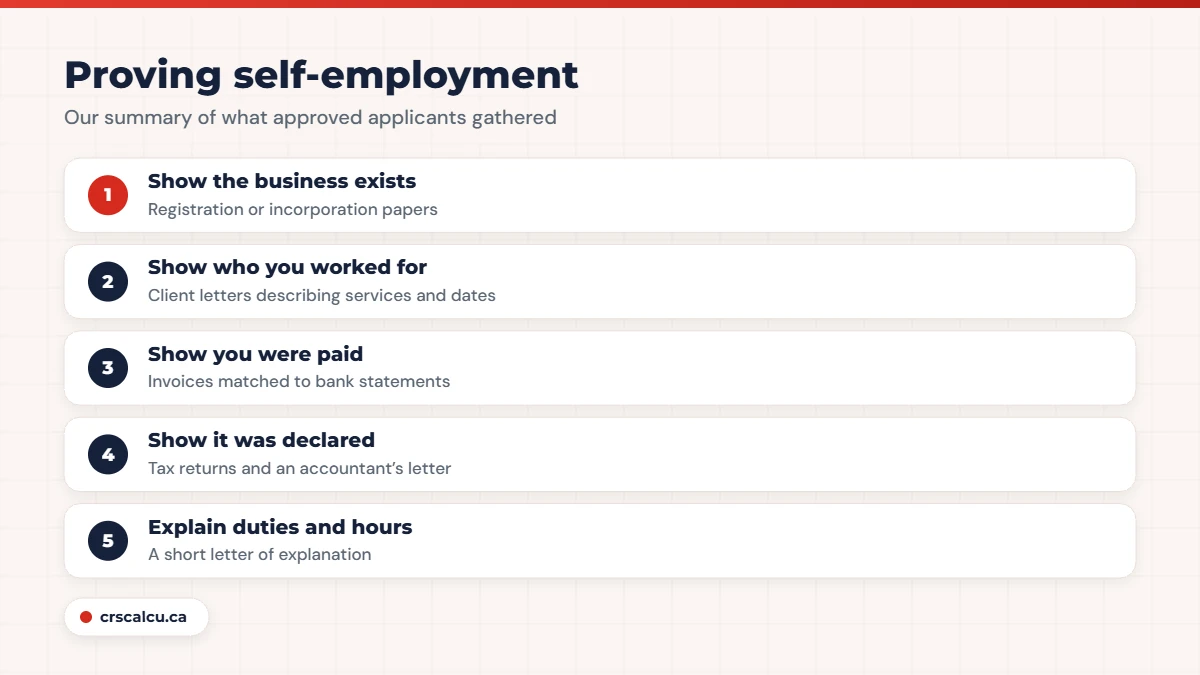
An employee hands in a reference letter. A self-employed person has to build the same picture from other people’s paper. In the 2016 thread, members quoted the instruction that self-employed applicants must provide documents from third parties indicating the service provided along with payment details. We did not find that sentence on the public pages we read, so check the wording in your own document checklist after an invitation. The logic holds either way: an officer needs to see what you did, for whom, for how long and that you were paid, from sources other than you.
Documents self-employed applicants gathered
Your duties still have to match the occupation you claim. Use our NOC TEER finder to check the lead statement and main duties, and read what a normal reference letter contains so your substitute documents cover the same ground.
Hours are the weak point
An employer’s letter states hours per week. A self-employed applicant has no one to state them. Keep or reconstruct a reasonable record: contracts that specify hours, invoices by day or week, calendars, project logs. Claim only what the paper supports, and remember that IRCC does not count hours above 30 a week.
The grey zone: contracting from Canada for a foreign client
Real case: living in Canada, contracting for a company abroad (December 2024)
An IT professional who had lived in Canada for four years worked on contract for a company in the United States, was paid in full by wire transfer and handled their own taxes. With one year of Canadian experience already counted and a score of 470, they asked whether the contract work could be claimed as foreign work experience. A member said it could be included as foreign experience, would not count for the Canadian Experience Class, and would need more documentation than an ordinary job: the contract, which set out 37.5 hours a week and the duties, plus proof of payment. No outcome was reported.
We would be careful here. IRCC’s scoring criteria define Canadian work experience as working for a Canadian employer in Canada, so this work is not that. Whether work done physically in Canada for a foreign client is “foreign” experience is not spelled out on the pages we read. The forum answer is one member’s view. If your invitation would depend on those points, get a licensed opinion before you claim them, because claiming points you are not entitled to is how misrepresentation in Express Entry problems begin.
Five mistakes with self-employed work experience
Five mistakes from the rules and the threads
Once you know which periods count, put them into the CRS calculator and compare the result with the latest draw cut-offs. One year of foreign experience can be the difference in the skill transferability section.
Frequently Asked Questions
Does self-employed work experience count for the Canadian Experience Class?
No. IRCC’s Canadian Experience Class page says self-employed work cannot be counted toward the minimum one year of Canadian experience, except for certain physicians under a temporary policy.
Does self-employment count for the Federal Skilled Worker Program?
IRCC’s page includes work done while self-employed among experience that can count, provided it is paid, in TEER 0, 1, 2 or 3, in your primary occupation, within the last ten years and at least one year continuous or 1,560 hours.
Can I get CRS points for self-employment outside Canada?
Forum members say yes, and one applicant who claimed foreign contractor and business experience in 2016 was approved in 2017. IRCC’s Help Centre confirms that work experience outside Canada counts toward the ranking score.
How do I prove self-employed work experience?
With documents from third parties: client letters describing the services and payments, contracts and invoices matched to bank statements, tax returns, business registration and an accountant’s letter. Add a letter of explanation setting out your duties and hours.
I work in Canada as a contractor. Is that self-employment?
It may be. In a 2020 forum case, a worker placed by an agency found their income reported as self-employment and was told it would not count for the Canadian Experience Class. Check your contract and tax slips, and get advice if it is unclear.
Do I need a reference letter if I am self-employed?
You cannot write your own. Client letters, contracts, tax records and an accountant’s letter take its place. They need to cover the same points: duties, dates, hours and pay.
Know which years count? Now see what they are worth
Enter only the experience that qualifies and compare your score with recent Express Entry cut-offs.
Final Thoughts
Self-employed work experience is neither worthless nor automatic in Express Entry. In Canada it does not meet the Canadian Experience Class minimum. Abroad, or under the Federal Skilled Worker Program, it can count if it was paid, skilled and continuous, and if you can prove it through other people’s documents. Work out which gate each period has to pass before you enter it in your profile.
If your status as employee or contractor in Canada is unclear, if you work from Canada for foreign clients, or if your business income does not map neatly onto hours and duties, speak to a licensed consultant or lawyer before you create your profile. These are judgment calls, and the cost of guessing wrong is an invitation you cannot use.