Express Entry Guide · Updated October 2026
Passport Request in Express Entry (PPR): What It Means, How Long Stamping Takes and What to Check First (Real Cases)
After months of “in progress”, one letter asks for your passport. It is the best news in the process, and there are still a few ways to get it wrong.

A passport request is the message Express Entry applicants outside Canada wait for. Forums shorten it to PPR. It means IRCC is ready to put a permanent resident visa in your passport and issue your Confirmation of Permanent Residence, the document you will land with.
It is close to the finish line, not across it. You still have to get a passport, or copies of it, to the right office in the right way, and you have to do it with one eye on dates: your passport’s expiry, your medical results, and the expiry date that will be printed on the confirmation. Applicants inside Canada usually follow a different route with no passport sent at all, which adds to the confusion.
We read IRCC’s three pages on what happens when an Express Entry application is approved and five public forum threads from 2017 to 2024 in which applicants timed the wait between sending a passport and getting it back. IRCC publishes no timeline for that step, so the timings below are applicant reports.
Quick answer: what does a passport request mean in Express Entry?
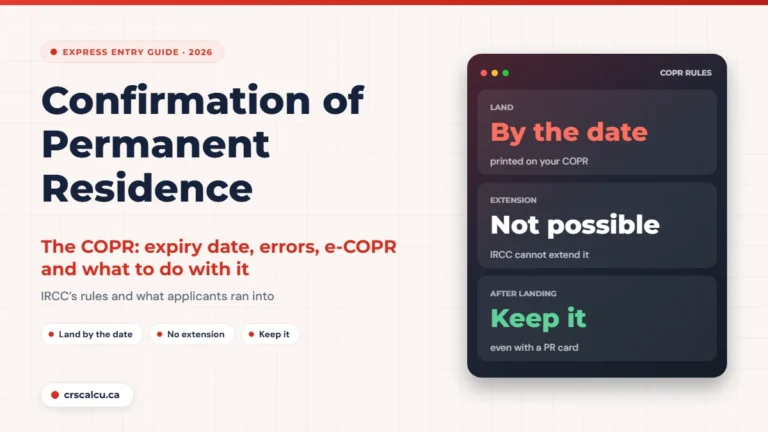
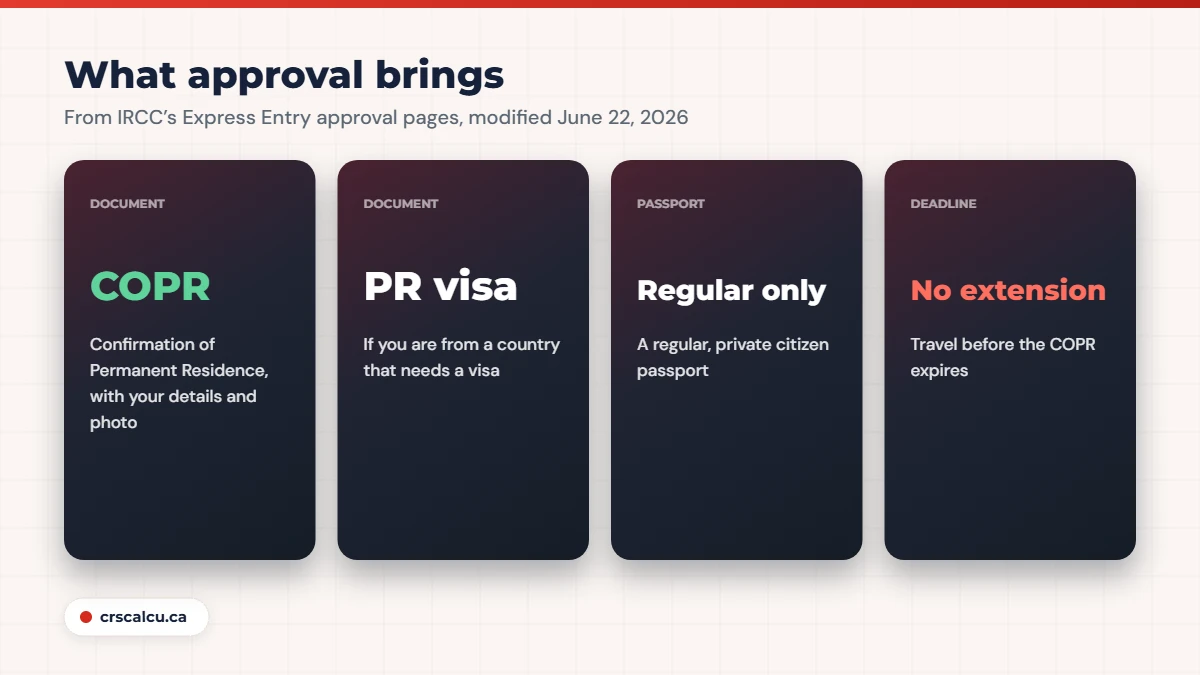
It means your application is at the final step. IRCC’s approval page says that when it approves an application it issues a Confirmation of Permanent Residence (COPR) and, if you are from a country that needs one, a permanent resident visa. To place that visa, the visa office asks for your passport. Follow the instructions in your own letter exactly. IRCC also says it cannot extend a COPR, so check your passport validity and travel plans before you send anything.
Key takeaways
What a passport request is, and what IRCC calls it
“Passport request” and “PPR” are applicant terms. Older letters were headed “ready for visa”, which is why you will see that phrase in threads too. IRCC’s public pages describe the result instead of the letter.
The page “If your Express Entry application is approved” (modified June 22, 2026) says approved applicants receive a Confirmation of Permanent Residence and a permanent resident visa if they are from a country that needs a visa. It says the COPR carries your identifying details and photograph, and that you should check them against your passport. Then it gives the line that governs everything after: IRCC cannot extend your COPR, so you should make sure to travel to Canada before it expires.
Point | What IRCC says | Page |
|---|---|---|
What you receive | A COPR, and a permanent resident visa if your country needs one | If your application is approved |
What to check | That the details on the COPR match your passport | Same page |
Extension | IRCC cannot extend your COPR | Same page |
Type of passport | A regular, private citizen passport | If approved: outside Canada |
At the border | You must enter Canada on or before the COPR expiry date | If approved: outside Canada |
If you are in Canada | Status is confirmed through a secure online portal, without an in-person interview | If approved: in Canada |
Our summary of IRCC’s three Express Entry approval pages, all modified June 22, 2026, read on October 5, 2026.
What those pages do not contain is the wording of the request letter itself: where to send the passport, whether to send the original or copies, which photos to include, and by when. Those instructions come in your own letter and can differ by visa office and by nationality. Follow the letter, not a forum post from 2019.
Is a passport request an approval?
Forum members like to say a passport request is as good as approved, on the reasoning that IRCC would not ask for a passport if it meant to refuse. One 2017 reply put it at “99%”.
The official position is narrower. You are a permanent resident only when your status is confirmed: at the border for people landing from abroad, or through the portal for people in Canada. IRCC’s page for arrivals says the border officer will check that you are the person who was approved and will ask a few questions to make sure you are still eligible to immigrate. So tell IRCC if something material changes between the request and landing, such as a marriage or a new child. The IRCC web form is the channel.
How long from sending a passport to getting it back
IRCC gives no figure. Here is what applicants recorded.
Real case: eight days, with a long weekend in the middle (April 2017)
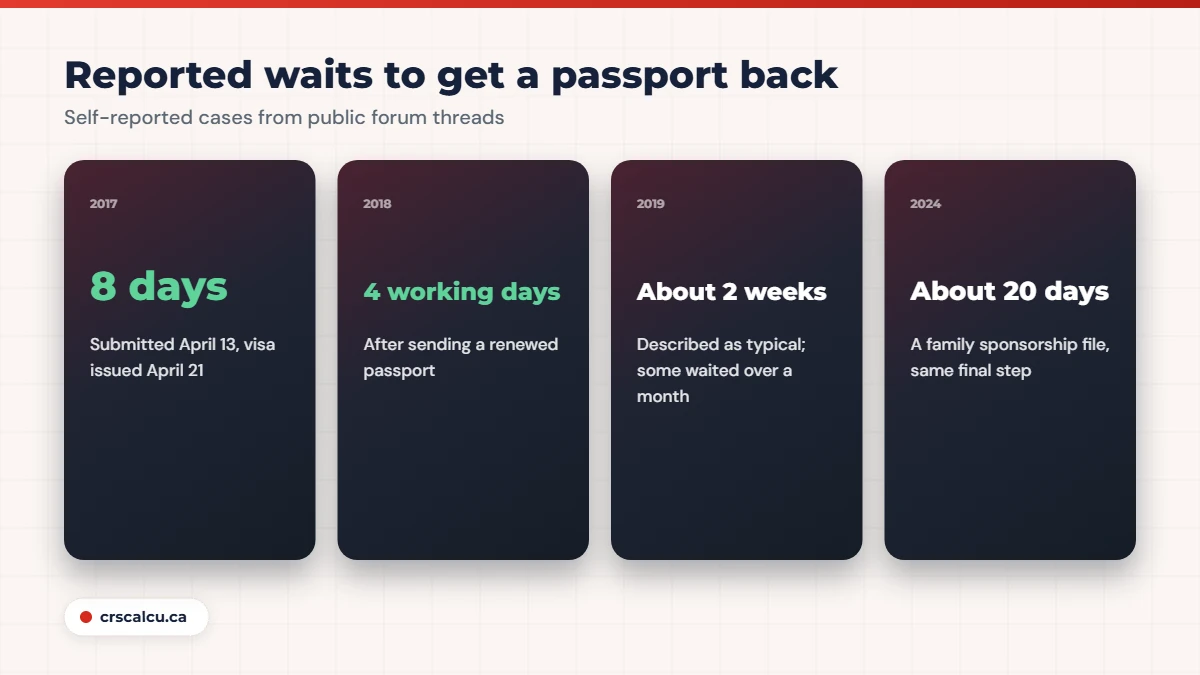
An applicant received the request on April 13 and handed the passport to a visa application centre the same day. Four days later they were already anxious, having seen someone else wait 25 days. Members pointed out that the following days were public holidays in Canada, so the passport would not reach the visa office until the 18th. Estimates in the thread ranged from five to seven business days to 20 to 25 days, and a few people had theirs back in three or four. The poster’s visa was issued on April 21, about eight days after they submitted.
Real case: “two weeks, but one in five waits over a month” (May to June 2019)
An applicant got a “ready for visa” notice on May 9, submitted through a visa application centre the next day, and the passport reached the visa office on May 13. Members described the usual pattern as about a week for the visa and a week for return delivery. One experienced member said roughly a fifth of applicants wait more than a month and that their own case took a month and a half with nothing wrong. The advice was not to book travel yet. One person in the thread saw return tracking start four days after their file was finalized; another had no news six days after delivery.
Real case: about 20 days in a family sponsorship file (February to March 2024)
This one is a spousal sponsorship, not Express Entry, but the final step is the same. The applicant, a citizen of a country that does not need a visa, was asked on February 26 for passport copies and photos within 30 days. Early replies guessed two to four weeks. A more experienced member said one to two months was more realistic, and two others were past four weeks with no update. The poster’s visa was issued on March 18, about 20 days after the request.
Put together: a week or two is common, three to five weeks is not unusual, and public holidays and courier time both count. None of this is a standard you can hold IRCC to.
Check your dates before you send anything
The reason to slow down for one evening is the expiry date on the COPR. IRCC cannot extend it. Applicants consistently report that this date is tied to the earlier of two things: the expiry of the medical exam results and the expiry of the passport. IRCC’s pages do not spell that out, but they do say medical results are valid for 12 months, and our medical exam guide explains how that clock runs.
Real case: passport expiring in seven months at the visa stage (March to June 2018)
An applicant received the request with seven months left on their passport, and the instructions mentioned six months of validity. By the time they travelled it would be under that. First replies said to send the current passport, since the visa’s validity follows whichever expires first, the passport or the medical. The applicant chose an urgent renewal instead. A later post warned that sending a new passport without first telling IRCC could leave the visa tied to the old passport’s date, and advised updating the file before submitting. In June 2018 the applicant reported getting the renewed passport back with the visa in four working days.
The useful part of that case is the order of operations: renew, tell IRCC about the new passport, then send it. If your passport is short on time now, deal with it before the request arrives.
Before you send your passport
If you are in Canada: usually no passport at all
For applicants living in Canada, IRCC’s page describes a different ending. It says IRCC confirms permanent resident status through a secure online portal, without in-person interviews, and that you do not have to do anything until it contacts you. The emails come from addresses ending in cic.gc.ca and ask you to confirm your email address, confirm that you are physically in Canada, and then give you information about the Permanent Residence Portal. An electronic COPR is made available in the portal.
The same page has one firm instruction: you must tell IRCC if you leave Canada before it grants you permanent resident status. A trip abroad at this stage changes which process applies to you.
Real case: principal applicant in the portal, family’s passports at a visa centre (October 2022 to January 2023)
A family’s file split in two. The dependants, outside Canada, received a request and submitted their passports on October 11, 2022. The principal applicant, in Canada, was invited to the portal on November 1. Nearly three months later the passports were still being held and the family wondered whether they had sent them too early. On January 10, 2023, the principal applicant’s electronic confirmation arrived, and the dependants’ passports were then sent on for stamping.
When a family is in two places, the outside-Canada members wait on the inside-Canada member. Expect the slower of the two tracks to set the pace.
Six mistakes people make at the passport request stage
Six mistakes from the rules and the threads
After the passport comes back
When the passport returns, check the visa and the COPR line by line against the passport: name, date of birth, passport number, and the expiry date. If something is wrong, contact IRCC before you travel. Our post on a name mismatch in Express Entry explains the process for correcting errors on the confirmation.

At the border, IRCC says to bring your valid passport, your COPR, your permanent resident visa and proof that you have the funds to support yourself and your family after you arrive. Our proof of funds guide covers what counts. The officer confirms the Canadian mailing address where your PR card will be sent. If you are not at this stage yet, the number that matters is still your score: check it with the CRS calculator against the latest draw cut-offs.
Frequently Asked Questions
What is a passport request in Express Entry?
It is the letter, often called PPR by applicants, asking for your passport or copies of it so the visa office can issue your permanent resident visa and Confirmation of Permanent Residence. It comes at the final step, after IRCC has decided to approve the application.
Does a passport request mean I am approved?
It means IRCC is ready to issue your documents. You become a permanent resident only when your status is confirmed at the border or through the portal. IRCC says the border officer checks that you are still eligible to immigrate.
How long does it take to get my passport back?
IRCC does not publish a time. In forum cases from 2017 to 2024, applicants reported three days to about six weeks, with one to three weeks most common.
Can my COPR be extended if I cannot travel in time?
No. IRCC’s approval page says it cannot extend your COPR and that you should travel to Canada before it expires.
I am in Canada. Do I send my passport?
Usually not. IRCC says it confirms permanent residence for people in Canada through a secure online portal without an in-person interview, and makes an electronic COPR available there. You must tell IRCC if you leave Canada before status is granted.
My passport expires soon. Should I renew before sending it?
Check the validity the letter asks for and how long you need to travel. In one 2018 forum case an applicant renewed, and members advised telling IRCC about the new passport before sending it. IRCC’s pages do not set out a rule for this step.
Not at this stage yet? It starts with your score
A passport request comes at the end of a long road. See where you are on it by checking your points against recent draws.
Final Thoughts
A passport request is the point where an Express Entry application turns into travel plans. Follow your own letter, check the three dates that matter, send exactly what is asked, and do not book a flight until the passport is back in your hands. Then check every line of the COPR before you go.
If your medical results or passport will expire before you can realistically travel, if your family situation has changed since you applied, or if the request has a deadline you cannot meet, speak to a licensed consultant or lawyer straight away. With a COPR that cannot be extended, timing errors at this stage are the expensive kind.