Express Entry Guide · Updated October 2026
Birth Certificate for Express Entry: Who Actually Needs One (Real Cases)
Few documents cause as much needless stress as this one. People spend months chasing a certificate the system never asks for. Here is who actually needs a birth certificate, when it does show up on a checklist, and what to do if yours does not exist.
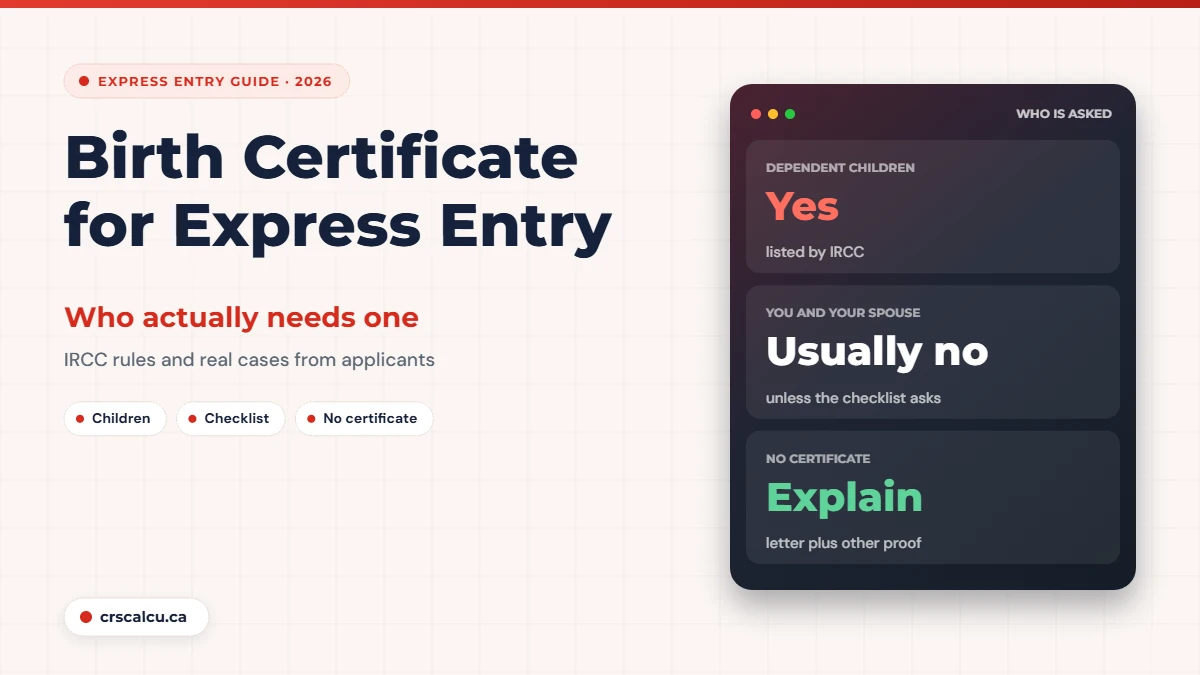
A birth certificate for Express Entry is on IRCC’s document list for dependent children. It is not a standard requirement for the principal applicant or a spouse. Your personalized document checklist, which appears after an invitation, is what decides. Applicants without children have reported for years that the checklist never asked for their own birth certificate.
That surprises many people, because other immigration programs, older paper applications and some advisers treat the birth certificate as essential. For Express Entry it mostly is not.
We checked IRCC’s current application page and read forum threads going back to the first Express Entry draws in 2015. Here is what the rules say, and what applicants with missing, late or mismatched birth records actually did.
Quick answer: do you need a birth certificate?
For dependent children, yes. IRCC lists a birth certificate for them among the application documents. For yourself or your spouse, usually no. Upload it only if your personalized document checklist asks, for example to prove a relationship to a relative in Canada. If a requested certificate cannot be obtained, upload a letter of explanation with other proof in its place.
Key takeaways
Who Needs a Birth Certificate for Express Entry
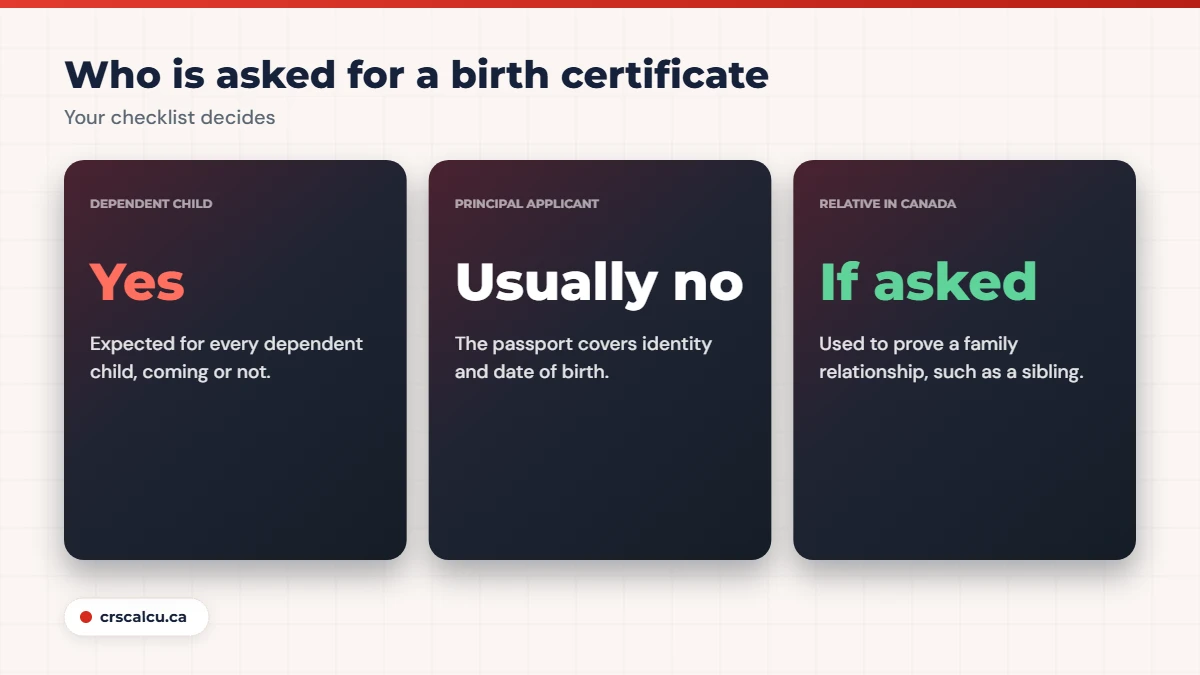
IRCC’s page on applying for permanent residence through Express Entry lists the documents for the application. A birth certificate appears there for dependent children. It sits beside the other family documents: marriage certificate, common-law union form, divorce, death and adoption certificates.
Person | Usually asked? | Why |
|---|---|---|
Principal applicant | No | The passport proves identity and date of birth |
Spouse or common-law partner | No | Same reason |
Dependent child, coming to Canada | Yes | Shows the child’s identity and parents |
Dependent child, not coming | Yes | All dependants are declared and documented |
Applicant claiming a relative in Canada | If the checklist asks | Used as proof of the relationship |
Based on IRCC’s Express Entry application page (modified June 22, 2026) and applicant reports. Your personalized checklist is the final word.
The pattern has held since the system began.
Real case: ready for a document nobody asked for
In July 2015, an applicant invited in one of the first Express Entry draws reached the upload stage and found no slot for a birth certificate. They were surprised. Their earlier paper application under the Canadian Experience Class in 2014 had been rejected over how their birth certificate was attested. A member quoted the rule of the time: the document is required only if the applicant identifies dependent children.
Others added to that thread in 2016, 2017 and 2018 with the same experience. Single applicants and couples without children were not asked. Several mentioned that their consultants had insisted on one anyway.
When It Does Show Up
There are a few situations where a birth certificate lands on your checklist or becomes useful proof.
Times you will need one
The last point matters. A provincial nominee program has its own document list, and some ask for birth certificates from everyone. Passing that stage does not change what the federal checklist asks for, and the federal checklist does not excuse you from the provincial one.
If You Do Not Have a Birth Certificate
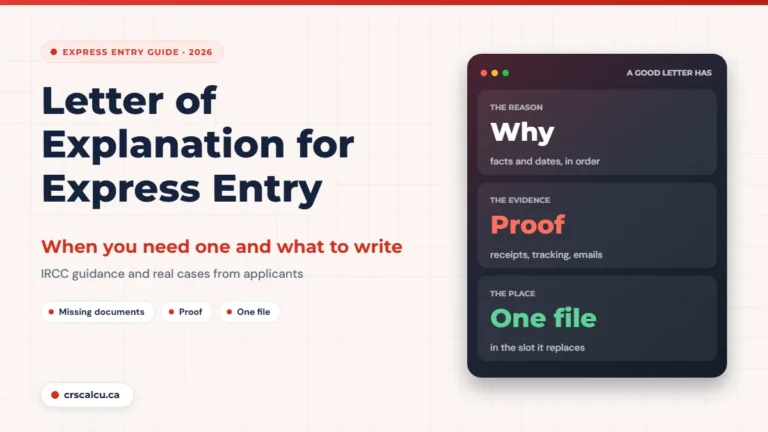
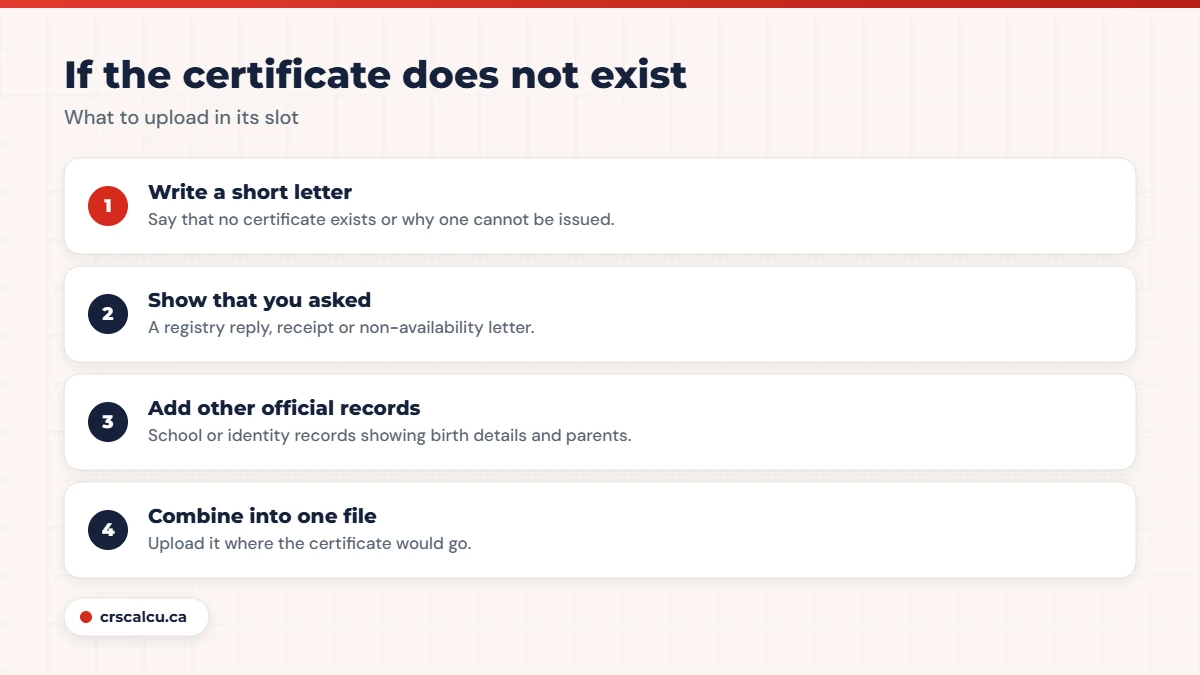
In many countries birth registration was not routine a generation ago, or records were lost. If your checklist does ask for a certificate you cannot get, IRCC’s general rule for missing documents applies: write a letter explaining why you cannot get it, attach supporting documents, and upload them as one file where the certificate would go.
What applicants put in its place
The first two items follow IRCC’s supporting documents guidance. The last two are common applicant practice, not an IRCC list.
IRCC is clear that a letter does not guarantee acceptance. The officer decides whether the file is complete. Our guide to the letter of explanation for Express Entry shows how to write one that gets read.
When the Certificate and Passport Do Not Match
A more common problem than a missing certificate is one that disagrees with your other papers.
Real case: a date of birth recorded wrong in first grade
In July 2022, a worker in Canada on an intra-company transfer permit explained that their date of birth had been entered incorrectly when they started school, and every document since then carried that date. Their birth certificate showed something else. Correcting all the records would take years. A member’s reply was short: a birth certificate is not required for Express Entry.
For that applicant the answer removed the problem. No child, no relative to prove, no slot for the certificate. The passport date was the one that mattered, and every form had to match it.
If you do have to upload a certificate that differs from your passport, do not hide it and do not alter anything. Explain it.
Handling a mismatch
Children’s Birth Certificates: Getting Them Right
For dependent children the certificate is expected, so it is worth doing carefully.
Check | Why it matters |
|---|---|
It names the parents | It is the proof of the parent and child relationship |
The names match the passports | Avoids an identity question |
It is the full version, if your country issues short and long forms | Short forms often leave out the parents |
It has a certified translation if not in English or French | Required by IRCC |
The original scan is in the same file as the translation | A translation alone is not enough |
Our checklist. The translation rule is from IRCC’s Express Entry application page.
IRCC’s translation rule applies to every certificate. A document not in English or French needs a translation by a certified translator, or one with the translator’s affidavit, and a scan of the original or of a certified photocopy. For an adopted child, the adoption certificate is listed alongside the birth certificate.
Children who are not coming still count
A dependent child who stays behind is still declared in your application, and their documents and medical exam are still needed. Leaving a child out to simplify the file can block you from sponsoring that child later. See our guides on the medical exam and a non-accompanying spouse.
Why Older Advice Says It Is Mandatory
If you search forums you will find confident posts saying the birth certificate is the most important document of all. Many are from before Express Entry, or about other programs.
Real case: two answers in one thread
In January 2017, an applicant asked whether the certificate was mandatory. One member said plainly that it was not. Another, who admitted their knowledge was older, described an application returned until an original certified certificate was supplied. A third reported approval under the Canadian Experience Class that same month without ever submitting their own.
All three were telling the truth about their own files. The programs and years were different. This is the general problem with forum advice: it is accurate for one person, one program and one year.
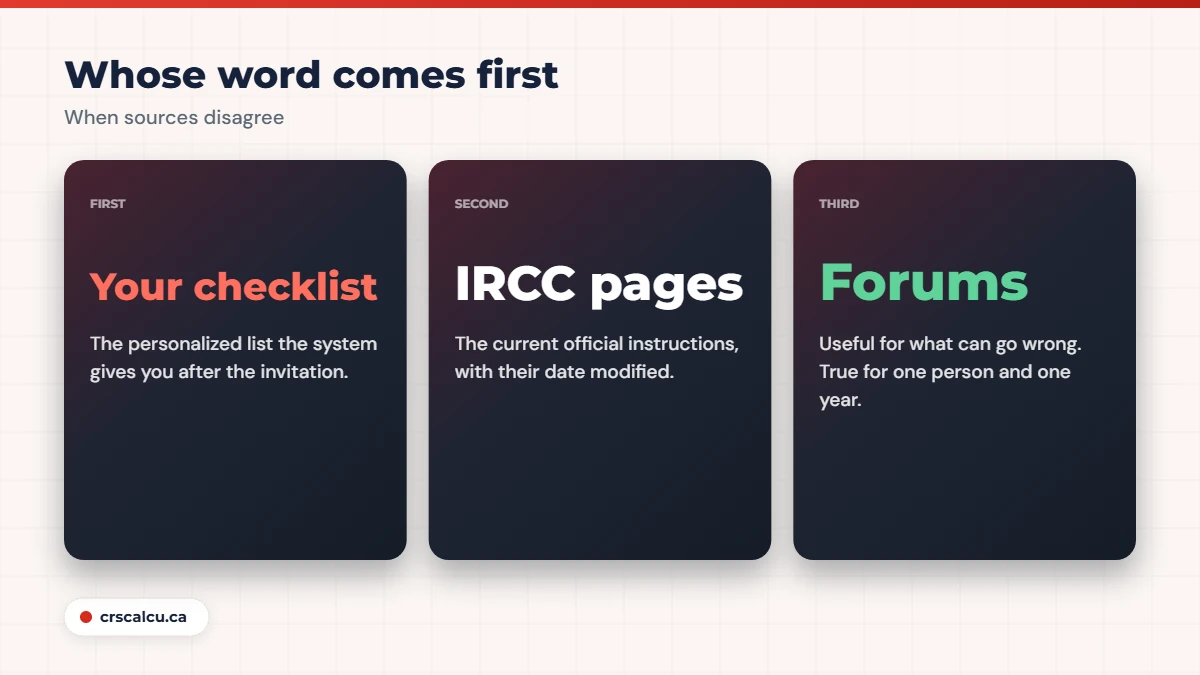
The reliable order is simple. Your personalized checklist first. The current IRCC page second. Forum experience third, as a guide to what can go wrong. Our Express Entry document checklist walks through the full list.
Frequently Asked Questions
Is a birth certificate mandatory for Express Entry?
Not for most principal applicants. IRCC lists the birth certificate for dependent children. Your personalized document checklist shows what you must upload.
Do I need my own birth certificate if I have no children?
Usually not. Applicants without dependent children have consistently reported that their checklist did not ask for it.
Does my child need a birth certificate for Express Entry?
Yes. A birth certificate for dependent children is among the application documents IRCC lists, with a certified translation if it is not in English or French.
What if I cannot get a birth certificate that my checklist asks for?
Upload a letter of explanation and supporting proof in that slot. IRCC’s guidance is to explain why you cannot get the document and attach evidence. The officer decides whether to accept it.
Do I need birth certificates to claim sibling points?
You need proof of the relationship, and birth certificates showing a shared parent are the usual way to provide it. Upload them if your checklist asks for proof of a relative in Canada.
My birth certificate has a different date than my passport. What should I do?
Use your passport details on every form. If the certificate must be uploaded, add a short explanation and any document that links the two. Do not alter the certificate.
Sort the score before the paperwork
Documents only matter after an invitation. See where your CRS score stands today.
Final Thoughts
For most people, the birth certificate for Express Entry is a document for their children, not for themselves. If you have no dependants and claim no relative in Canada, there is a good chance it never appears on your checklist.
If it does, give the officer a clean file: the full certificate, the original scan with its translation, and a short explanation for anything that does not match. And if it cannot be had at all, say so in a letter and back it with proof.