Express Entry Guide · Updated October 2026
Background Check in Express Entry: Criminality, Security Screening and Why It Takes So Long (Real Cases)
It is the section that moves last and explains least. Here is what the government says happens during the background check, and what applicants found when theirs stalled.
The background check in Express Entry is where most long waits sit. Your medical is passed, your biometrics are in, the documents were all there on day one, and one line in your account still says “in progress” or “not started” week after week.
It is also the part of the process the government describes least to applicants. There is no IRCC page that walks you through it step by step. What exists is a set of briefing notes prepared for parliamentary committees and a page from the Canadian Security Intelligence Service, and together they give a reasonably clear outline of who checks what.
We read those official sources, IRCC’s definitions of the status words, and six public forum threads from 2017 to 2024 where applicants described long background checks and, in some cases, what their file notes revealed. Nothing here will speed yours up. It may stop you worrying about the wrong thing.
Quick answer: what is the background check in Express Entry?
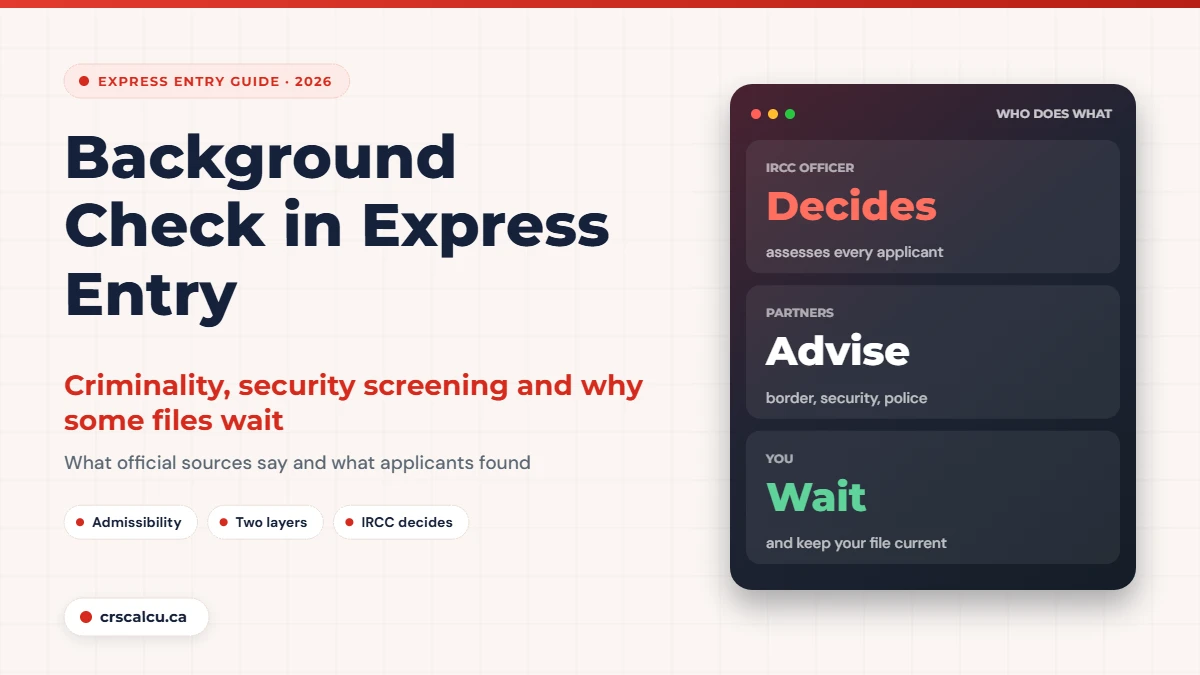
It is the stage where officers decide whether you are admissible to Canada. An IRCC briefing note (modified August 18, 2026) says every applicant is assessed by a trained officer, that fingerprints are screened against domestic and international databases, and that most permanent residence applicants must provide a police certificate. Some files are sent for comprehensive security screening with partner agencies. IRCC makes the final decision. No official page gives a timeline for this stage.
Key takeaways
What the background check in Express Entry covers
Start with the official outline. The briefing note “Security Screening”, prepared by IRCC for a House of Commons committee meeting in April 2026 and modified August 18, 2026, describes the system in a few plain sentences.
Part | What the source says | Source |
|---|---|---|
Officer assessment | Every applicant is assessed by a trained immigration officer, who must be satisfied they are not inadmissible | IRCC briefing note |
Biometrics | Fingerprints are screened against domestic and international databases | IRCC briefing note |
Biographic information | Factual details about your life are used to identify risks to national security and public safety | IRCC briefing note |
Criminal record | Most permanent residence applicants must provide a police certificate or criminal record check | IRCC briefing note |
Comprehensive screening | Assessment against the sections on security, human or international rights violations, and organized criminality | IRCC briefing note |
Security service | One of the organizations IRCC may consult; it gives advice, and IRCC decides | CSIS security screening page |
Our summary of the IRCC committee briefing note (modified August 18, 2026) and the CSIS security screening page (modified January 22, 2026).
In everyday terms there are two layers. The first is what every applicant goes through: your fingerprints, your police certificates and the history you declared are checked. The second is a deeper review that only some files are referred to, done with public safety partners. The briefing note names the Canada Border Services Agency, the security service and the national police as the partners IRCC works with.

Who actually does the checking
Applicants often picture one office doing everything. The official sources describe a shared job with a single decision-maker.
IRCC’s officers assess the application and decide. The briefing note says IRCC reviews each applicant in collaboration with its public safety partners. The security service’s own page (modified January 22, 2026) says it is one of the organizations IRCC may consult while assessing applications, that its role under its governing act is to provide advice and information on security matters, and that IRCC determines who is granted permanent residence. On timing it says only that it is committed to performing its screening in a timely manner where possible while ensuring the safety of Canada and Canadians.
That same page includes a line worth knowing before you spend money on enquiries: the service’s access to information office has no authority to intercede in screening, and it expects significant delays for status questions.
What you see in your account while it happens
Your account shows a single “background check” line. IRCC’s Help Centre defines the words: “not started” means the review of that section has not begun, and “in progress” means it is being reviewed. Neither tells you which layer your file is in. We go through all the status words in Express Entry application status.
Real case: the wording changed, the meaning did not (June 2017)
An applicant saw the background check line change to a message that the application was in progress and that a message would be sent when the background check started. They asked whether this was a real change from “not started” or just new wording. Others had watched the line flip between “in progress” and “not applicable” within days of the medical passing and were equally confused. Members offered their own theories about stages. No clear resolution was reported.
You will meet those theories on every forum: numbered stages with short codes that are said to map onto the background check line. They are applicant inventions. IRCC does not publish them, and the cases below show how little the line reveals either way.
Real case: approved two months after applying (May 2023)
An applicant who submitted on March 22, 2023, was puzzled that the background check showed “in progress” while the eligibility section still said “not started”. Others in the thread had been waiting more than a month at the same point. On May 26, 2023, the original poster reported that the application had been approved, about two months after it was filed.
That is the ordinary outcome. For most applicants the background check is invisible because it finishes before they start to wonder about it.
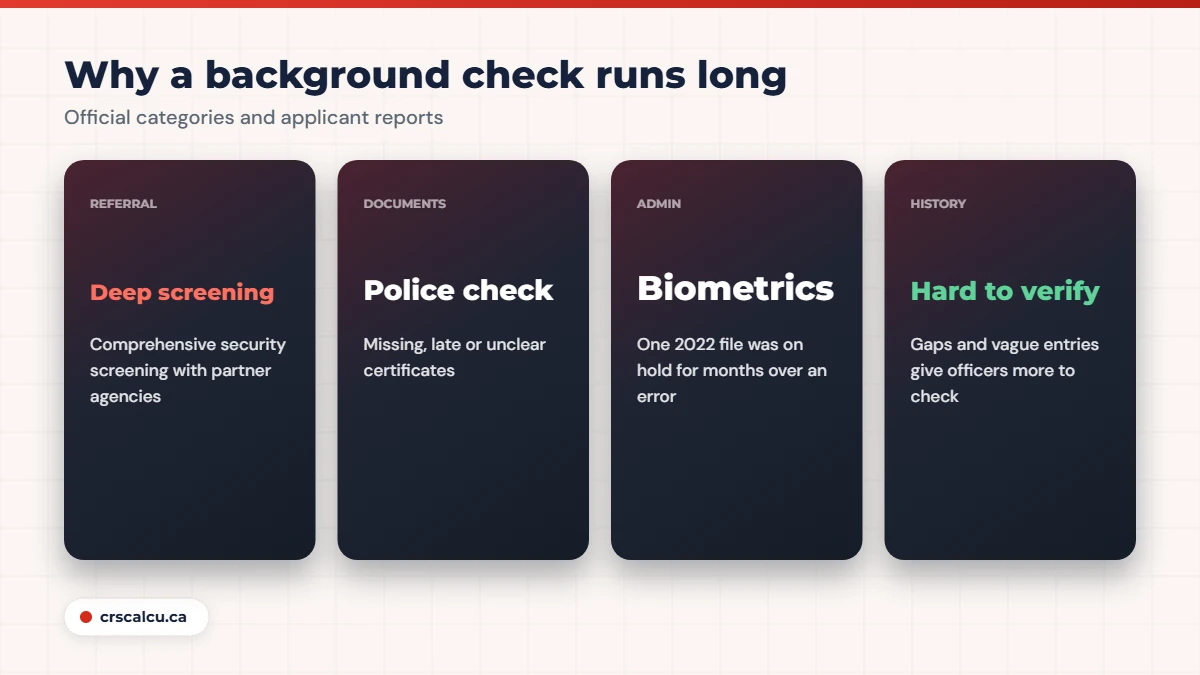
Five reasons a background check runs long
IRCC does not publish a list of causes for a slow background check. This list combines what the official sources say is checked with what applicants found in their own files, and we mark which is which.
Five reasons, and where each comes from
Real case: five months on hold over biometrics, visible only in the notes (October 2022)
An applicant with a provincial nomination had the medical review completed in January 2022 and biometrics in February. By October the background check was still pending, despite a clean police certificate from the United States. They ordered their file notes and found that the file had been placed on hold in May because of a biometrics error. The online account had shown nothing about it. Later posts in the same thread, from 2024, described similar long waits, some involving military service that needed extra documents.
This case is the best argument for ordering your notes once a file is well past the normal time. The delay was not a security matter at all. It was an administrative problem that nobody had told the applicant about.
Comprehensive security screening: what applicants reported
This is the stage people fear, and the official sources give no figures for it. The following comes from applicants only.
Real case: one agency finished, the other still “in progress” (April 2018)
An applicant who had been in security screening since October 2017 used access requests to ask two agencies where things stood. The security service indicated its part was complete. The border agency said the file was still in progress. Others in the thread were in the same position. Over time several posted how it ended: one counted 12.5 months of security screening and 17.5 months in total before permanent residence, an applicant inside Canada counted 11 months for the two agencies combined, and another 11.5 months. Members also noted that the border agency often extended its 30-day response time for access requests by 60 days.
Real case: “expect about one year” (March 2024 to April 2025)
A thread asked for success stories from people in comprehensive security screening. One applicant gave their dates: submitted in mid-October 2023, background verification started two weeks later, still in progress in April 2024. Experienced members advised asking for notes from all three bodies and told them to expect about a year. Another person reported being three months into screening in November 2024. No completed case had been posted by the time the thread went quiet in April 2025.
Two cautions about these numbers. They come from people who chose to post, which skews toward long waits. And they span different years. Treat “about a year” as what some applicants experienced, not as a standard.
Real case: “security: not started” in the notes did not mean screening (January 2019)
An applicant read their file notes and saw eligibility, criminality and medical marked as passed, with security showing “not started” and a security entry dated a few months earlier. They asked whether that meant they were in security screening. An experienced member told them to look at the activity section of the notes instead. It listed criminality, a police screening step and selection results, with nothing security-specific, and the member concluded the applicant was probably not in comprehensive screening at all.
So even with the notes in hand, the labels can mislead. “Not started” beside security can simply mean that step was never needed.
What you can and cannot do
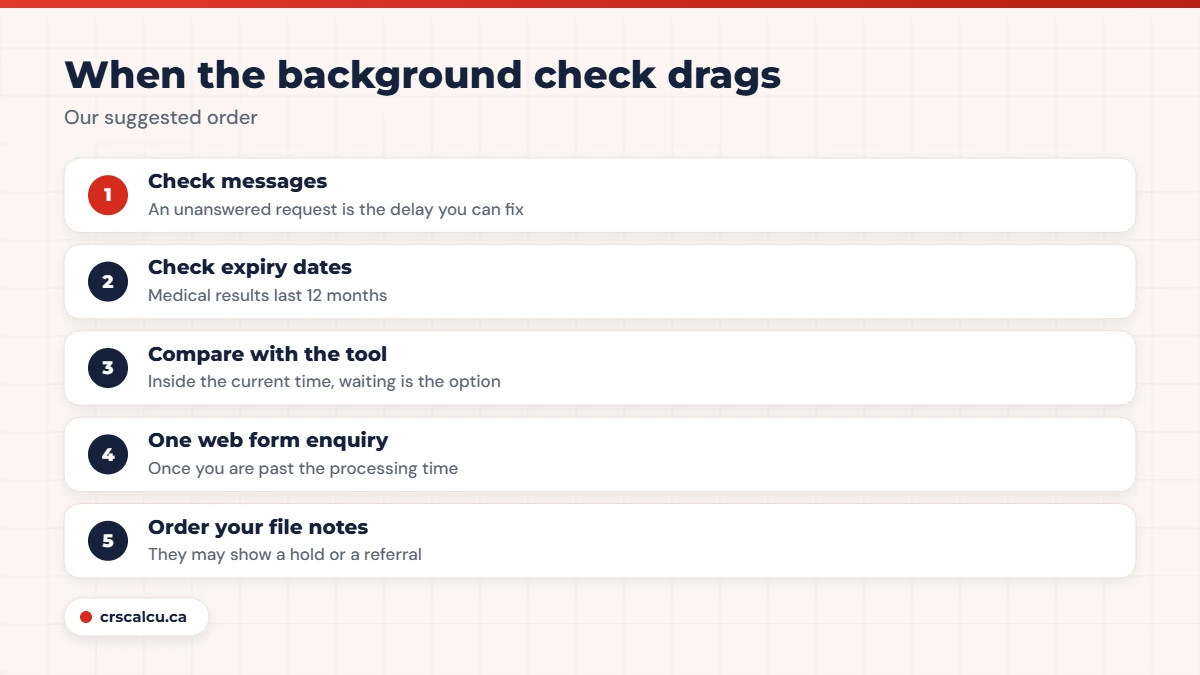
Nothing an applicant does makes the screening itself faster. What you can do is make sure the delay is not something else, and keep your own file from creating a new one.
Our suggested order when the background check drags
Front-load the things officers verify
You cannot influence partner agencies, but you can make the first layer quick. Give full addresses and no gaps in your history, list every trip, and send police certificates that meet the rules the first time. A file that is easy to verify gives an officer no reason to pause.
If IRCC writes to you about a concern, for example about information that does not match, read our post on misrepresentation in Express Entry before you reply. And if you are still in the pool, none of this has started yet: your next step is your score, which you can check with the CRS calculator against the latest draw cut-offs.
Frequently Asked Questions
How long does the background check in Express Entry take?
No official page gives a figure. For most applicants it finishes inside the overall processing time. Applicants who reported going through comprehensive security screening on public forums described waits of roughly 11 to 12.5 months for that stage.
What is checked in the background check?
An IRCC briefing note says every applicant is assessed by an officer, fingerprints are screened against domestic and international databases, biographic information is used to identify risks, and most permanent residence applicants must provide a police certificate. Some files go to comprehensive security screening.
Does “not started” mean something is wrong?
No. IRCC’s definition is that the review of that section has not begun. In a 2023 forum case an applicant was approved two months after applying, shortly after wondering about the order of their sections.
Who decides: IRCC or the security agencies?
IRCC. The security service’s own page says it provides advice and information and that IRCC determines who is granted permanent residence.
Can I speed up a background check?
We found no official way to do so. You can make sure nothing is waiting on you, keep documents from expiring, send one web form enquiry once you are past the current processing time, and order your file notes to see whether something specific is holding the file.
Will my file notes show if I am in security screening?
They can, but the labels are easy to misread. In a 2019 forum case, “security: not started” in the notes turned out not to mean comprehensive screening. Applicants also request notes from the border agency and the security service, which can take longer.
Still in the pool? The background check comes later
Screening only begins after an invitation and a complete application. See how your points compare with recent cut-offs.
Final Thoughts
The background check in Express Entry has two layers. Every applicant gets the first: fingerprints, police certificates and an officer’s review of the history they declared. A smaller number are referred to comprehensive security screening with partner agencies, and those are the files that wait. You cannot see which layer you are in from the account, and you cannot hurry either one.
If your file has been in the background check far beyond the current processing time, if you have served in a military or security role, or if IRCC has sent a letter raising an admissibility concern, speak to a licensed consultant or lawyer. They can help you request and read the notes from each agency and judge whether any legal step is appropriate.