Express Entry Guide · Updated October 2026
Biometrics for Express Entry: Who Gives Them, the Letter and the 30-Day Deadline (Real Cases)
You gave fingerprints for a study permit three years ago, and now IRCC wants them again. Here is what the official pages say about who gives biometrics, when the letter comes and how long you have.
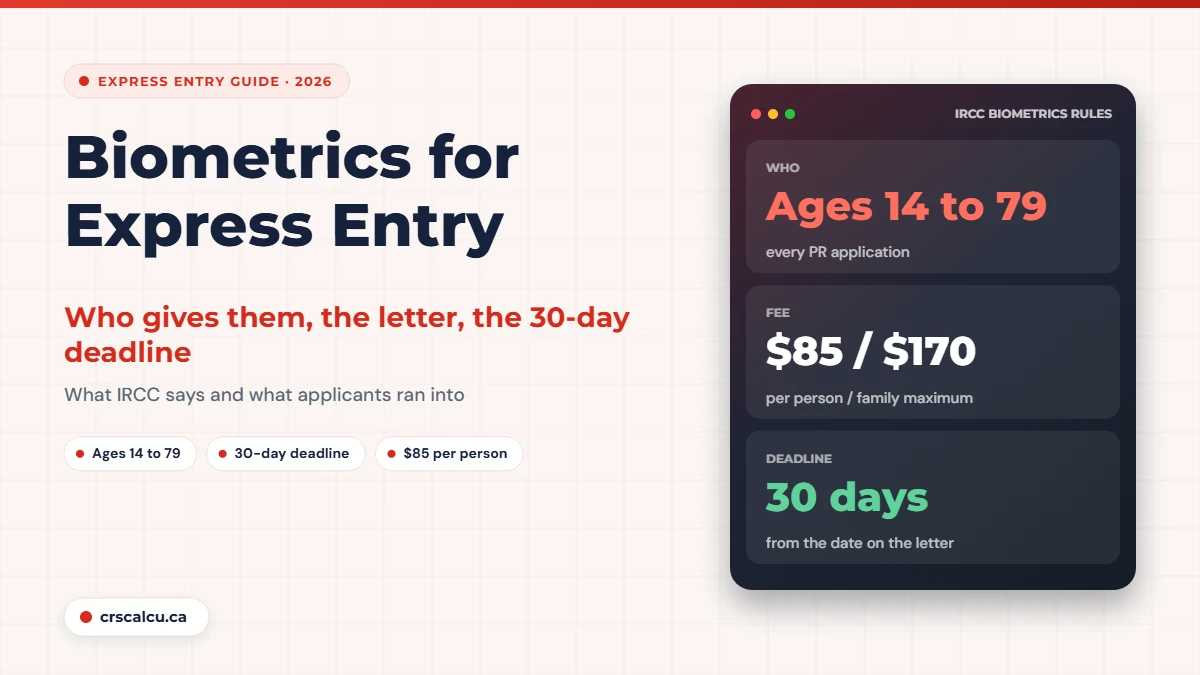
Biometrics for Express Entry sound like the easy part of the file: fingerprints, one photo, a short visit to a counter. The questions people actually ask are about everything around that visit. Do I have to go again if I already gave them for a work permit? Where is my letter? What if the only appointment is after my deadline?
IRCC’s answers are spread over several pages, and one notice still describes a pandemic-era policy that an Express Entry page later said was revoked. That is why forum advice is so mixed. Some of it was true in 2021 and is wrong now.
We read the IRCC biometrics pages and the Express Entry pages as they stood on October 5, 2026, and went through public forum threads from 2019 to 2026 about missing letters, unexpected fees and appointments nobody could get. This guide puts the two side by side and says where the official pages go quiet.
Quick answer: do you have to give biometrics again for Express Entry?
Yes, in almost every case. IRCC says that if you are between 14 and 79 years old you give fingerprints and a photo for every permanent residence application you submit, even if you already gave them for a visitor visa, study permit or work permit. You pay the biometric fee with the application, wait for the biometric instruction letter, and then have 30 days from the date on the letter. Biometrics do not change your points, so you can still calculate your CRS score while you wait.
Key takeaways
The 7 official rules on biometrics for Express Entry
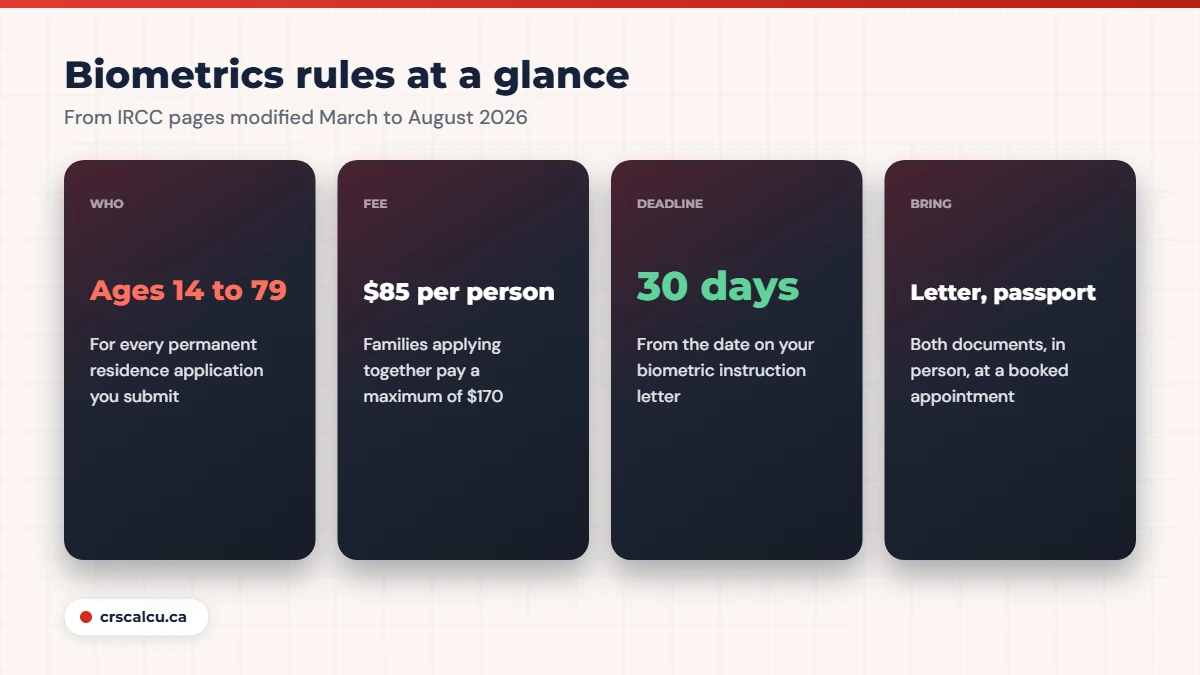
Everything IRCC says about biometrics for Express Entry fits into seven rules. We took them from the “Express Entry: After you apply” page (modified August 4, 2026) and from the main biometrics pages, modified between March 30 and August 24, 2026.
Rule | What IRCC says | Where it is written |
|---|---|---|
1. Who | Applicants between 14 and 79 years old, for every permanent residence application | Express Entry: After you apply |
2. Old biometrics | Give them every time you apply for permanent residence, even if you have already given them | When to give: permanent resident applicants |
3. Fee | $85 per person; $170 maximum for families applying together; pay when you submit | Express Entry: After you apply |
4. Letter | If your application is complete, IRCC sends a letter confirming you need to give biometrics | Express Entry: After you apply |
5. Deadline | 30 days from the date on the letter | Express Entry: After you apply |
6. In person | By appointment, with the letter and a valid passport | How to give your biometrics |
7. Late | Use the web form to say why you need more time | Where to give your biometrics |
Our summary of the IRCC pages listed under Sources, read on October 5, 2026. The middle column follows the official wording closely.
Who has to give biometrics, and who is exempt
The Express Entry page puts it in one sentence: if you are between 14 and 79 years old, you need to give your fingerprints and photo for every permanent residence application you submit. An earlier copy of the Express Entry fees page, which we come back to below, applies the same age range to the accompanying dependents listed in your application.
The “Who needs to give” page (modified July 9, 2026) lists the exemptions. Two matter for a family in Express Entry: a child under the age of 14, and an applicant over the age of 79. The page says age is assessed on the date you submitted your application, so someone who was 79 on submission day still has to go, even after a birthday.
Biometrics already given for a visa or permit: do they count?
For temporary residence, the general “When to give” page (modified March 30, 2026) says applicants need to give biometrics only once every 10 years. That is where the “valid for 10 years” idea comes from, and it holds for visitor visas, study permits and work permits.
For permanent residence, the same page says most applicants must give their biometrics every time they apply. The permanent residence version is blunter: you must give your biometrics every time you apply for permanent residence, even if you have already given them. If you came through one of the TR to PR pathways or are applying under the Canadian Experience Class, the fingerprints on file from your study or work permit do not replace a new visit.
The temporary policy that used to allow reuse
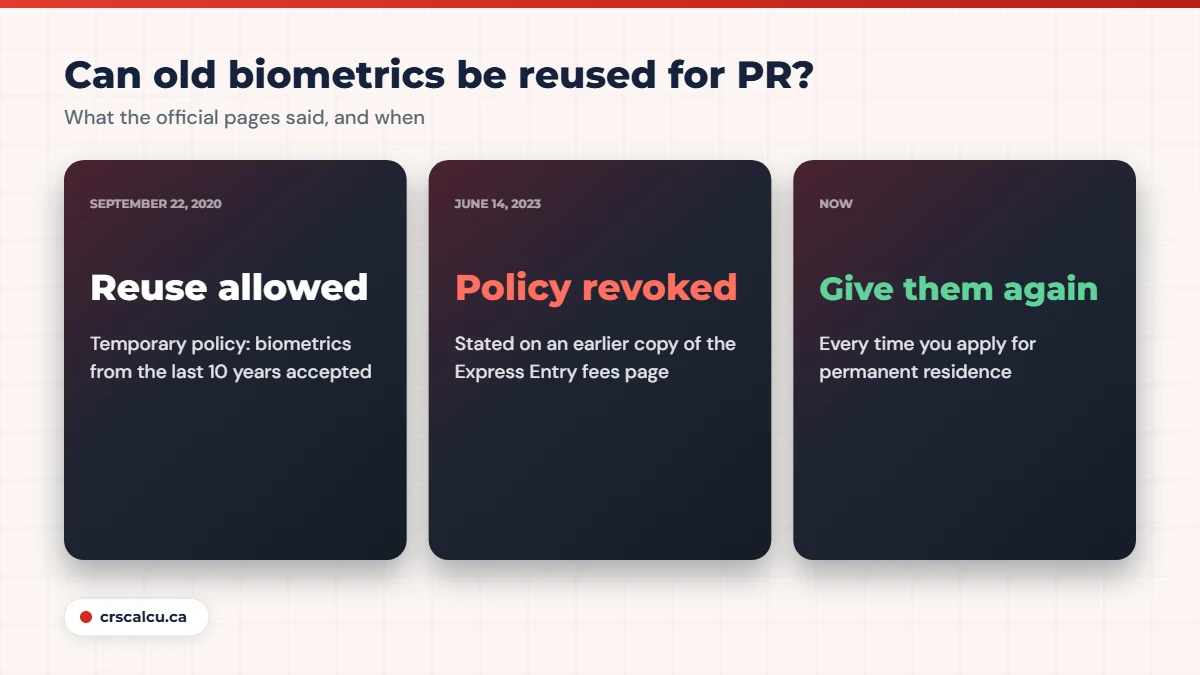
For a while the answer was different. A notice dated September 22, 2020 (modified February 9, 2023) announced a temporary public policy: permanent residence applicants who had given biometrics for an immigration application within the last 10 years were exempt from giving them again, until further notice, and were told not to pay the $85 fee.
That notice is still online and, when we fetched it, carried no banner saying it had ended. But an earlier copy of the Express Entry “Pay your fees” page, modified February 3, 2025, states that on June 14, 2023 the temporary public policy was revoked, and that people who applied on or after that date must pay the biometric fee for every permanent residence application, even if they gave biometrics in the past and those are still valid. The current fees page (modified June 22, 2026) no longer mentions the date.
So a friend who was approved in 2021 or 2022 without a new appointment is probably right about their own file. It does not apply to one submitted today.
Real case: paid the fee anyway and got it back (January 2022)
A person preparing a spousal sponsorship application (permanent residence, but not Express Entry) found two official tools disagreeing. The spouse had already given biometrics for a visitor visa. The guide said to pay and give them again; an online tool said no payment was needed. A member suggested paying up front to avoid a delay. In December 2022 the poster reported that they had paid and that a refund arrived during processing. The temporary policy was still in force then.
The biometric instruction letter: when it arrives
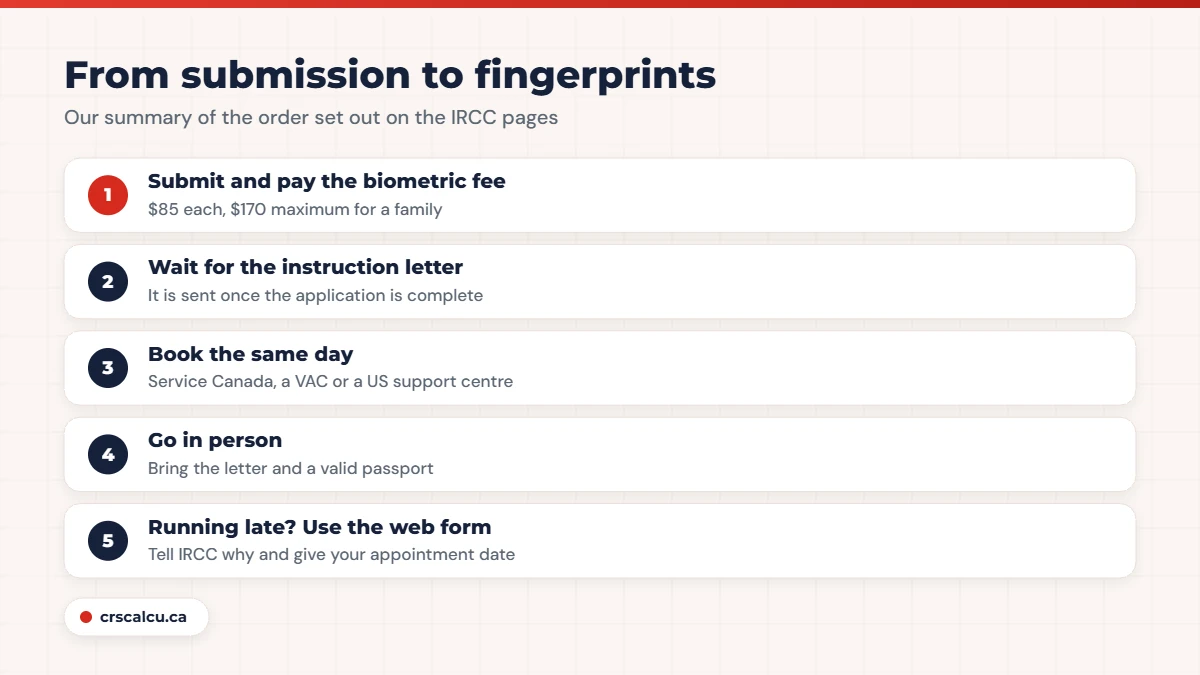
The “How to give” page (modified March 30, 2026) says that after you pay the biometric fee you get a biometric instruction letter, often shortened to BIL. It confirms that you need to give biometrics and tells you how to book.
The Express Entry page ties the letter to a complete application and gives no number of days after your acknowledgement of receipt (AOR). The only timing we found is on an older IRCC page about giving biometrics (modified January 18, 2024). For an online permanent residence application with the fee paid, it says the letter arrives in your account message box “within several days or several weeks”. If you pay the fee after applying, it says several weeks.
Real case: about a month after AOR, still no letter (February 2026)
An Express Entry applicant had the AOR but no biometric instruction letter roughly a month later. Their history included an earlier refusal on a temporary application and more than one client ID. One reply said a month was still normal and suggested waiting about eight weeks before another enquiry. Others said they had waited more than 110 days. In late March 2026 the poster reported that the letter had arrived and biometrics were done on March 2.
Real case: more than 70 days of waiting (January 2024)
Another Express Entry applicant posted after more than 70 days with no letter. A second applicant, whose AOR was dated mid-November, was in the same spot and had been told the completeness check was still in progress. A long-time member said letters were slow at the time and that waits of three to four months had been seen. No final outcome was reported in the thread.
While you wait for the letter
The biometric fee: $85 per person, $170 for a family
The Express Entry page lists $85 for an individual applicant and a maximum of $170 for families applying together. The “How to give” page defines a family as two or more members applying at the same time. Both say to pay when you submit, or you may have delays.
Our example: a couple applying with a 15-year-old and a 9-year-old. Three people are between 14 and 79. Three times $85 would be $255, but the family maximum caps it at $170.
The biometric fee is separate from the processing fee and from the right of permanent residence fee. We add them all up in our guide to Express Entry fees.
Where to give your biometrics, inside and outside Canada
The “Where to give” page (modified August 24, 2026) names three kinds of collection point. For biometrics for Express Entry, which one you use depends on where you are when the letter arrives.
Where you are | Collection point | What the page says |
|---|---|---|
In Canada | Designated Service Canada office | Book with the online tool; do not go without a scheduled appointment |
Outside Canada and the US | Visa application centre (VAC) | Make an appointment; if your country has no VAC, go to any other VAC |
In the United States | Application support centre (ASC) or a VAC | You must be legally in the US |
Our summary of “Where to give your biometrics” (modified August 24, 2026).
Appointments are free, and IRCC says not to pay anyone for one. And you cannot give biometrics at the border if you have already submitted an application and received a letter.
Appointment day, in order
That counter photo is separate from the digital photo for Express Entry you upload with your forms.
If you miss the 30 days or cannot get a biometrics appointment
The Express Entry page gives you 30 days from the date on the letter. The “Where to give” page says 30 days from the time you get it. Count from the date printed on the letter, the stricter reading.
If you cannot do it in time, the “Where to give” page is direct: use the web form to tell IRCC why you need more time, with details. Its own example is the common one. If you could not get an appointment by the deadline, tell them the date of the one you did get.
None of the pages we read says what happens if you miss the 30 days and say nothing, so we will not guess. Treat the deadline as real and put your reason in writing before it passes.
Real case: one collection office, eight hours away (May 2024)
An applicant in a family sponsorship file processed outside Canada (not Express Entry) received the letter with its 30-day deadline. The only collection office in their country was more than eight hours from home, and their planned trip fell two weeks after the deadline. Replies suggested booking anyway, sending a web form naming the booking date, and attending even if no answer came first. Later posters described being a few days late. Nobody in the thread reported an application cancelled over a short delay.
Things that turn a small delay into a real one
After the appointment: when your account does not update
You leave the centre and your account still shows the biometrics step as outstanding. The official pages we read do not say how long that update takes. We would ask IRCC by web form before making a second visit like the one below.
Real case: status still said fingerprints not received (May 2019)
An Express Entry applicant gave biometrics at a US centre on April 18, 2019. Nearly three weeks later the account still showed the fingerprints as not received, so they went a second time on May 7. Other members had seen the same lag, said the update could take about a month, and suggested a web form enquiry. The poster reported that the status changed about a week after the second visit.
Two other requirements have their own guides: the medical exam for Express Entry and the police certificate for Express Entry. None of them touch your ranking. If you are still in the pool, the number to watch is the cut-off in the latest Express Entry draws.
Frequently Asked Questions
Do I need to give biometrics for Express Entry if I gave them for a study or work permit?
Yes. IRCC’s page for permanent resident applicants says you must give your biometrics every time you apply for permanent residence, even if you have already given them. An earlier copy of the Express Entry fees page states that the temporary policy allowing reuse was revoked on June 14, 2023.
Are my biometrics not valid for 10 years?
The 10-year rule is for temporary residence. IRCC says temporary residence applicants give biometrics only once every 10 years, while most permanent residence applicants must give them every time they apply.
How long after AOR does the biometric instruction letter come?
IRCC does not publish a fixed number of days. An older IRCC page (modified January 18, 2024) says “within several days or several weeks” for an online permanent residence application with the fee paid. In forum threads we read, waits ranged from about a month to more than 110 days.
How much is the biometric fee for a family?
$85 per person, with a maximum of $170 for a family applying together, according to the Express Entry “After you apply” page (modified August 4, 2026).
What if I cannot get a biometrics appointment within 30 days?
Book the earliest date you can, then use the IRCC web form to explain why you need more time and give the appointment date. That is the instruction on the “Where to give your biometrics” page.
What do I bring to give my biometrics?
Two documents: your biometric instruction letter and your valid passport. That is the list on IRCC’s “How to give your biometrics” page.
Biometrics booked? Check where your score stands
Fingerprints and a photo do not add or remove a single point. Run your profile through the calculator and compare it with the most recent cut-offs.
Final Thoughts
Biometrics for Express Entry come down to a short list: pay the fee with the application, watch your account for the letter, book the same day, bring the letter and your passport, and write to IRCC before the 30 days run out if you are going to be late. What trips people up is old advice about reusing biometrics.
If your letter has not arrived after several months, if your file includes a past refusal or more than one client ID, or if you have already missed a deadline, speak to a licensed consultant or lawyer instead of relying on forum timelines.