Express Entry Guide · Updated October 2026
Job Change After ITA: Does a New Employer Hurt Your Express Entry Application? (Real Cases)
A better offer rarely waits for your permanent residence file. Here is when a new job is harmless, when it is not, and how people reported it.
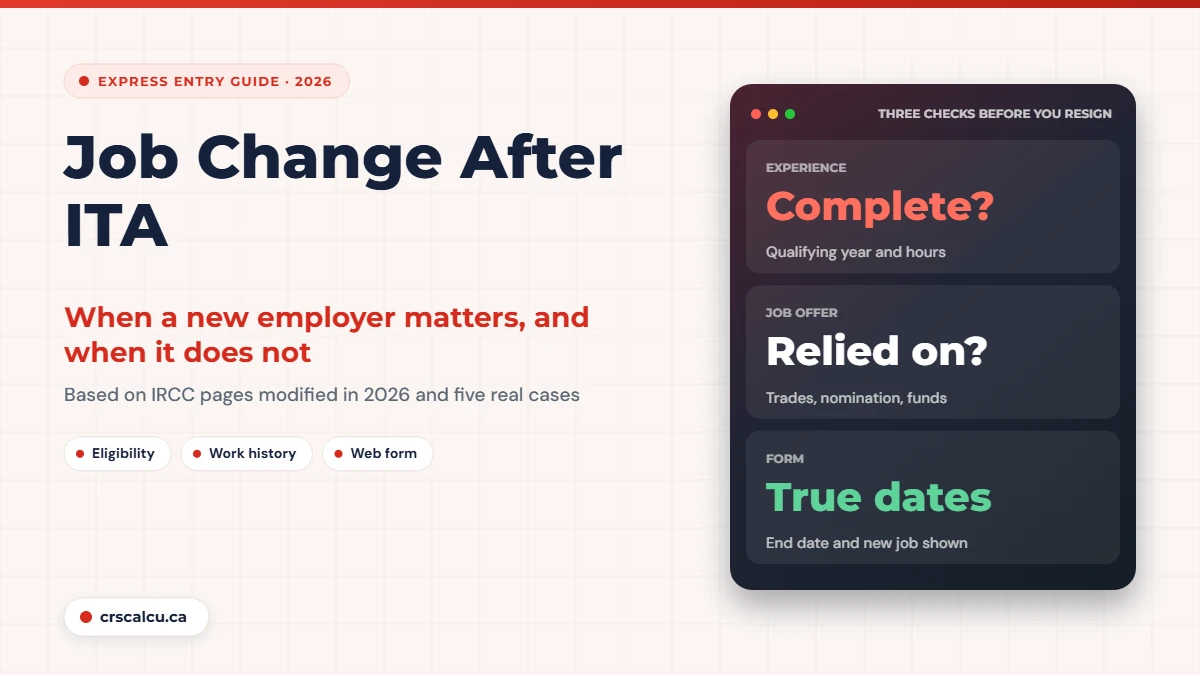
A job change after ITA worries people more than almost any other mid-process event, mostly because the invitation feels tied to the job that earned it. In most cases it is not. The points you were invited on came from experience you had already built, and a new employer does not erase it.
New rules, November 3, 2026: From November 3, 2026, job offers in high-wage occupations earn CRS points again, and an officer checks that every offer is genuine. IRCC pauses rounds for up to two weeks while it recalculates profiles. Check your score under the new rules · IRCC details
There are exceptions, and they matter: programs and nominations that depend on a specific job offer, a settlement funds exemption that depends on one, and an application form that has to be true on the day you submit it. The forum threads we read are full of people who did nothing wrong by switching jobs and then created a problem by not writing it down.
We read IRCC’s pages on responding to an invitation, applying, updating an application and job offers, plus the CRS criteria (all modified in 2026), and five public forum threads from 2017 to 2020. This is general information, not legal advice.
Quick answer: can you change jobs after an ITA?
Yes, nothing on the IRCC pages we read forbids it. What matters is whether the change touches your eligibility or your score. Past skilled work that already met the program rules still counts after you leave. A job offer you rely on for the Federal Skilled Trades Program, a provincial nomination or the settlement funds exemption is different: lose it and the basis of your application can change. Either way, your work history must be accurate when you submit, and IRCC’s update page says to report changes after you apply. Re-check your number in our CRS calculator first.
Key takeaways
Job change after ITA: what IRCC’s pages say
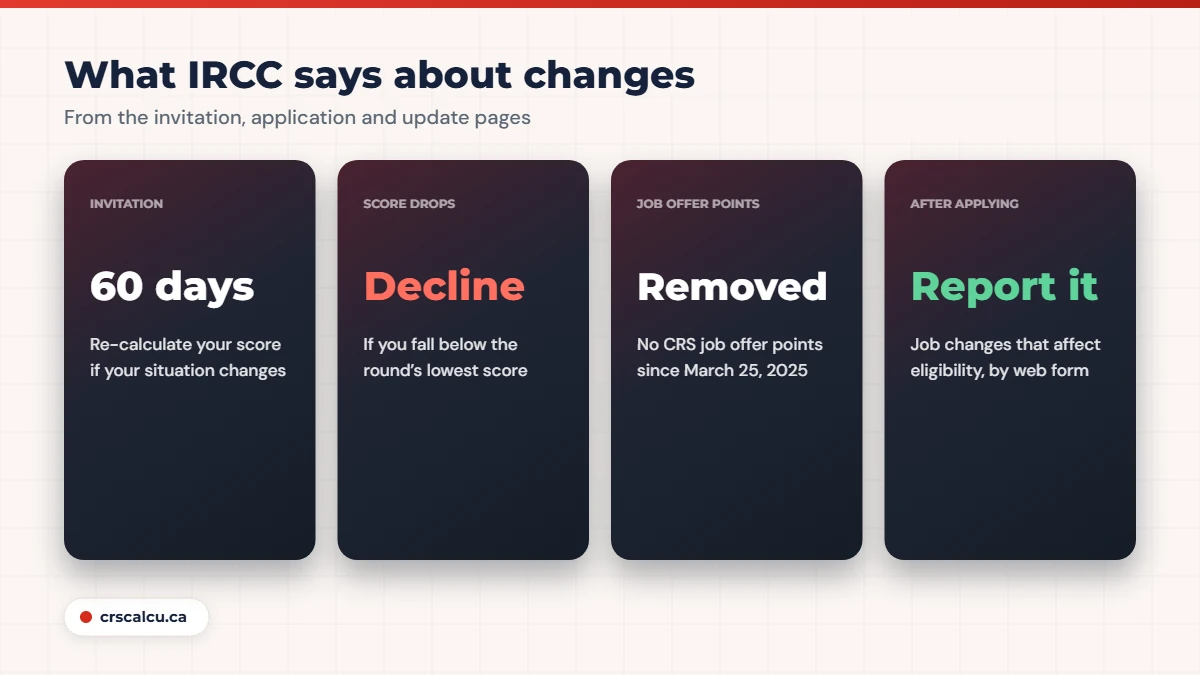
Three official pages cover the ground. The respond-to-invitation page (modified June 22, 2026) says an invitation is valid for 60 days only, that you should re-calculate your score if your situation changes, and that if the new score is below the lowest score invited in your round you should decline. The page on applying for permanent residence (modified June 22, 2026) warns that some changes can lower your score and lead to a refusal with no refund; its examples are an expired job offer, a lost provincial nomination and expired language results. And the Update your application page (modified September 3, 2026) says that once you have applied you must tell IRCC about changes to your job, education or language results that affect your eligibility.
None of those pages says “do not change jobs”. They say: check whether the change matters, and keep IRCC’s picture of you accurate.
Does a job change after ITA affect points or eligibility?
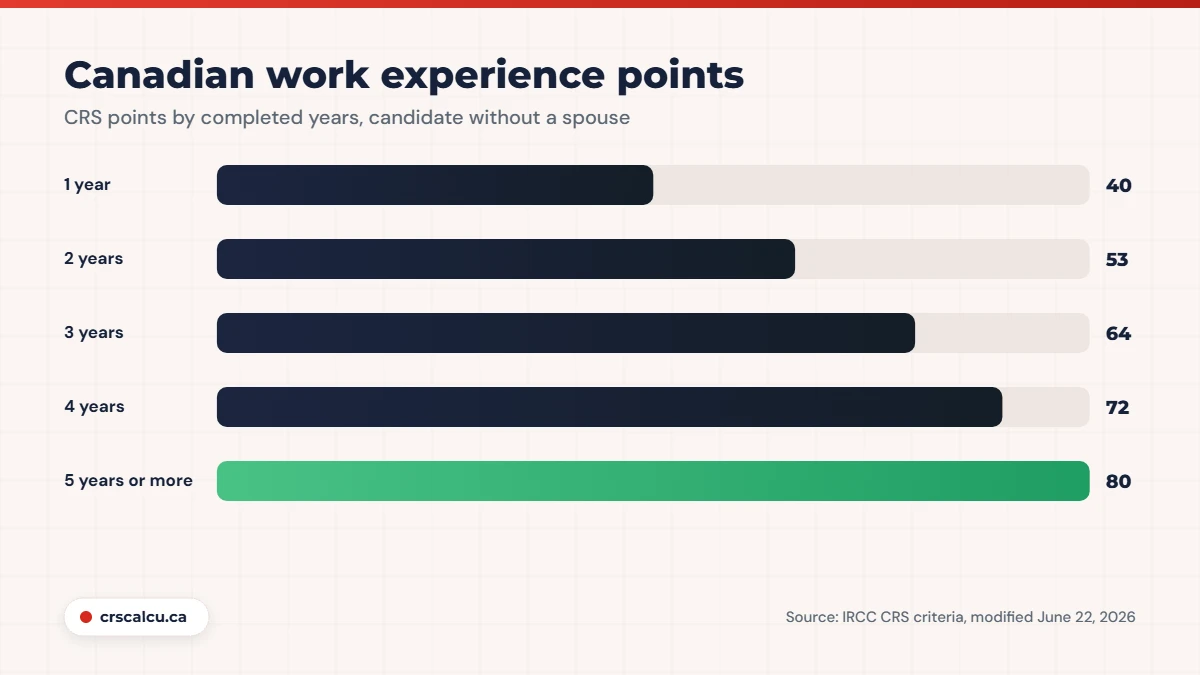
It depends on what your application is built on. Start with the points. IRCC’s job offer page says that, as of November 3, 2026, you don’t need an LMIA for a job offer to qualify, that an LMIA gives no extra CRS points or priority, and that offers may be for an existing or a new position and with any employer. So leaving an employer costs you CRS points only if your score includes points for that employer’s offer in a high-wage occupation. Canadian work experience points are counted in completed years, and years you have already worked stay worked.
Eligibility is where the programs differ.
Route | What eligibility rests on | Effect of changing employer |
|---|---|---|
Canadian Experience Class | 1 year of skilled work in Canada in the last 3 years; no job offer needed | Usually none, if the year is already complete |
Federal Skilled Worker | 1 year of continuous skilled work in the last 10 years, plus 67 grid points | Usually none on experience; check arranged employment and funds |
Federal Skilled Trades | 2 years in the trade in the last 5, plus a job offer or certificate of qualification | Can remove the basis if you relied on the offer |
Provincial nomination | The province’s own conditions | Ask the province before you move |
Our summary of IRCC’s eligibility page and job offer page (both modified June 22, 2026). The third column is our reading, not IRCC text.
Two details hide in the Federal Skilled Worker row. The selection grid gives 10 points for arranged employment, and some applicants need those to reach 67; test yours in the FSW points calculator. And IRCC’s Federal Skilled Worker page says you must show settlement funds unless you are authorized to work in Canada and have a valid job offer. If you were counting on that exemption and the job goes, the funds requirement comes back. Our proof of funds post has the current table.
For the trades, the Federal Skilled Trades Program guide and our post on the certificate of qualification explain the two ways to qualify. If your route is the offer, treat a job change as a question for a professional before you resign.
Real case: 474 points and a better offer (October 2019)
A candidate with 474 points had worked for more than two years as a food service supervisor and expected to accept a management job elsewhere soon after being invited. They asked whether quitting would cause trouble, how to tell IRCC, and whether an offer letter could stand in for experience. Experienced replies said the reference letter for the old job is dated and stays valid after you leave, that a change before submitting should be shown by adding an end date to the old job and listing the new one in the personal history, and that the new job needs no documents if no points are claimed for it. One reply went further and called anything after the acknowledgment of receipt irrelevant. No outcome was reported by the original poster.
That last remark is a forum opinion and it is stronger than what IRCC’s update page says. We would not rely on it.
Changing jobs before you submit: get the form right
Between the invitation and the day you press submit, the profile turns into an application, and you sign off on every line of it. If you leave a job in that window, the form has to show it. IRCC’s Help Centre says to include your work experience for the last 10 years, and its create-profile page warns that false information or missing details can lead to refusal, a finding of inadmissibility and a five-year bar.
Real case: “until present” on a job already left (September 2020)
An applicant changed jobs two weeks before submitting. The earlier job had lasted 54 weeks, enough for the experience they needed. Their representative left that job’s end date as “present” and did not add the new one. Replies treated this as a real omission: applicants must disclose changes in circumstances, the new job should at least have appeared in the personal history, and the applicant answers for the form even when someone else fills it in. The advice was to speak to the representative first, get written confirmation that they had known about the change, and send IRCC a web form correcting the record. The poster thanked the group; no outcome was reported.
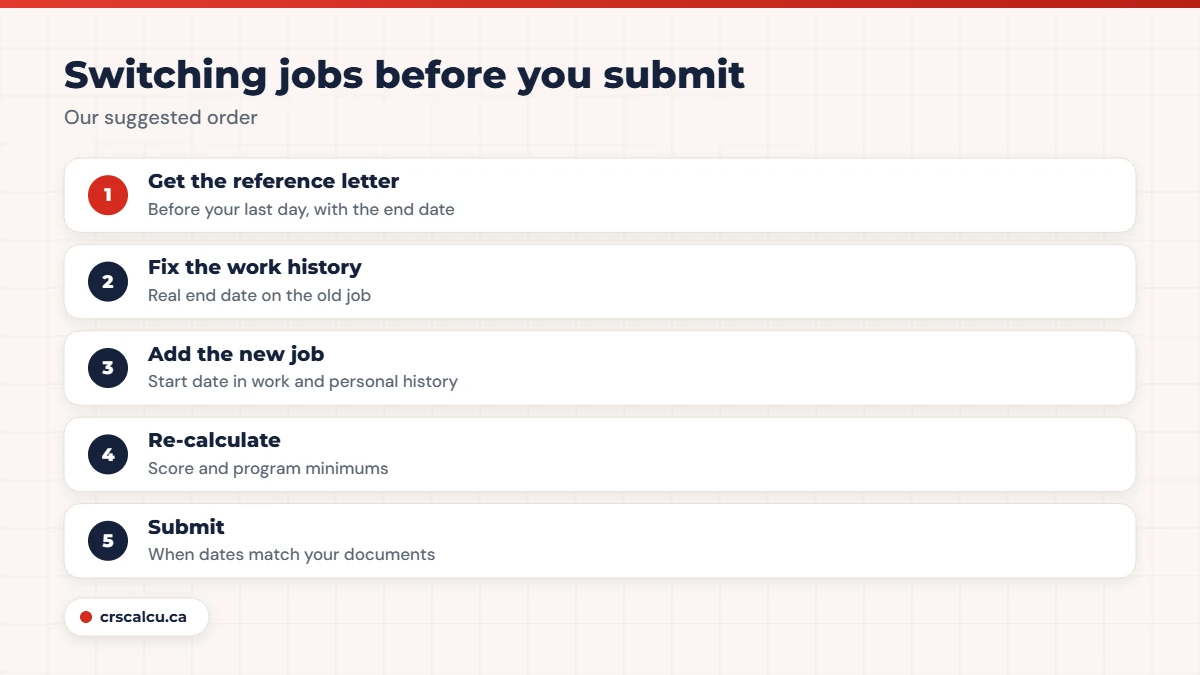
If you switch before submitting (our suggested order)
The first step is the one people regret skipping. A former employer has less reason to help you. Our post on the reference letter for Express Entry lists what the letter has to contain.
The 12-month trap
The September 2020 applicant had 54 weeks in the old job. That margin mattered. If your qualifying year is not complete when you leave, a job change can break it: the Federal Skilled Worker Program wants one continuous year, and all three programs count hours. Our post on 1,560 hours shows how to check. Do the count before you hand in notice, not after.
After you apply: do you have to tell IRCC?
IRCC’s Update your application page says you must report changes to your job, education or language results that affect your eligibility, and it sends you to the web form with proof. Read strictly, that covers job changes that touch eligibility. It does not say every change of employer must be reported, and it does not say they need not be.
The forum practice we saw is to report anyway, briefly, because it costs little and removes doubt.
Real case: reported by web form, no delay (November 2017 to May 2019)
A Federal Skilled Worker applicant about to submit expected to change jobs soon after and feared the old employer would not cooperate if IRCC came back with questions. Replies said a change after the acknowledgment of receipt is fine as long as the claimed experience is already complete. In May 2019 an applicant who had been through it described what they sent: a letter from the old employer’s human resources team confirming the role and last day, and the offer letter from the new employer, both by web form. IRCC acknowledged the update within days. Asked later whether IRCC wanted a reference letter from the new company or whether processing slowed down, the answer to both was no.
Real case: a new offer in the middle of processing (October 2019)
An applicant whose file was in process, with a letter from the current employer on it, received an offer from another company. Replies thought the change would probably not matter, and one member who had switched jobs said the key was that the job used for points had already lasted the required time; they had sent their documents by web form. The general view was that telling IRCC is not strictly required when points do not change, but is the tidier choice. No outcome was reported.
What people sent with a job-change web form (forum practice, not an IRCC list)
Promotions and new titles at the same employer
Not every change is a new company. A promotion can move you to different duties, and duties are what decide your occupation code.
Real case: promoted ten months ago (October 2018)
Someone with two and a half years at one company had been promoted ten months earlier and did not know whether to enter one job or two. The main reply said that with the same company and location, one entry under the current title covering the whole period was enough, provided the reference letter set out both roles with their duties and dates. It added a condition: if the two roles fall under different occupation codes, at least one needs 12 months or more, while the same code causes no issue. The poster accepted this. Later readers kept asking how to apply it, and no approval was reported.
The condition in that reply is the part to keep. If the promotion changed your code, check both in the NOC and TEER finder and read our post on a wrong NOC code. IRCC’s Federal Skilled Worker page says the qualifying experience has to be in the same occupation as your primary one.
Five mistakes people make with a job change after ITA
Avoid these
What IRCC does not say
We did not find an IRCC page that says whether a change of employer with no effect on eligibility must be reported, or how long a job-change update takes to be noted on a file. We also found nothing that makes a job change by itself a ground for refusal. Compare your score with the latest draw cut-offs if you think the change could move it.
Frequently Asked Questions
Is a job change after ITA allowed?
Nothing on the IRCC pages we read prohibits it. IRCC says to re-calculate your score if your situation changes and to keep your application accurate. Whether it matters depends on your program and on what the old job was supporting.
Will I lose CRS points if I change employer?
Only if your score includes points for a job offer in a high-wage occupation from the employer you leave (as of November 3, 2026). Canadian work experience points are based on completed years, which you keep. Re-calculate to be sure nothing else changed.
Do I need a reference letter from my new employer?
In the cases we read, applicants who were not claiming points for the new job sent only an offer letter or contract when they reported the change, and one said IRCC never asked for more. IRCC does not publish a rule on this.
Do I have to tell IRCC after I apply?
IRCC’s Update your application page says you must report job changes that affect your eligibility. For other job changes it is silent. Applicants in the threads we read generally sent a short web form anyway.
What if my provincial nomination is tied to my employer?
Ask the province before you move. IRCC’s application page lists a lost provincial nomination as a change that can lower your score and lead to refusal with no refund.
Does a promotion count as a job change?
It can, if the duties move you to a different occupation code. One forum reply suggested a single work history entry for the same employer with a reference letter covering both roles. Check both codes before you rely on that.
Re-check your score before you resign
Run your numbers with the new dates and see whether anything moves.
Final Thoughts
For most candidates a job change after ITA is a paperwork matter, not a threat: finish the qualifying experience, collect the letter, put true dates on the form and report what IRCC asks you to report. The risky cases are the ones where the job itself was holding something up.
If your eligibility depends on a job offer or a nomination, or if you have already submitted a form that no longer matches reality, speak to a licensed immigration consultant or an immigration lawyer before you do anything else.