Express Entry Guide · Updated October 2026
Express Entry From Outside Canada: Requirements, Score Ceiling and Landing (Real Cases)
No Canadian job, no Canadian degree, never set foot in the country. You can still apply. Here is what it takes and how high the score can go.
You can enter Express Entry from outside Canada without ever having worked or studied there. The Federal Skilled Worker Program exists for exactly that. What catches people out is not eligibility. It is the gap between being eligible and being competitive, and the paperwork that only applies to applicants abroad.
An overseas candidate has to qualify on foreign experience alone, pass a 67-point grid, hold settlement funds, and then compete on a CRS table that gives its richest rewards to Canadian work. It can be done, and the arithmetic below shows how far a strong profile gets. It also shows why so many overseas candidates end up studying French.
We read IRCC’s program, funds, CRS and approval pages (all modified in 2026) and four public forum threads from 2023 and 2024. Figures marked “our arithmetic” are ours. This is general information, not legal advice.
Quick answer: can you apply for Express Entry from outside Canada?
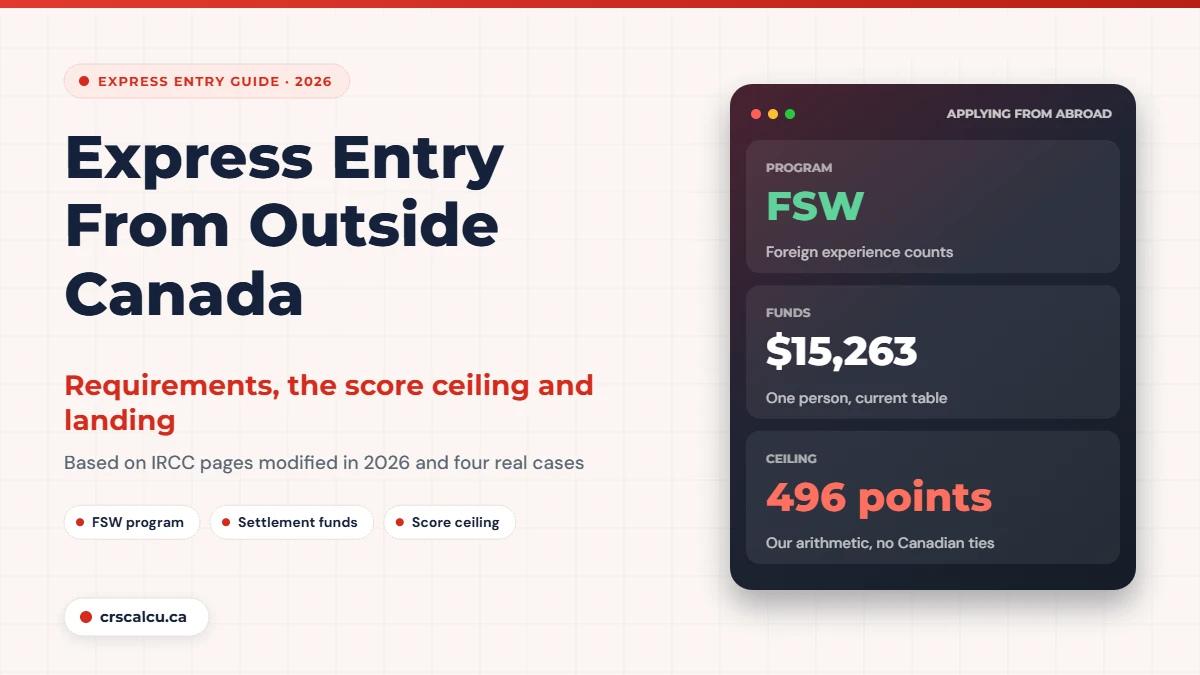
Yes. The Federal Skilled Worker Program accepts one continuous year of skilled work done anywhere in the last ten years, with CLB 7 in all four language abilities, at least secondary education, 67 points on the selection grid and proof of settlement funds. You do not need a job offer or any Canadian experience. Our arithmetic puts the CRS ceiling for a single candidate with no Canadian ties and no French at 496 with a doctorate and 481 with a master’s degree. See where you land with our CRS calculator.
Key takeaways
Express Entry from outside Canada: which program takes you?
IRCC’s eligibility page (modified June 22, 2026) describes three programs. The Canadian Experience Class needs a year of skilled work in Canada. The Federal Skilled Trades Program needs two years in a trade and either a job offer or a certificate of qualification. The Federal Skilled Worker Program is the one built for foreign experience: one year of continuous skilled work in the last ten years, anywhere in the world.
There is one exception worth knowing. If you worked in Canada before and went home, the Help Centre says you can still be eligible for the Canadian Experience Class as long as 12 months of that work fall within the three years before the invitation. We compare the two programs in FSW vs CEC.
What you need before you create a profile
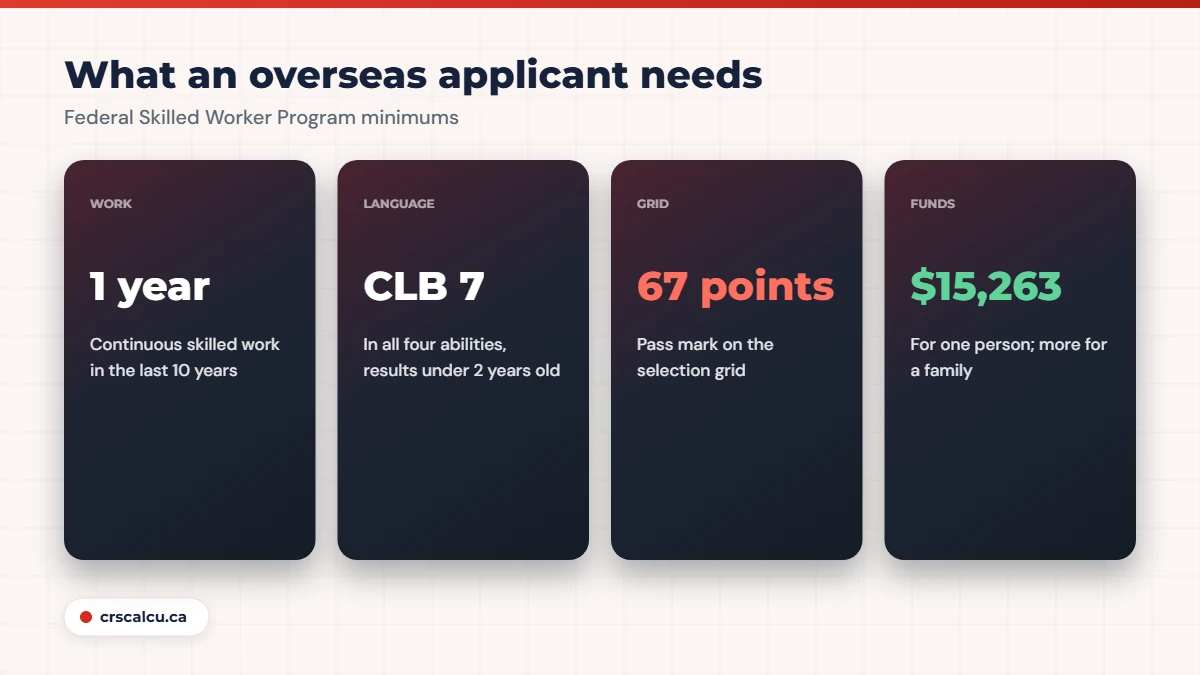
Requirement | What IRCC asks for | Where people slip |
|---|---|---|
Skilled work | 1 continuous year, or 1,560 hours, in the last 10 years, paid, in TEER 0 to 3 | Gaps in the year; duties that do not match the occupation |
Language | CLB 7 in all four abilities; results less than 2 years old | One ability a band short |
Education | Secondary at minimum; an assessment for foreign credentials, less than 5 years old | Assessment from a body IRCC has not designated |
Selection grid | 67 points out of 100 | Confusing it with the CRS score |
Settlement funds | By family size; $15,263 for one person | Borrowed money; counting only yourself |
Our summary of IRCC’s Federal Skilled Worker page (modified September 24, 2026), language and credential assessment pages and proof of funds page (all modified June 22, 2026). The third column is ours.
Three of those take time, so start them in parallel. The credential assessment has to come from one of the organizations IRCC has designated and be issued for immigration purposes; see online degree and ECA for a case where that went wrong. The language test has to be one IRCC approves. And the work experience has to be proven with employer letters; our post on the reference letter for Express Entry lists what they must say.
The 67 points are a pass mark for this program only. Language is worth up to 28, education 25, experience 15, age 12, arranged employment 10 and adaptability 10. Check yours in the FSW points calculator. Passing the grid gets you into the pool. It does not get you invited.
The score ceiling without Canadian experience
Invitations go by CRS rank, and the CRS criteria page (modified June 22, 2026) gives foreign work experience no core points at all. It counts only through two skill transferability pairs, with language and with Canadian work, and without Canadian work only the first is available.
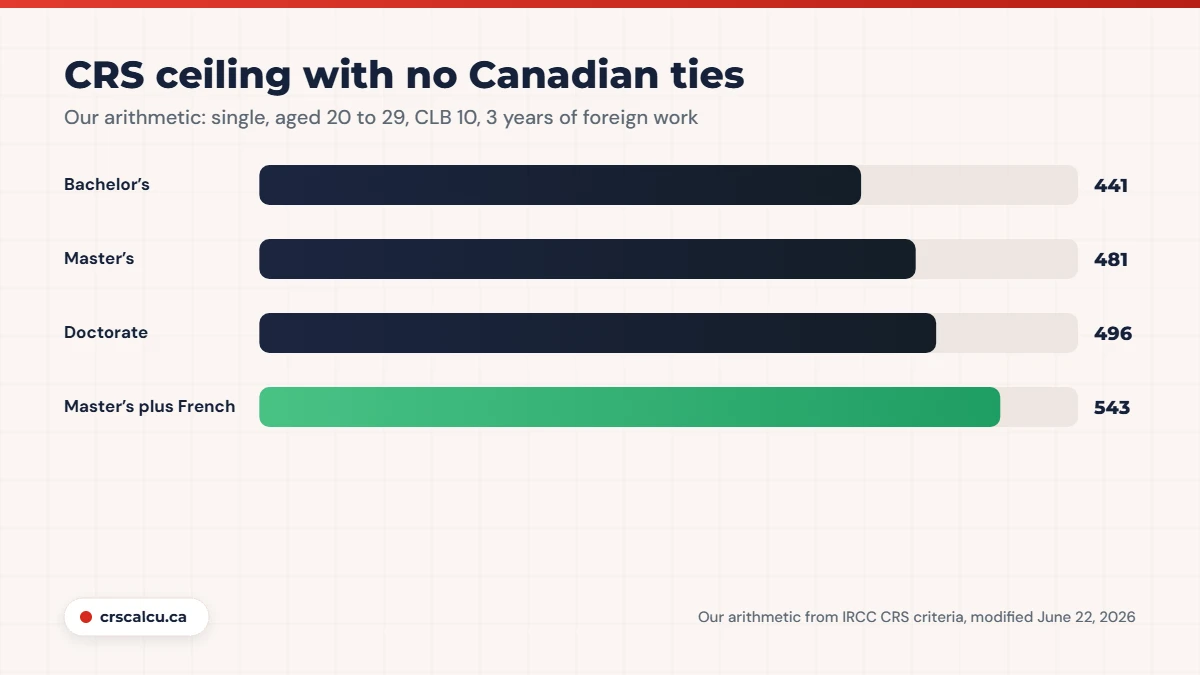
Line | Bachelor’s | Master’s | Doctorate |
|---|---|---|---|
Age | 110 | 110 | 110 |
Education | 120 | 135 | 150 |
First language (4 x 34) | 136 | 136 | 136 |
Education and language pair | 25 | 50 | 50 |
Foreign work and language pair | 50 | 50 | 50 |
Total | 441 | 481 | 496 |
Our arithmetic using IRCC’s CRS criteria page (modified June 22, 2026). No spouse, no Canadian work or study, no French, no sibling in Canada, no nomination.
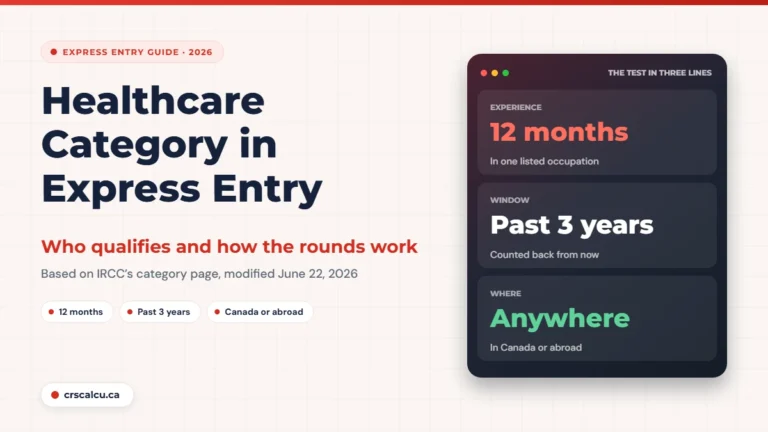
Those are best cases: the right age, top language results and three years of work. Drop to CLB 9 and each column loses 12. Turn 32 and each loses 16. That is the reality an overseas candidate plans around, and it is why the additional points matter so much. French at NCLC 7 in all four abilities adds 50, plus 12 as a second language, which takes the master’s column from 481 to 543. A sibling in Canada adds 15. A provincial nomination adds 600. Category-based rounds can also invite at lower scores for listed occupations; IRCC’s category page says the 12 months of work can have been gained in Canada or abroad. See category-based draws, improve CRS score and the latest draw cut-offs.
Foreign work means work done abroad
Where you were sitting when you did the work matters. The CRS criteria page defines Canadian work experience as working for a Canadian employer in Canada, and says remote work counts if you were physically in Canada. The reverse follows: a remote job for a Canadian company, done from your home country, is not Canadian experience.
Real case: remote foreign job while living in Canada (August 2023)
A Federal Skilled Worker applicant was refused. For 2022 and 2023 they had claimed foreign work experience from a full-time remote job with an employer abroad, while they were studying full-time in Canada and working part-time there. The officer was not satisfied that they had been outside Canada during that period. A forum member pointed to the ministerial instructions, which describe foreign work experience as acquired outside Canada, and concluded that remote work for a foreign company performed while physically in Canada does not qualify. The poster said they understood. They did not report an appeal or a new application.
That reply cites the instructions, which we did not read ourselves for this post, so take the wording as reported. The lesson for someone applying from abroad is simple and works in your favour: experience gained in your own country, for a local or a foreign employer, is foreign work experience. Our post on foreign work experience in Express Entry has the points table.
Settlement funds: at application and again at the border
IRCC’s proof of funds page (modified June 22, 2026) says funds are required under the Federal Skilled Worker and Federal Skilled Trades programs unless you have a valid job offer and are authorized to work in Canada. Family size counts you, your spouse or partner and all dependent children, whether or not they are coming. The amounts on the page, updated on July 7, 2025, are $15,263 for one person, $19,001 for two, $23,360 for three and $28,362 for four. Our proof of funds post covers which money counts.
The requirement does not end when the application is approved. IRCC’s page for approved applicants outside Canada (modified June 22, 2026) lists what to have with you on arrival: your valid passport, and proof that you have the funds to support yourself and your family, unless you are exempt. It also says that if you arrive with CAN$10,000 or more, you must tell the border officer, and that failing to do so can mean a fine and seizure of the money.
Real case: two days from landing, funds question (March 2023)
Someone holding a confirmation of permanent residence was flying in two days and asked whether proof of funds would be checked at the border. An experienced member said to bring it regardless, since funds were part of the application and officers can ask. They suggested a current bank statement showing the balance would do, and mentioned carrying some cash because officers sometimes ask about it. The poster asked whether a current account summary was enough without a history, and was told recent evidence of the balance was acceptable. No update followed.
The cash figure in that reply is one person’s habit. IRCC’s page asks for proof of funds and for disclosure at CAN$10,000 or more; it does not tell you to carry cash.
From invitation to landing
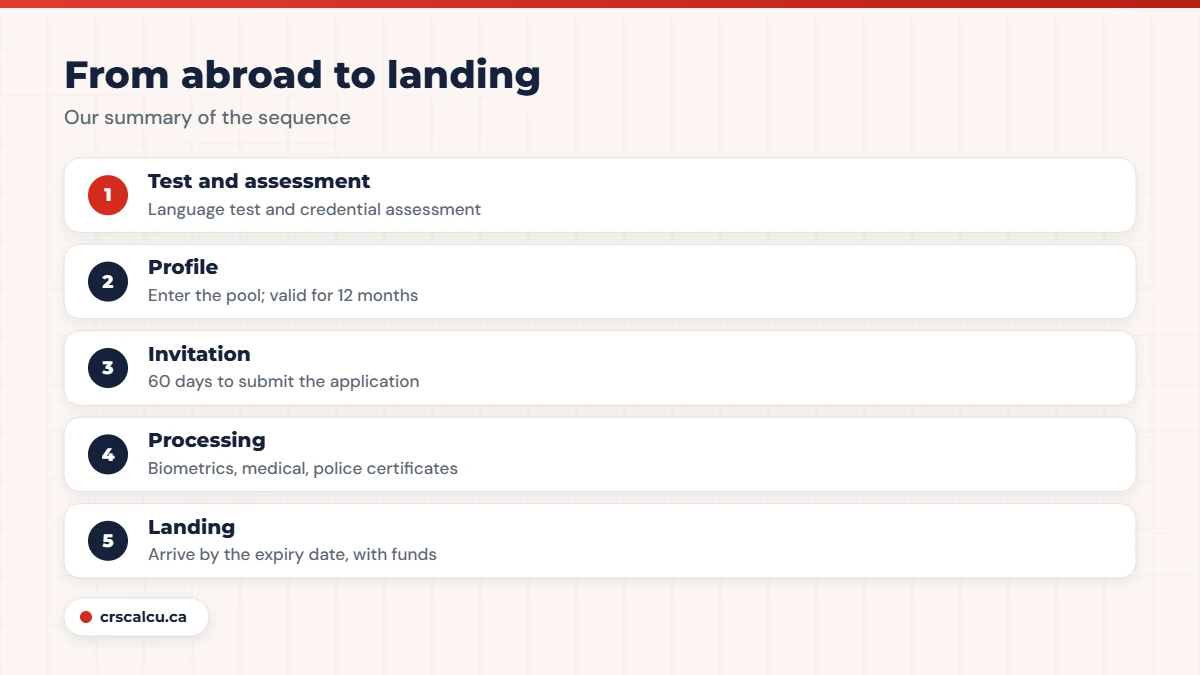
The sequence for an overseas applicant (our summary)
IRCC’s approval page says the border officer will check that you are arriving on or before the expiry date shown on your confirmation, confirm your identity, and take the Canadian mailing address where your PR card will be sent. If your address changes after you arrive, you have 180 days to update it by web form.
Real case: destination city, funds and the PR card address (January 2023)
A newly approved skilled worker had four worries. Their online account still showed nothing weeks after the confirmation letter; the confirmation named one city and they wanted to land in another; they were unsure which funds to declare; and they planned a short first visit with no Canadian address for the PR card. Experienced members replied that an unchanged account is common, that applicants who are not provincial nominees can land anywhere, that only money physically carried needs declaring at the CAN$10,000 mark, and that a post office box cannot be used for the card, so a friend or relative’s address is the usual answer. The poster said in early February that the answers had helped.
Those are forum answers to questions IRCC’s page does not fully cover. The parts it does cover, the expiry date, the documents and the mailing address, match.
How long it takes
We are not going to give you a number, because IRCC does not promise one.
Real case: “six months” against real timelines (February 2024)
A Federal Skilled Worker applicant invited on February 14, 2024 had seen a six-month figure on the official site and asked what people actually experienced. A member explained that the published figure describes how long most past applications took, so some always take longer, and that complexity varies too much to predict. By the middle of 2024, applicants in the same thread were reporting much longer waits, some beyond 18 months, involving security screening, extra document requests and medical exams that had to be redone. No outcome was reported for the original poster.
Plan for the published figure and budget for longer. A medical exam and police certificates have their own validity, and a long file can outlast them.
Five mistakes people make applying from abroad
Avoid these
What IRCC does not say
IRCC does not publish a score that guarantees an invitation, a processing time it commits to for an individual file, or an amount of cash to carry on arrival. It also does not say, on the pages we read, how officers verify where remote work was performed. Where we have filled those gaps with forum accounts, we have said so.
Frequently Asked Questions
Can I apply for Express Entry from outside Canada without a job offer?
Yes. The Federal Skilled Worker Program does not require a job offer. You need one continuous year of skilled work, CLB 7, at least secondary education, 67 points on the selection grid and settlement funds.
What CRS score can I reach with no Canadian experience?
Our arithmetic gives 441 with a bachelor’s degree, 481 with a master’s and 496 with a doctorate, for a single candidate aged 20 to 29 with three years of foreign work and CLB 10. French, a sibling in Canada or a nomination add to that.
How much money do I need?
IRCC’s proof of funds page lists $15,263 for one person, $19,001 for two and $28,362 for a family of four, with amounts updated on July 7, 2025. Check the page for the current table before you apply.
Do I have to show funds again when I land?
IRCC’s page for approved applicants outside Canada says to bring proof that you have the funds to support yourself and your family, unless you are exempt, and to declare CAN$10,000 or more.
Does remote work for a Canadian employer count as Canadian experience?
Only if you were physically in Canada. The CRS criteria page says Canadian work experience means working for a Canadian employer in Canada.
Can I land in a different city from the one on my confirmation?
Forum members say applicants who are not provincial nominees can land anywhere in Canada. IRCC’s approval page does not address it directly.
See your overseas score
Enter your age, education, language and foreign work and see how close you are to recent cut-offs.
Final Thoughts
Express Entry from outside Canada is open to anyone who meets the Federal Skilled Worker rules, and the path is clear enough: test, assessment, profile, invitation, application, landing. The hard part is the ranking, where a profile with no Canadian ties tops out below 500 unless French, family or a province adds to it.
If your work history is mixed between countries, if part of it was remote, or if your funds are borrowed or recently moved, speak to a licensed immigration consultant or an immigration lawyer before you create the profile.