Express Entry Guide · Updated October 2026
Express Entry for International Students: What Counts After You Graduate (Real Cases)
You studied here, worked here and paid tuition here. The system counts less of that than you would expect, and the clock starts later than you think.
Express Entry for international students looks straightforward from the outside: graduate, work, apply. Most graduates do follow that path. The surprises are in what the system refuses to count. Years of part-time work during a degree, co-op terms with a good employer, and the months between your last exam and your work permit can all turn out to be worth less than you assumed.
New rules, November 3, 2026: After graduation, Canadian work in a high-wage occupation is worth more: as of November 3, 2026, 12+ months in such a job adds 20, 40 or 70 CRS points. IRCC pauses rounds for up to two weeks while it recalculates profiles. Check your score under the new rules · IRCC details
None of that is hidden. IRCC’s Help Centre spells out how student work is treated in each program, and the points table says exactly what a Canadian credential adds. The trouble is that graduates usually find these pages after they have already planned around the wrong numbers.
We read IRCC’s Help Centre answers on student work, the Canadian Experience Class page, the CRS criteria and the post-graduation work permit pages (all modified in 2026), plus four public forum threads from 2021 to 2025. Figures marked “our arithmetic” are ours. This is general information, not legal advice.
Quick answer: how does Express Entry work for international students?
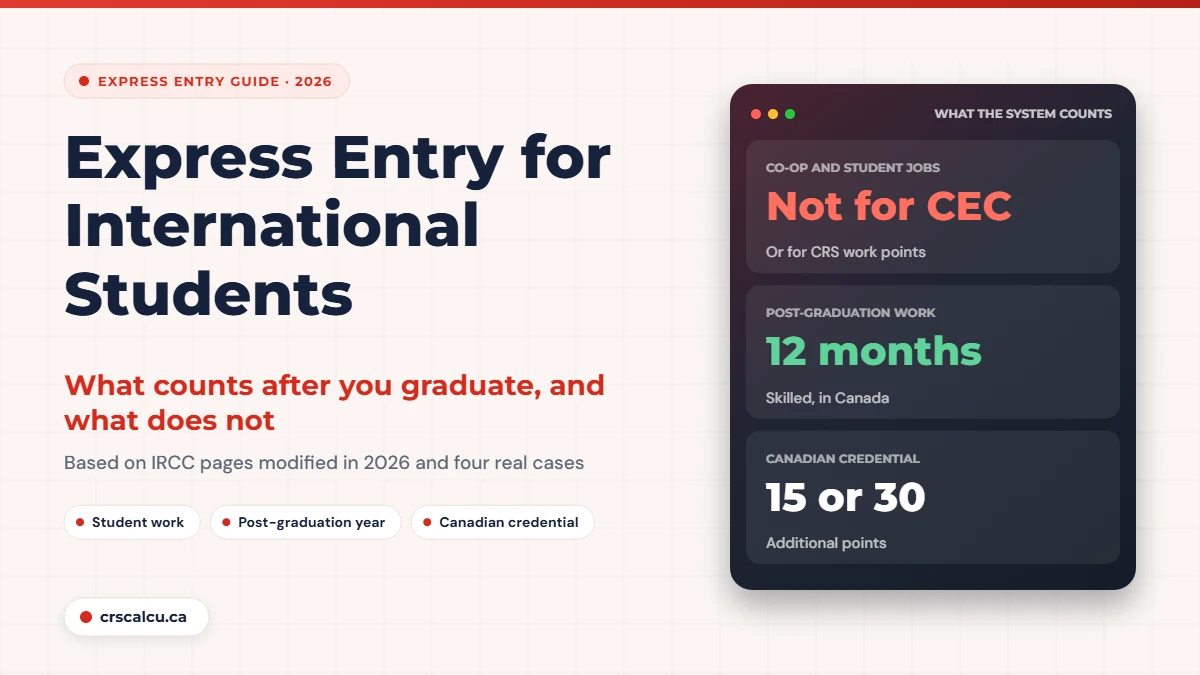
Your Canadian credential earns 15 or 30 additional points, and needs no foreign credential assessment. Work is where it gets strict. IRCC’s Help Centre says student work experience does not count toward the minimum requirements of the Canadian Experience Class, and Canadian work done as a full-time student does not add to your ranking score. So for most graduates the qualifying year begins after graduation, on a post-graduation work permit. Student work can count toward the Federal Skilled Worker minimum if it was paid and continuous. Test your numbers in our CRS calculator.
Key takeaways
Express Entry for international students: the route most graduates take
The usual sequence has four stages: finish an eligible program, obtain a post-graduation work permit, complete 12 months of skilled work in Canada, and enter the pool under the Canadian Experience Class. IRCC’s eligibility page (modified June 22, 2026) sets that class’s minimum at one year of skilled work in Canada in the last three years, in TEER 0 to 3, with CLB 7 for TEER 0 or 1 jobs and CLB 5 for TEER 2 or 3. It has no education requirement, though your education still earns points. Our Canadian Experience Class guide covers the details.
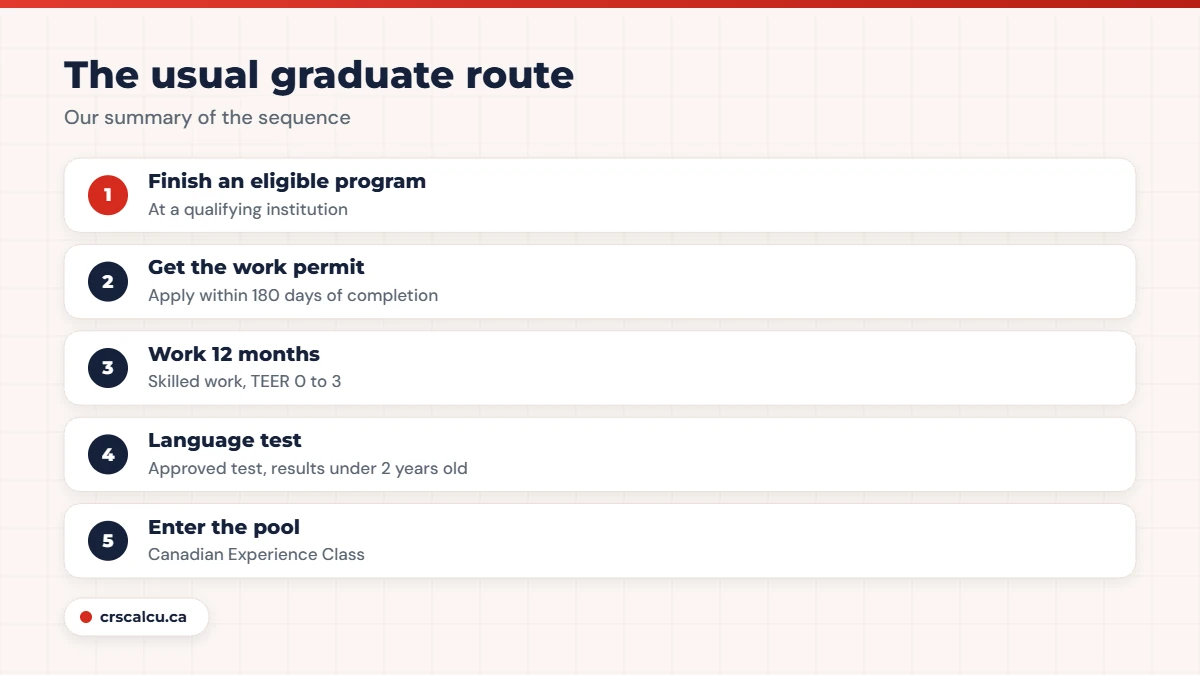
How long your work permit lasts decides how much room you have for that year. IRCC’s post-graduation work permit page (modified March 9, 2026) says a program of 8 months to under 2 years may give a permit up to the length of the program, a program of 2 years or more may give 3 years, and master’s graduates can apply for 3 years if the program was at least 8 months. We go through the planning in study in Canada for CRS points.
Which student work counts, and where
IRCC’s Help Centre answer on student work (modified September 1, 2026) is the page to read twice.
Purpose | Work while a full-time student in Canada | Work while a student outside Canada |
|---|---|---|
Canadian Experience Class minimum | Does not count | Not Canadian experience |
Federal Skilled Trades minimum | Does not count | Does not count |
Federal Skilled Worker minimum | Counts if paid, continuous and otherwise qualifying, including co-op | Counts on the same conditions |
CRS ranking score | Canadian work as a full-time student does not count | Counts |
Our summary of the IRCC Help Centre answer on student work experience (modified September 1, 2026).
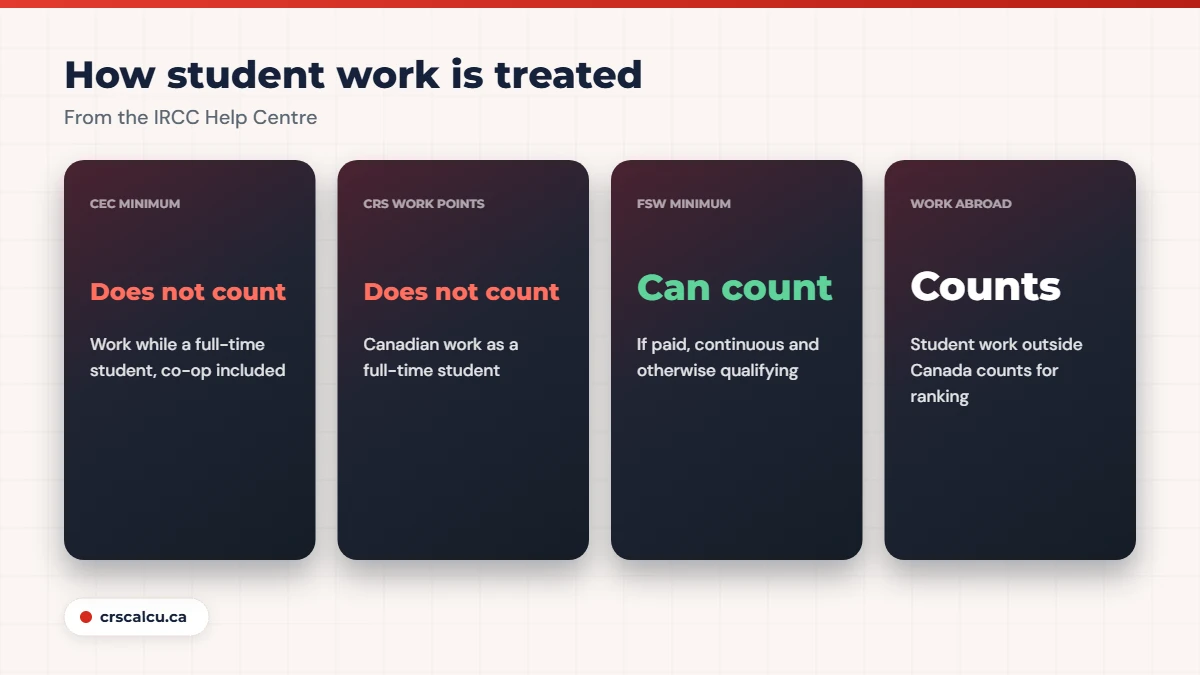
Two consequences follow. First, the hours you worked during your degree, on or off campus, do not move you toward the Canadian Experience Class and do not add Canadian work points. Second, the same work can still help you clear the Federal Skilled Worker minimum, which matters for graduates who want to enter the pool before they have a year of post-graduation work. We compare the two programs in FSW vs CEC.
Real case: co-op, then a full-time offer from the same employer (November 2021)
A student in a paid co-op placement was offered a permanent job by the same employer, starting straight after graduation with no gap. They asked whether the co-op months would count toward the Canadian Experience Class. Several experienced members said no, and one quoted IRCC’s wording that student work experience does not count toward that class’s minimum requirements. They added that the same experience might count for the Federal Skilled Worker Program if it was paid and continuous. The poster acknowledged the answer and did not post again.
Real case: 16 months of co-op and two months of real work (March 2021)
A graduate who finished a bachelor’s degree in December 2020 held a post-graduation work permit. They had 16 months of co-op in a professional occupation, five months of part-time work during school, and two months of full-time work since graduating, and a score of about 470. Members explained that work during studies does not count as Canadian experience, that only the post-graduation months count toward the Canadian Experience Class, and that a Canadian degree needs no credential assessment. The consensus was to work for about a year and then apply under that class. No outcome was reported.
Both graduates had done substantial, relevant work as students. For the Canadian Experience Class, both were starting from zero on graduation day. A co-op employer who keeps you on is valuable for the job it gives you afterwards, not for the months before.
When does the clock start?
If student work does not count, the next question is the exact day post-graduation work begins to count. IRCC’s Help Centre says experience gained while studying full time on a study permit does not count, and the Canadian Experience Class page says the work must have been authorized. The pages we read do not name a start date for graduates.
Real case: working while the permit was in process (February 2021)
A graduate applied for a post-graduation work permit as soon as they had their completion letter, while their study permit was still valid, and waited two months for the permit itself. They asked whether work during those two months counted toward the Canadian Experience Class. An experienced member said experience can be counted from the date the permit application was submitted, citing an answer IRCC had given on social media. A later poster asking the same in 2024 was told the same: count from the application date, not from the end of the program.
That is forum guidance resting on a social media reply we have not seen, so treat it as the working assumption people use and not as a published rule. If your year depends on those first weeks, keep the proof: the completion letter, the date you applied for the permit, and pay records from that date.
Then count hours, not just months. Twelve months of full-time work means 1,560 hours, and hours above 30 a week are not counted, so overtime does not shorten the year. See 1,560 hours.
Entering the pool before the year is complete
Real case: a profile at 11 months (January 2025)
A worker who would complete one year of Canadian experience on March 6, 2025 asked whether they could create a profile on February 1. Their projected score was 523, with eligibility for French rounds as well. One member said yes, as long as the application itself went in after the year was complete. The poster pointed to the rule that the information must be valid both when the invitation is issued and when the application is received, and worried about being invited too early. In the same thread, someone who wanted to create a profile before taking a language test was told flatly not to enter results they did not have, since false information can mean a five-year ban.
The poster’s caution was sound. A profile has to be true when you submit it. If you do not yet have the year, you do not meet the Canadian Experience Class minimum, and a profile that says you do is false. If you qualify under the Federal Skilled Worker Program in the meantime, perhaps on student work or foreign experience, you can enter on that basis and update the profile when the Canadian year is complete; updating does not change your tie-breaker time. Otherwise, wait the few weeks.
What your Canadian education is worth
The CRS criteria page (modified June 22, 2026) pays for a Canadian credential twice. It counts at its level on the education line, and it earns additional points: 15 for a credential of one or two years, 30 for one of three years or more. The details, including which programs qualify, are in Canadian education points.
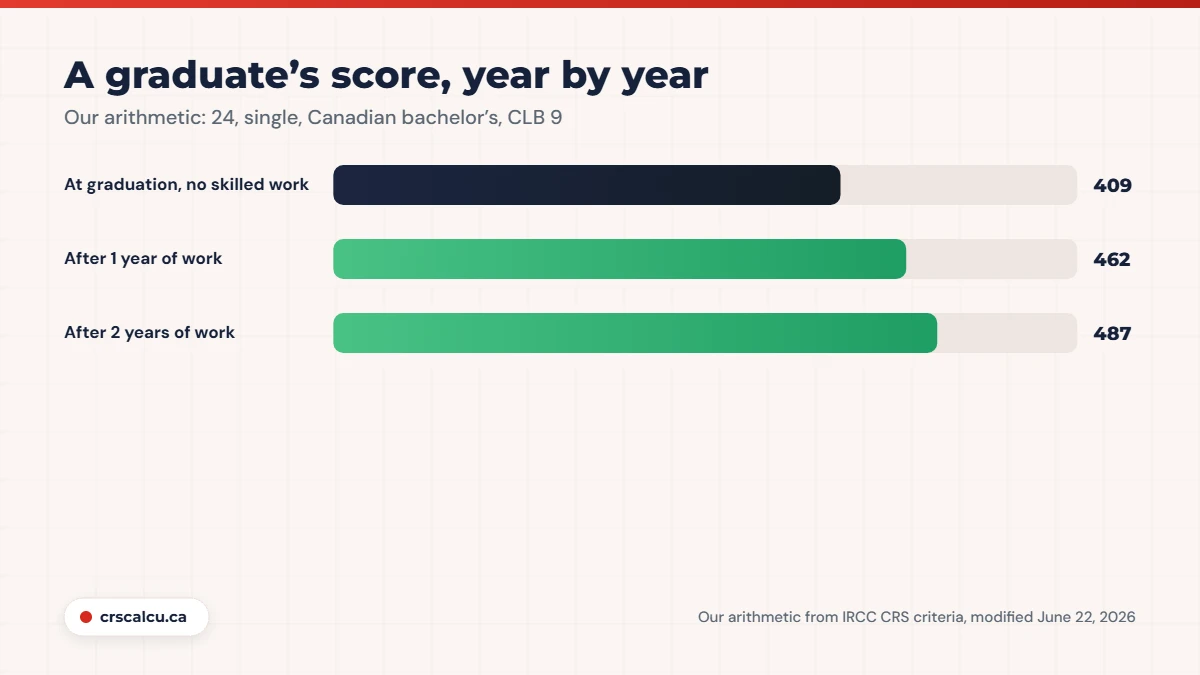
Our arithmetic for a typical graduate: 24 years old, single, a Canadian bachelor’s degree, CLB 9 in all four abilities and one year of skilled Canadian work. That is 110 for age, 120 for education, 124 for language and 40 for work, plus 25 and 13 from the two education pairs in skill transferability, plus 30 for Canadian study: 462. A second year of work lifts the work line to 53 and the transferability total to 50, for 487. Reaching CLB 10 adds 12 to either figure.
Language is the line graduates most often neglect. Studying in English or French does not exempt you from a test. IRCC’s language page requires results from an approved test, less than two years old when you submit your profile and when you apply. Convert your scores with the CLB calculator, and see improve CRS score for what each band is worth.
Age, timing and categories
Graduates in their early twenties have time on their side: the age line is at its maximum from 20 to 29. Those who came for a second degree in their late twenties or thirties do not, and each birthday from 30 costs five or six points. If a birthday falls between an invitation and your application, see CRS score dropped after ITA.
Category rounds can help. If your post-graduation job is in a listed occupation, or you have French at NCLC 7, you may be invited at a lower score than a general round requires. The tests are in category-based selection eligibility. Compare your number with the latest draw cut-offs for each type.
A graduate’s timeline (our suggested order)
If the permit will run out before an invitation comes, our guide to TR to PR pathways lists the other options.
Express Entry for international students: six mistakes to avoid
Avoid these
What IRCC does not say
The pages we read do not state the exact date from which a graduate’s work starts to count, and they make no promise that a graduate will be invited. They also do not tell you whether a particular job title is skilled; that depends on its duties.
Frequently Asked Questions
Is Express Entry for international students different from the normal process?
No. Graduates use the same programs and the same points table. The differences are that student work mostly does not count, and that a Canadian credential earns 15 or 30 additional points.
Does co-op count as Canadian work experience?
Not for the Canadian Experience Class or for CRS points. IRCC’s Help Centre says co-op terms can count toward the Federal Skilled Worker minimum if the work was paid and continuous.
Does part-time work during my studies count?
Canadian work done while you were a full-time student does not count for the Canadian Experience Class or for the ranking score. It may count toward the Federal Skilled Worker minimum.
Do I need a credential assessment for my Canadian degree?
The assessment IRCC requires is for education completed outside Canada. A Canadian credential is entered directly.
Do I need a language test if I studied in English?
Yes. IRCC requires results from an approved test, less than two years old, for every candidate.
Can I apply while I am back in school?
IRCC’s Help Centre says yes for the Canadian Experience Class, as long as you have a year of skilled work in Canada within the three years before applying. Work done while studying full time does not count.
See your graduate score
Enter your Canadian credential, your language results and your work since graduating.
Final Thoughts
Express Entry for international students rewards the credential and the work that follows it, and very little of what came before. Plan from graduation day: the permit length, the 12 months, the language test and your age when it all lines up.
If your work history mixes student and post-graduation periods, if your permit is short, or if you are unsure when your year began, speak to a licensed immigration consultant or an immigration lawyer before you create the profile.