Express Entry Guide · Updated October 2026
Mistake in Express Entry Profile: How to Fix It at Each Stage (Real Cases)
A wrong date, a test score typed as 7.5 when it was 7, a degree entered one level too high. What you do next depends on where you are and whether points were involved.
Discovering a mistake in Express Entry profile details usually happens at the worst moment: just after an invitation, when you finally sit down with your documents and one of them does not match what you typed months ago. The panic that follows tends to produce one of two bad ideas. Say nothing and hope, or decline everything and start again.
Neither is usually right. Most errors can be corrected, and corrected openly, without losing the invitation. A few cannot, because the corrected facts would not have earned the invitation in the first place. Telling the two apart takes three questions, and this post is built around them.
We read IRCC’s create-profile page, its Help Centre answers on updating a profile, and its pages on responding to an invitation and updating an application (all modified in 2026), plus five public forum threads from 2017 and 2018. This is general information, not legal advice.
Quick answer: what should you do about a mistake in your profile?
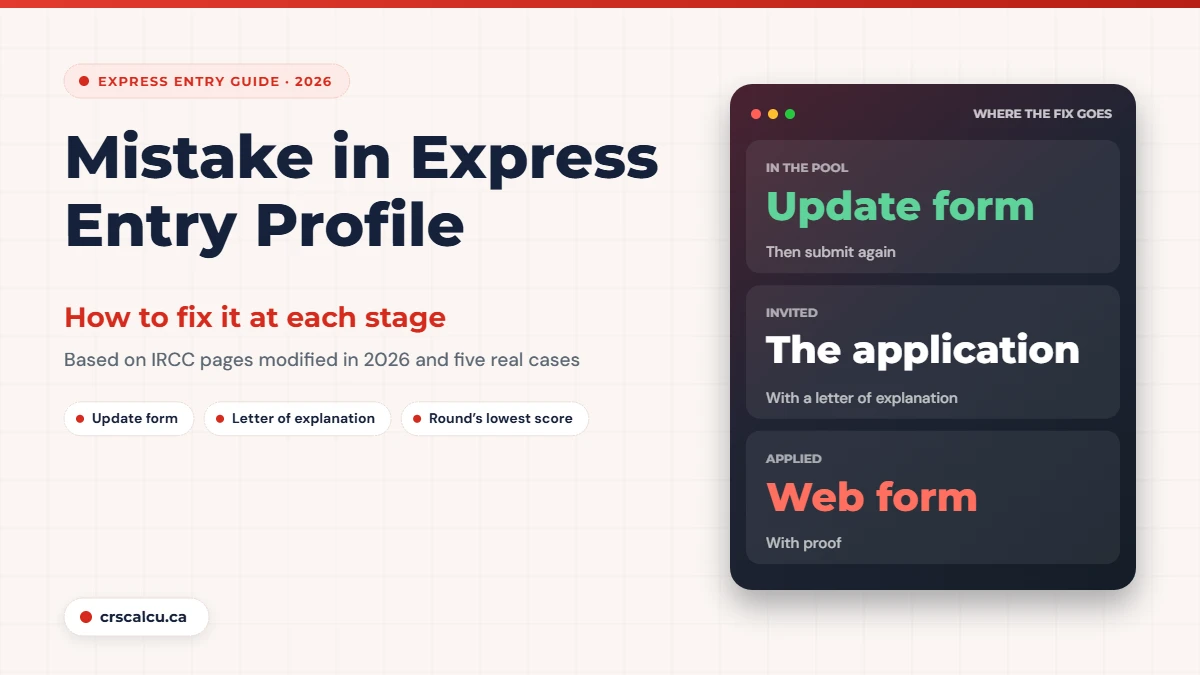
Correct it, in the place your stage allows, and explain it. In the pool, use the Update form button and submit the profile again. After an invitation, the profile can no longer be edited, so put the correct information in the application and add a letter of explanation; first re-calculate your score, and if the true score is below the lowest score invited in your round, IRCC says you should decline. After you have applied, tell IRCC through the web form. Do not leave an error in place: IRCC warns that false information can mean refusal and a five-year bar. Re-check your numbers in our CRS calculator.
Key takeaways
Three questions that decide everything
Before you touch anything, answer these in order.
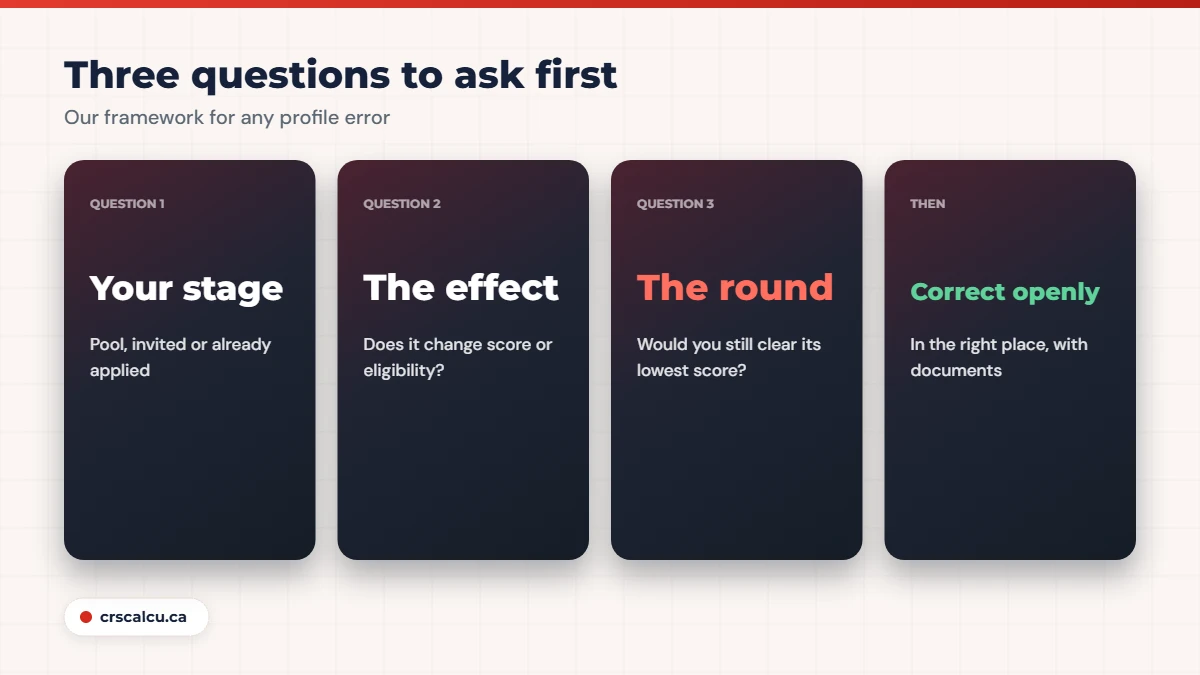
What stage am I at? A profile in the pool, an invitation not yet answered, or an application already submitted. Each has its own way of making a correction.
Does the correct information change my score or my eligibility? A wrong passport detail changes neither. A language score entered half a band too high may change the score. A job entered with the wrong dates may change eligibility if the corrected dates leave you short of a full year.
With the correct information, would I still have been invited? This is the test IRCC’s respond-to-invitation page (modified June 22, 2026) sets: re-calculate, and if your score is lower than the lowest score invited in your round, decline.
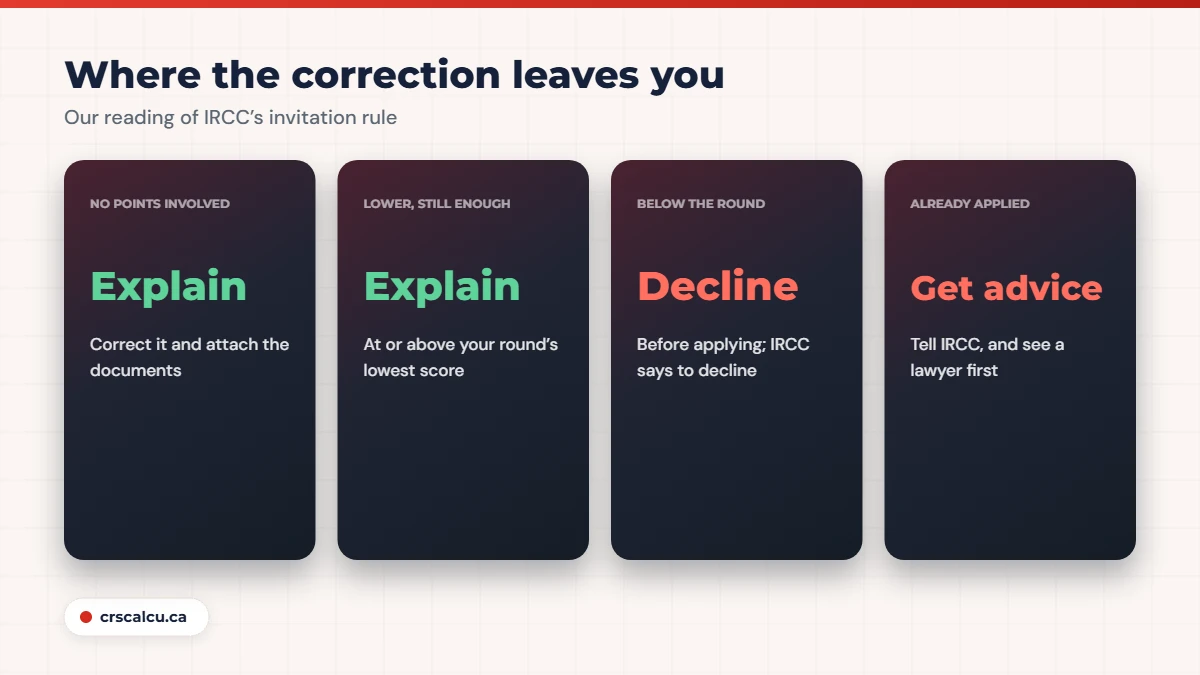
Effect of the correction | Before you apply | After you apply |
|---|---|---|
No change to score or eligibility | Correct it and explain | Tell IRCC by web form |
Score lower, still at or above the round’s lowest | Correct it and explain | Tell IRCC by web form, with the recalculation |
Score below the round’s lowest, or no longer eligible | Decline the invitation | Tell IRCC and get legal advice at once |
Our reading of IRCC’s respond-to-invitation page (modified June 22, 2026), create-profile page (September 24, 2026) and Update your application page (September 3, 2026). IRCC does not publish this table.
Fixing a mistake in Express Entry profile details, stage by stage
In the pool
This is the easy case. IRCC’s Help Centre (modified September 1, 2026) says a submitted, eligible profile can be updated: open it from “View the applications you submitted”, use the “Update form” button on the section concerned, save, then continue and submit the profile again. The create-profile page says updating does not change the date and time IRCC received your profile, so there is no penalty in rank for fixing an error. The steps are in update Express Entry profile.
Fix it the day you find it. A profile with an error in your favour can be invited on points you do not have, and then the easy case becomes the hard one. Take care with edits to your work history and primary occupation, which can make a profile ineligible; an ineligible profile cannot be updated and has to be replaced.
After an invitation, before you apply
The forum cases agree that the profile becomes view-only once you are invited. Corrections are made in the application you are about to submit, and the difference between profile and application is explained in a letter.
Real case: start date a year out (March 2017)
A candidate invited in January 2017 with 451 points noticed, while preparing the application, that the profile gave January 2014 as the start of a job that had in fact begun in January 2013. Their documents showed the earlier date. They feared misrepresentation and wondered whether to decline. Several members advised going ahead: the correction did not reduce the score that had earned the invitation, the documents matched the true date, and a letter of explanation would cover the discrepancy. One noted that refusals tend to arise where a profile claimed extra points through overstated experience, which was not this case. No outcome was reported.
Real case: two jobs entered as one (November 2018)
An applicant invited on November 14 found that the profile showed a single job from October 2017 to the present, when there had been two roles under the same occupation code, one from November 2017 to February 2018 and another from March 2018. Police certificates and medicals were already done. Most replies said to proceed and explain the typing error in a letter, as long as the employment documents supported what was claimed. One member looked more closely: the corrected dates had to be checked for any gap between the two jobs that might affect eligibility, and the correction should go in with an explanation for the officer to assess. No outcome was reported.
The second reply in that case is the careful one. Correcting dates is not automatically harmless. Work out what the corrected history adds up to, in months and in hours; see 1,560 hours.
Real case: 7.5 typed, 7 achieved (September 2017)
An invited applicant realized that one language test component had been entered as 7.5 when the result was 7. Their representative had made the same error in a provincial application, which had been approved. Corrected, the score went from 358 to 355. Members advised using the correct score in the application, telling the province about the discrepancy, and attaching a letter of explanation with the test report. Their reasoning was that three points made no difference to the outcome, because the provincial nomination kept the applicant far above the level required. No outcome was reported.
That is the middle row of the table: a lower score that still clears the round. The reasoning held only because of the nomination, and note that the province had to be told as well. For how a nomination changes the arithmetic, see provincial nomination in Express Entry; to convert test results correctly, use the CLB calculator.
When the true score would not have been invited
Real case: a doctorate entered in place of a master’s (March 2017)
An applicant had selected a doctoral degree in the profile when they held a master’s. The profile score was 460; the true score was 441. The cut-off of their round was 459. They had been invited and had already submitted the application before the error came to light. One member suggested writing to IRCC to explain. A more experienced member pointed out that, recalculated, the applicant fell below the cut-off, that refusal was likely, and that a finding of misrepresentation was a risk, and urged an immediate message to IRCC. Several replies recommended asking to withdraw the application. The thread ended with unanswered questions about how to do that and when a new profile could be created.
This is the bottom row. With the correct degree, there would have been no invitation. Before applying, the answer is to decline, which IRCC says returns you to the pool and does not affect later invitations; see declining an ITA. After applying, as here, it is a matter for a lawyer, and quickly. We go through the scoring logic in CRS score dropped after ITA.
After you have applied
IRCC’s Update your application page (modified September 3, 2026) sends changes and corrections through the web form, and asks for proof.
Real case: country of issue confused with place of issue (December 2017)
After submitting the application and passing the medical, an applicant noticed they had entered the wrong country of issue for their passports, having confused it with the place of issue. A member suggested sending a web form to report the unintentional error and thought it minor. The applicant also phoned IRCC. The agent, as they reported it, said it was not a major issue, added a note to the file and advised sending the web form anyway, observing that the officer would see the passport scans and recognize the slip. Later posters asked about similar errors.
A harmless error, reported promptly, treated as harmless. The applicant still reported it. That is the pattern to copy.
Writing the letter of explanation
IRCC does not publish a template. The letters described in these threads share a shape.
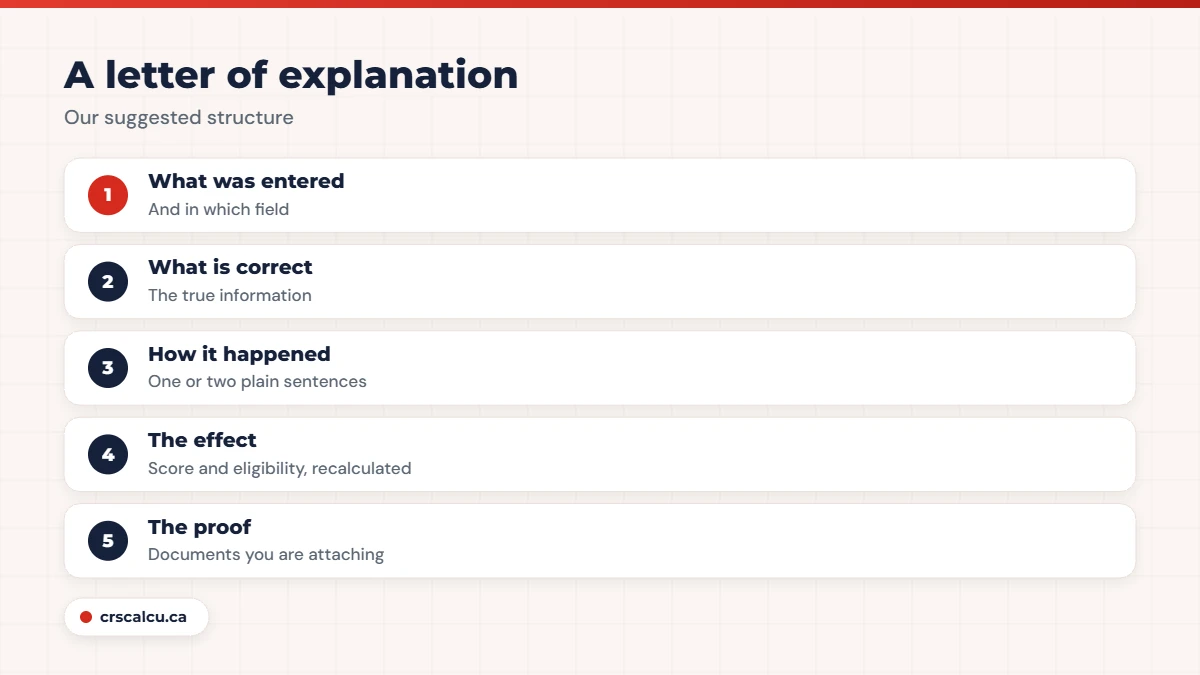
A letter of explanation (our suggested structure)
Before you send a correction
Honest mistakes and misrepresentation
IRCC’s create-profile page (modified September 24, 2026) says that if it finds you gave false information or left out important details, it can refuse your application, find you inadmissible and bar you from applying for five years. The page does not carve out an exception for accidents.
In practice, the cases above show a clear difference in how experienced members read the risk. An error that gave no advantage, is corrected by the applicant and is supported by documents is treated as an error. An error that produced an invitation the applicant would not otherwise have had is treated as serious whatever the intent. And an error left uncorrected after the applicant knew about it is the hardest to defend. You cannot change what you typed months ago. You can decide today whether IRCC hears about it from you.
If the error was made by someone acting for you, it is still yours; see immigration representative for Express Entry. If the wrong entry is your occupation code, see wrong NOC code in Express Entry. And if you are thinking of abandoning the profile to start over, read two Express Entry profiles first.
Mistake in Express Entry profile: five errors that put an application at risk
Avoid these
What IRCC does not say
IRCC’s pages do not describe editing a profile after an invitation, do not provide a format for a letter of explanation, and do not say how officers distinguish an honest error from misrepresentation. On those points we have relied on forum experience and said so. No page promises that a corrected error will be excused.
Frequently Asked Questions
How do I fix a mistake in Express Entry profile information before I am invited?
Open the profile from “View the applications you submitted”, use the “Update form” button on the section, save, then continue and submit the profile again. Updating does not change your original submission time.
I found the mistake after my invitation. Can I still edit the profile?
In the cases we read, the profile was view-only after an invitation. Applicants entered the correct information in the application and attached a letter of explanation.
Should I decline my invitation because of an error?
IRCC says to decline if your recalculated score is lower than the lowest score invited in your round. If the correction costs no points, or leaves you at or above that score, the forum advice was to proceed and explain.
I already submitted my application with a mistake. What now?
Tell IRCC through the web form, with the correct information and proof. If the correction means you would not have been invited, get legal advice before you write.
Is a typo misrepresentation?
IRCC’s warning about false information does not mention intent. In practice, errors that gave no advantage and were corrected by the applicant with supporting documents were treated in these threads as errors, but no page guarantees that.
What goes in a letter of explanation?
What was entered, what is correct, how it happened, the effect on your score and eligibility, and the documents that prove the correct information.
Recalculate with the correct facts
Enter the right dates, scores and credentials and see what your score should have been.
Final Thoughts
A mistake in Express Entry profile details is common and, most of the time, fixable. Work out your stage, the effect of the correction and whether you still clear your round. Then correct it in the open, with documents, and let the explanation be short and factual.
If the true figures would not have earned your invitation, or you have already applied on wrong information that affected your score, speak to an immigration lawyer or a licensed consultant before you send anything further.