Express Entry Guide · Updated October 2026
Common-Law Partner in Express Entry: The 12-Month Rule, Points and Proof (Real Cases)
Living together but not married? IRCC has a specific test for common-law, and it decides your marital status, your points and your paperwork.
Declaring a common-law partner in Express Entry is not a choice you make because it feels accurate, or avoid because the paperwork is thin. IRCC has a definition, and you either meet it on the day you fill in the form or you do not.
That sounds simple, and then real life gets in the way: a couple who have been together for three years but under one roof for nine months, a lease with only one name on it, a home country that has no such thing as a common-law union. Those are the situations people bring to the forums, usually a few days after an invitation arrives.
We read IRCC’s Help Centre definition, its Express Entry application page, the CRS criteria and a permanent residence guide (all modified in 2026), plus five public forum threads from 2017 to 2020. This is general information, not legal advice.
Quick answer: when does a partner count as common-law for Express Entry?
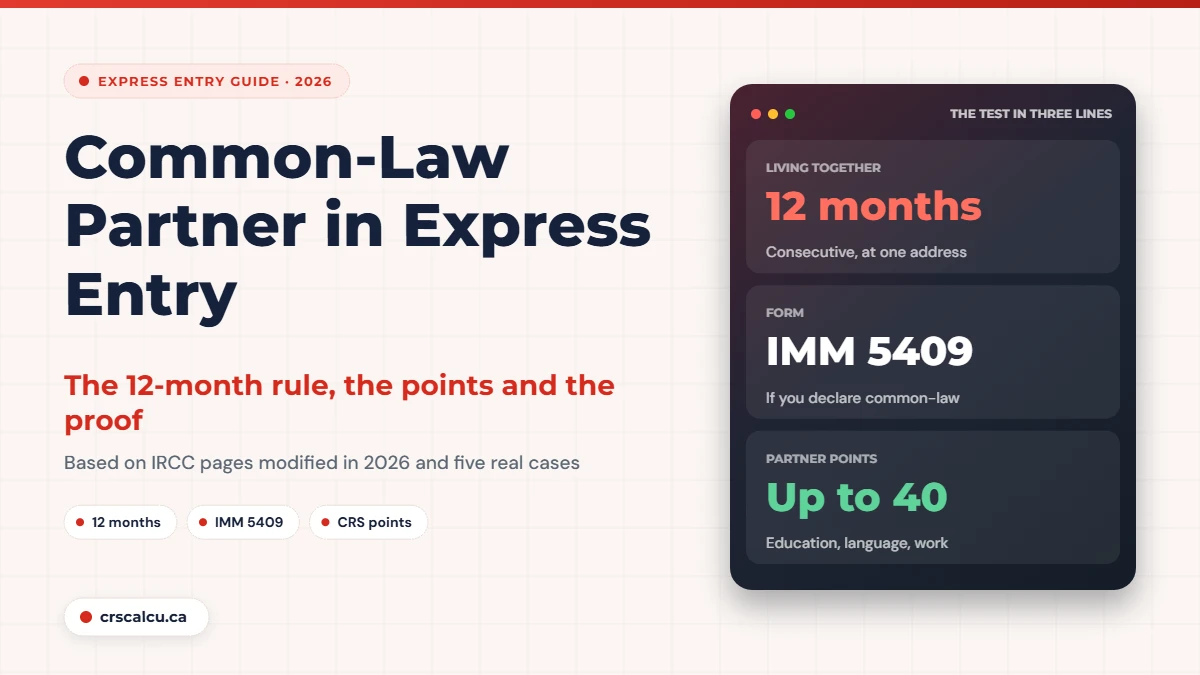
IRCC’s Help Centre says a common-law partner is someone who is not legally married to you, is 18 or older and has been living with you for at least 12 consecutive months. Absences have to be short and temporary. If you meet that test, common-law is your marital status and you declare it, with the common-law union form (IMM 5409) at the application stage. If you do not meet it yet, you are not common-law yet. Either way, check your points in our CRS calculator under the status that is true today.
Key takeaways
How IRCC defines a common-law partner in Express Entry
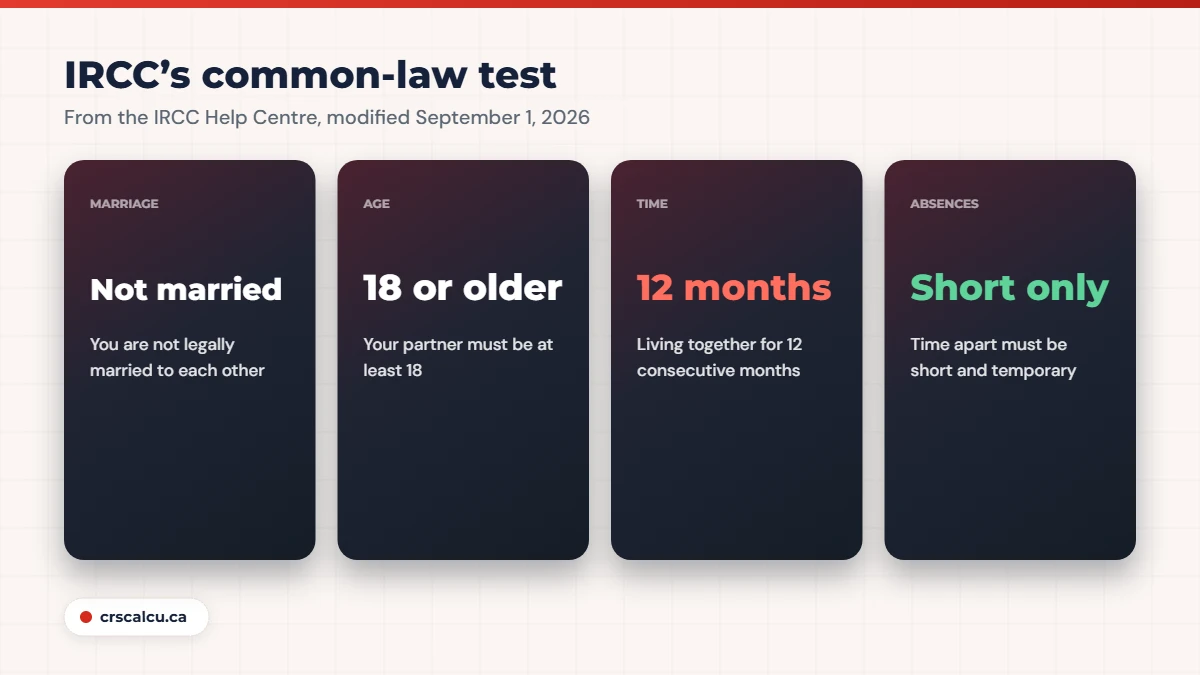
The clearest wording we found is in the IRCC Help Centre (modified September 1, 2026). The answer is filed under family sponsorship, but it is the department’s plain-language definition, and the permanent residence guide we read uses the same one-year idea. According to that answer, your common-law partner is not legally married to you, can be either sex, is 18 or older, and has been living with you for at least 12 consecutive months.
It also explains what “consecutive” means. You have lived together for one year without long periods apart. Time away for family obligations or for work or business travel is allowed, but the absence has to be short and temporary. And the Help Centre adds that when at least one partner chooses to end the relationship, IRCC considers the partnership to be over.
IRCC’s Guide 0118 (modified April 23, 2026) puts the status in one line: you are common-law if you have lived continuously with your partner in a marital-type relationship for one year or more.
The 12 consecutive months test
Nearly every thread we read came down to counting. The date that matters is the day you started living at the same address, not the day you met, got engaged or opened a joint account. Our example: a couple who moved in together on March 1, 2026 reach 12 consecutive months at the start of March 2027, as long as neither of them moved out in between. Before that date they do not meet the definition. After it, they do, and it is no longer optional.
Situation | IRCC wording that applies | Our reading |
|---|---|---|
Together 3 years, living together 9 months | Living with you for at least 12 consecutive months | Not common-law yet |
Living together 14 months, two weeks apart for a work trip | Absences must be short and temporary | Still common-law |
Living together 2 years, one partner ended it and moved out | Partnership is over when one partner ends it | No longer common-law |
Living together 13 months, no joint lease | Definition turns on living together, not on a lease | Common-law; proof is the hard part |
Our reading of the IRCC Help Centre definition (modified September 1, 2026). IRCC does not publish this table, and an officer decides each case on its own documents.
Real case: invited as common-law at nine months (January 2020)
A candidate who had been invited had built the profile as common-law. The couple had been together since April 2017 but had kept separate homes for study and work, visiting often, and had only lived at one address for nine months. They shared accounts and insurance and planned to marry that summer. Experienced replies said IRCC is strict about the 12 months of living together. The options offered were to marry before the application deadline, or, if the candidate’s own points were enough, to apply as a single applicant with a letter explaining the mismatch and add the partner once the 12 months were reached. The original poster did not report an outcome. In April 2024 another person in the same position wrote that they had taken the partner off, applied alone and been approved.
Two points from that case are worth separating. The first is factual: a profile that says common-law before the 12 months are complete describes something that is not yet true. The second is strategic, and it is forum advice, not an IRCC rule. Whether applying alone works depends on whether the invitation still holds up once the score is recalculated, which is the next section.
What a common-law partner does to your CRS score
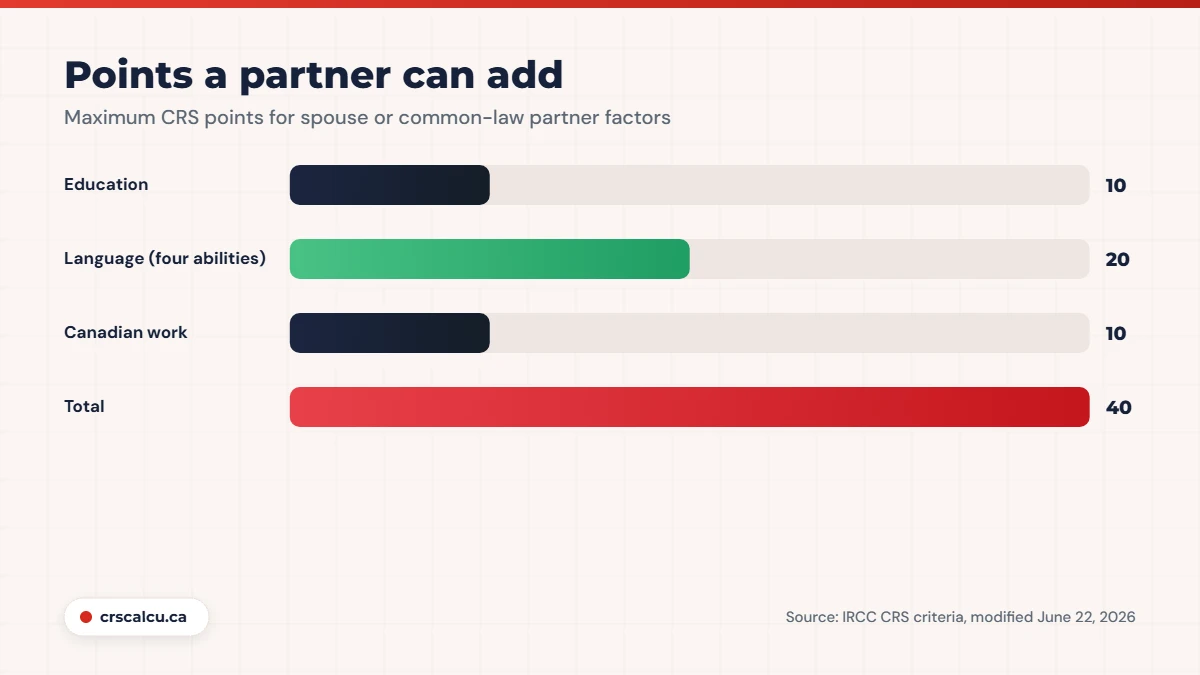
For points, a common-law partner is treated the same as a spouse. The CRS criteria page (modified June 22, 2026) has one column for candidates “with a spouse or common-law partner” and one for candidates without. With a partner, your own core points are a little lower, and your partner’s education, language and Canadian work can add points back.
Factor | With a partner | Without a partner |
|---|---|---|
Age 29 | 100 | 110 |
Master’s degree | 126 | 135 |
Canadian work experience, 2 years | 46 | 53 |
Partner’s education, language and Canadian work | Up to 40 | 0 |
Points from IRCC’s CRS criteria page (modified June 22, 2026).
Our arithmetic on those three rows: 272 with a partner against 298 without, a gap of 26 before the partner’s own points. A partner with a bachelor’s degree (8), CLB 9 or higher in all four abilities (20) and one year of Canadian work (5) adds 33. A partner with no language test adds nothing for language at all. So reaching the 12-month mark can move a score up or down, and you should run it both ways before the date arrives.
The same page has an exception that matters a lot for couples already in Canada. If your partner is a Canadian citizen or permanent resident, or is not coming with you, you earn points as if you did not have a spouse or partner. You still declare the relationship. You are just scored in the other column. We cover the not-coming version in our post on a non-accompanying spouse.
Real case: Canadian partner, and the partner’s sibling (November 2020)
Someone building a profile had a common-law partner who was a Canadian citizen, and the partner had a sibling in Canada. The poster hoped to claim the 15 sibling points and was unsure how to answer the marital status and accompanying questions. An experienced reply said the points could not be claimed through a Canadian partner, and that with a Canadian partner the candidate would be scored as if they had no partner. The poster accepted the explanation and asked where IRCC states it. No further outcome was reported.
For the record, the sibling rule is on the CRS criteria page and we go through it in sibling points in Express Entry. Compare your result with the latest draw cut-offs and our post on what CRS score you need.
The form and the proof: IMM 5409 and what goes with it
IRCC’s page on applying for permanent residence through Express Entry (modified June 22, 2026) lists the common-law union form, IMM 5409, as a document to upload if you declared your marital status as common-law. That is the only common-law item we found on that page. The Help Centre adds that you need documents to back up the status, without listing them in the answer we read.
So the official position is short: a declaration form, plus evidence. What the evidence should be is where forum experience takes over, and none of what follows is an IRCC list.
Real case: four years together, one name on the lease (March 2019)
A poster had lived with a partner for four years. Both names were on the lease from August 2015 to May 2018, then the partner’s name came off, although she kept living there. The worry was that the missing name would undermine the common-law claim. Replies suggested going well past the basic checklist: a written history of the relationship, sworn statements from people who know the couple, identification showing the shared address, utility bills covering more than 12 months, joint financial accounts, photographs and travel records. No final outcome was reported.
Proof people in the threads gathered (forum experience, not an IRCC list)
Real case: one upload, not two (September 2017)
An invited applicant asked whether to upload only the signed common-law declaration at first and send the supporting evidence later. An experienced reply said to combine the declaration and the evidence in a single file, because IRCC would not come back and ask for the evidence afterwards. Another poster said they had uploaded the form by itself and put the rest in the additional documents section. In June 2022 the original poster returned to say the application had succeeded with everything uploaded together, and that they had since become a Canadian citizen.
“We cannot prove it, so can we apply as single?”
This question comes up more than any other, and the forum answer is consistent: no. If you meet the definition, common-law is your marital status, and a profile or application that says single is false. IRCC’s create-profile page (modified September 24, 2026) warns that false information can lead to refusal, a finding of inadmissibility and a five-year bar on applying.
Real case: no documents, no common-law status at home (May 2020)
A candidate with an invitation had lived with a partner for nearly a year. Their home country does not recognize common-law unions, and the usual papers, such as a rental contract or utility bills, were either missing or unreliable. They asked whether both could simply apply as single. Replies were firm that a common-law partner has to be declared whether or not the proof is easy, and that applying separately as singles would be misrepresentation. They also pointed out that if the one-year mark had not been reached when the application went in, the candidate could apply as single and tell IRCC once the status changed. The poster accepted this in mid-May 2020 and asked how to notify IRCC later. No final outcome was reported.
Notice the difference between the two halves of that advice. “Single” is false if you have passed 12 months. “Single” is true if you have not. The honest route for a couple at month eleven is to apply under the status that is true that day and report the change when it happens.
If you become common-law part-way through
IRCC’s Guide 0118 tells applicants to inform the department immediately of any change in marital status or family composition, and its examples include a common-law relationship by name. What you do depends on the stage.
Stage | What IRCC says | What to do |
|---|---|---|
Profile in the pool | Keep your profile up to date | Change your family information and check the new score |
Invited, not yet applied | Invitation valid 60 days; re-calculate if your situation changes | Re-run your score; decline if it falls below the round’s lowest |
Application submitted | Report changes in your family situation | Use the web form, with IMM 5409 and proof |
Our summary of IRCC’s create-profile page (modified September 24, 2026), respond-to-invitation page (June 22, 2026), Update your application page (September 3, 2026) and Guide 0118 (April 23, 2026).
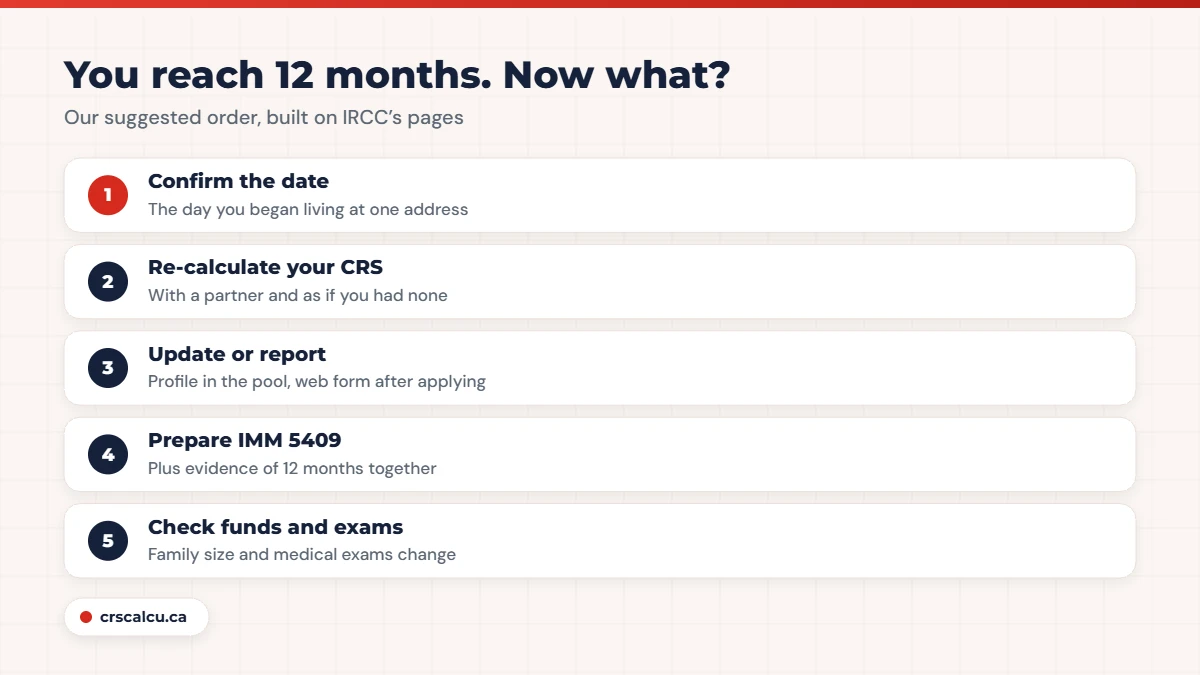
After an invitation, a new common-law status can drop your score, because you move to the lower column. IRCC’s respond-to-invitation page says that if your recalculated score is below the lowest score in your round, you should decline; see declining an ITA. A new partner also changes your family size for settlement funds, so check the table in our proof of funds post.
The same guide carries a warning for couples tempted to leave a partner off: a family member who was not examined before you became a permanent resident can never be sponsored by you later. And IRCC’s application page says family members need a medical exam even if they are not coming. If the relationship ends instead, the reporting duty runs the other way; we cover that in divorce during Express Entry.
Six mistakes with a common-law partner in Express Entry
Avoid these
What IRCC does not say
We did not find, on the Express Entry pages we read, a list of documents that prove 12 months of living together, a number of days that makes an absence too long, or a rule for couples whose country issues no joint paperwork. The Help Centre says absences must be short and temporary and stops there. Where the pages are silent, an officer weighs what you send.
Frequently Asked Questions
Do I have to declare a common-law partner in Express Entry if we are not married?
Yes, if you meet IRCC’s definition: not legally married to each other, both 18 or older, and living together for at least 12 consecutive months. At that point common-law is your marital status.
We have lived together for 10 months. Can I put common-law?
Not yet. IRCC’s Help Centre wording requires at least 12 consecutive months of living together. Use the status that is true today and update it when you reach 12 months.
What is IMM 5409?
It is the common-law union form. IRCC’s Express Entry application page (modified June 22, 2026) lists it as a document to upload if you declared your marital status as common-law.
Does a common-law partner lower my CRS score?
Your own core points are lower in the “with a spouse or common-law partner” column, but your partner can add up to 40 points for education, language and Canadian work. In our example the gap before partner points was 26.
My common-law partner is a Canadian citizen. How am I scored?
The CRS criteria page says that if your partner is a Canadian citizen or permanent resident, or is not coming with you, you earn points as if you did not have a spouse or partner. You still declare the relationship.
Do time apart and work trips break the 12 months?
IRCC’s Help Centre says you must have lived together for a year without long periods apart, and that absences for family obligations or work travel must be short and temporary. It does not give a number of days.
Score it both ways before the 12-month date
Enter your details with and without a partner and see which column you land in.
Final Thoughts
The rule for a common-law partner in Express Entry is narrower than most couples expect and less flexible than they hope. Twelve consecutive months under one roof makes you common-law. One day short of that, you are not. Your points, your forms and your duty to report all follow from which side of that date you are on.
If your dates are close to an invitation deadline, if you have long gaps apart, or if you cannot document a shared address, talk to a licensed immigration consultant or an immigration lawyer before you submit anything.