Express Entry Guide · Updated October 2026
TEF vs TCF for Express Entry: NCLC 7 Scores on Each Test and What People Who Took Both Found (Real Cases)
French can add up to 50 points to an Express Entry profile and open a whole category of draws. Two tests get you there. Here is how they differ on paper and in practice.
TEF vs TCF for Express Entry is a question almost nobody asked ten years ago and a great many people ask now. French has become the most reliable way to add points to a profile that is otherwise stuck, and both tests lead to the same place: a level on the NCLC scale, which is the French version of the Canadian Language Benchmarks.
IRCC treats the two tests as equals. The differences are in the exam room: how many tasks, how the reading is laid out, how the speaking is run. Those differences matter a lot to an adult learner who has spent two years getting to the edge of NCLC 7 and needs all four abilities to land on the right side of the line on the same day.
We read IRCC’s language test page and its conversion tables for both French tests, the ranking criteria and the category-based selection page, along with five public forum threads from 2019 to 2025, including one candidate who missed the points on one test and got them on the other.
Quick answer: TEF vs TCF for Express Entry, which one?
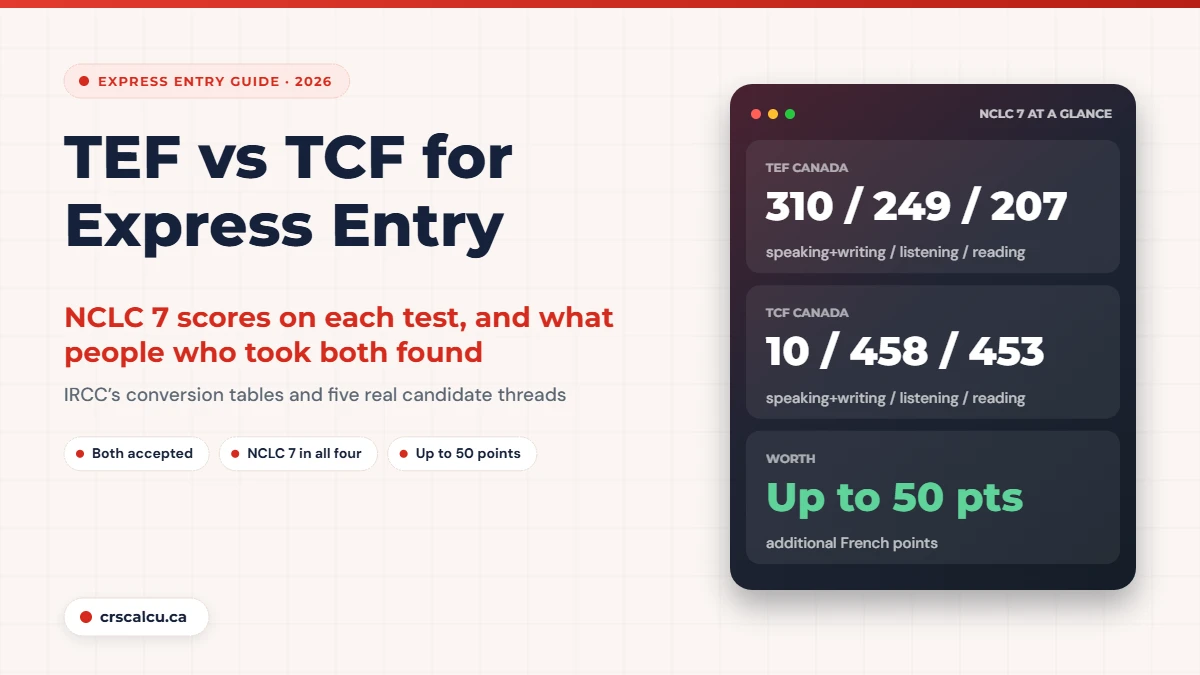
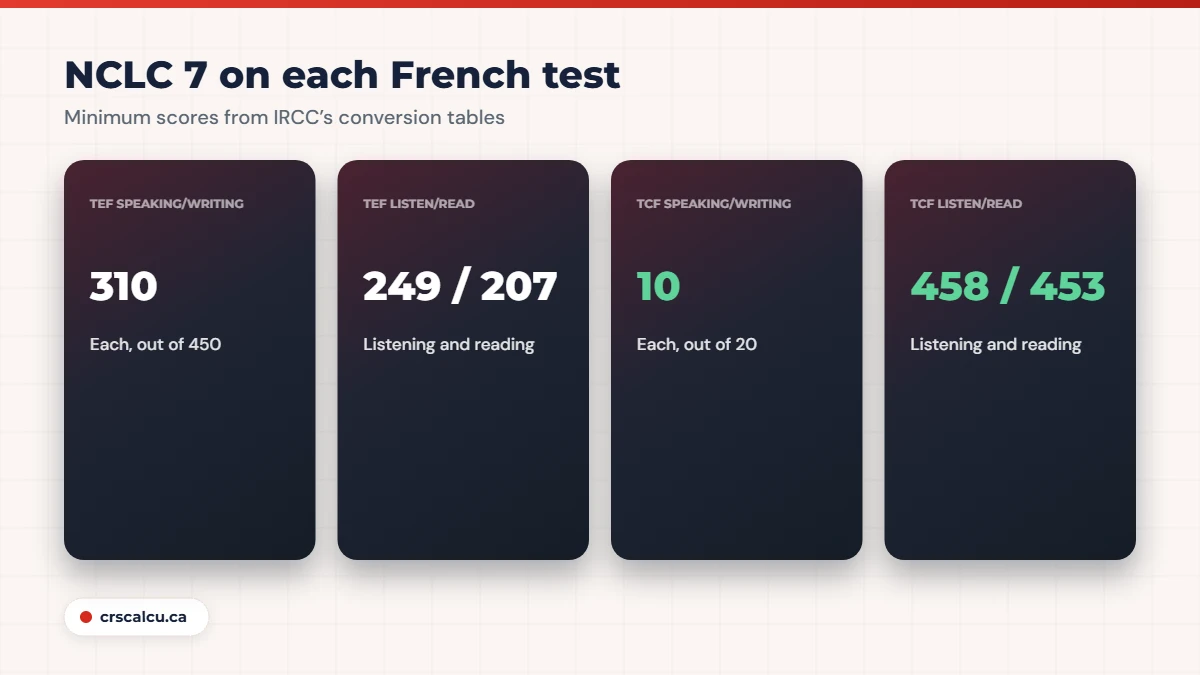
IRCC’s language page (modified June 22, 2026) lists TEF Canada and TCF Canada as the approved French tests and converts both to NCLC levels. Points depend only on the level. The level that matters most is NCLC 7 in all four abilities: it unlocks the additional French points and the French-language category. On TEF Canada that means 310 in speaking and writing, 249 in listening and 207 in reading. On TCF Canada it means 10 in speaking and writing, 458 in listening and 453 in reading. Candidates who took both reported different strengths on each.
Key takeaways
TEF vs TCF for Express Entry: what IRCC says
The official side is simple. Under French tests, IRCC lists TEF Canada (Test d’évaluation de français) and TCF Canada (Test de connaissance du français). Results must be less than two years old when you complete your profile and when you apply. Each test has a conversion table.
Ability | TEF Canada | TCF Canada |
|---|---|---|
Speaking | 310-348 | 10-11 |
Listening | 249-279 | 458-502 |
Reading | 207-232 | 453-498 |
Writing | 310-348 | 10-11 |
From IRCC’s “Express Entry: Language test results” page (modified June 22, 2026).
The two tests use different scales even within themselves. TCF Canada marks speaking and writing out of 20 and listening and reading on a scale that runs to 699. TEF Canada uses a different maximum for each ability. That is why you should never compare a TEF number with a TCF number directly. Convert each ability to NCLC first.
Level | TEF Canada (S / L / R / W) | TCF Canada (S / L / R / W) |
|---|---|---|
NCLC 5 | 226 / 181 / 151 / 226 | 6 / 369 / 375 / 6 |
NCLC 7 | 310 / 249 / 207 / 310 | 10 / 458 / 453 / 10 |
NCLC 9 | 371 / 298 / 248 / 371 | 14 / 523 / 524 / 14 |
Minimum score for each level, from IRCC’s conversion tables (modified June 22, 2026). S = speaking, L = listening, R = reading, W = writing.
Why NCLC 7 is the line that matters
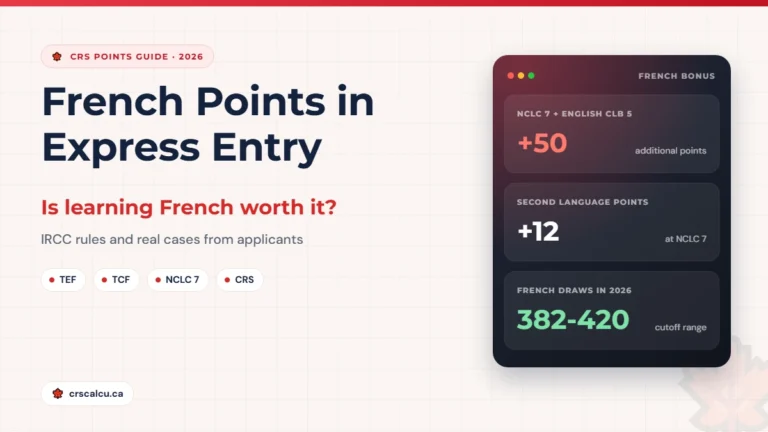
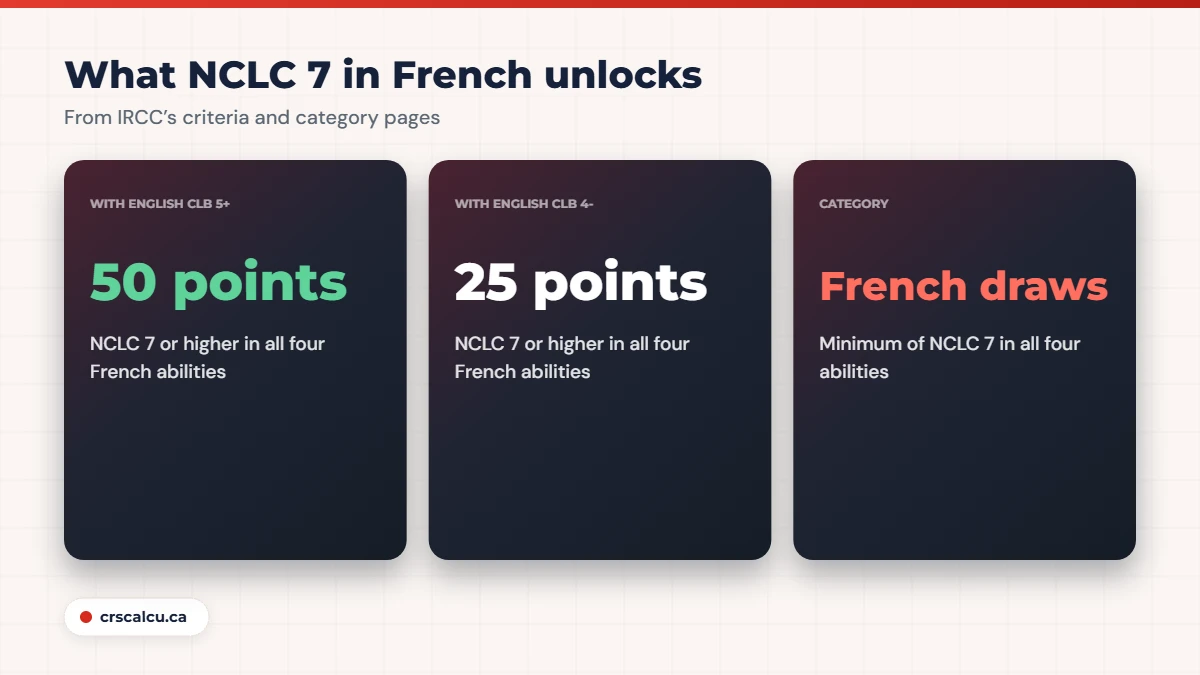
French earns points in three ways, and two of them switch on at NCLC 7.
What French is worth
“All four abilities” is the hard part. A candidate with three abilities at NCLC 8 and writing at NCLC 6 gets second-language points and nothing else. That is why the format of the weakest ability matters more than the overall difficulty of the test. Our CLB calculator converts scores for both French tests.
Here is the cost of one weak ability, in our own illustration. A candidate whose first language in the profile is English sits TCF Canada and scores 12 in speaking, 510 in listening, 505 in reading and 9 in writing. The first three are NCLC 8. Writing at 9 is NCLC 6. As a second language that earns 3 + 3 + 3 + 1, or 10 points. With one more mark in writing, to 10, all four abilities would be at NCLC 7 or above: 12 second-language points, plus the 50 additional points if their English is CLB 5 or higher, and eligibility for the French-language category. One mark in one ability is the difference between 10 points and 62.
TEF vs TCF for Express Entry: what candidates who took both reported
Real case: missed the points on one test, got them on the other (April 2021)
A candidate aiming for the 50 additional points took TEF Canada first. Speaking and listening were strong, but writing and reading came in below the level needed, and the points were lost. They then took TCF Canada and reached the level in all four abilities. Their explanation was mostly about reading and writing. They found the TCF reading section more manageable, with fewer questions in the same time and difficulty that rose steadily, where the TEF reading jumped between easy items and very hard literary passages. In writing, the TEF asked for a news-style story they found demanding, while the TCF set three shorter, more everyday tasks. They had studied French for about three years.
Real case: “TEF, because it has fewer tasks” (January 2019)
A learner at an intermediate level asked which test to take. Replies favoured TEF Canada. Their reasons: the writing and speaking parts each have two tasks where the TCF has three, more preparation material was available online, and listening was the easiest part while writing was the hardest. They advised timing practice answers and recording your own voice. One member said it had taken about a year and a half to reach an upper-intermediate level from scratch, and estimated two years to NCLC 7. The poster chose TEF Canada.
Real case: a native speaker found the TEF reading harder too (March 2020)
A self-taught learner worried about the speaking test asked which exam was easier for NCLC 7. One person who had sat both replied that the TCF felt slightly more accessible, mainly because the reading texts in the TEF seemed noticeably harder, and that they scored a little higher on the TCF. Their spouse, a native French speaker, had the same experience. Nobody else answered.
Three accounts, and the same two themes: reading leans toward the TCF, and the number of writing and speaking tasks leans toward the TEF.
The format differences candidates described
The following comes from candidates’ descriptions between 2019 and 2021, not from the test providers. Formats are revised from time to time, so confirm each point on the providers’ own sites before you rely on it.
Part | TEF Canada | TCF Canada |
|---|---|---|
Reading | More questions in the hour; several questions per document; difficulty jumps around | Fewer questions; one document per question; difficulty rises gradually |
Writing | Two tasks, one a news-style story | Three shorter tasks in one hour |
Speaking | Two tasks | Three tasks, with a self-introduction and preparation time for a role-play |
Listening | Reported as broadly similar | Reported as broadly similar |
Our summary of candidates’ descriptions in forum threads from 2019 to 2021. Not official test specifications.
Real case: a detailed format comparison (August 2021)
A candidate holding advanced French diplomas asked which test to take. An experienced test taker set out the differences. In reading, one exam attaches several questions to each document and the other gives one document per question, which means more to read but a steady rise in difficulty. In writing, one asks for two tasks and the other for three short ones within the hour. In speaking, the harder version includes a monologue of several minutes with no preparation time. They also warned that both use recordings with Quebec accents that challenge even advanced learners. No decision was reported.
TEF vs TCF for Express Entry: how to choose
Real case: a beginner asks which is easier (October 2025)
A beginner wanted to know which test would be easier for raising their score. Members first asked which of the four abilities was their strongest, since the two tests suit different learners. Once it was clear the poster was just starting, they pointed out that NCLC 7 in every ability is an upper-intermediate level and recommended a tutor and conversation groups. One said the TCF is usually seen as a little more structured and predictable. Another found the TEF easier and said it depends on the person.
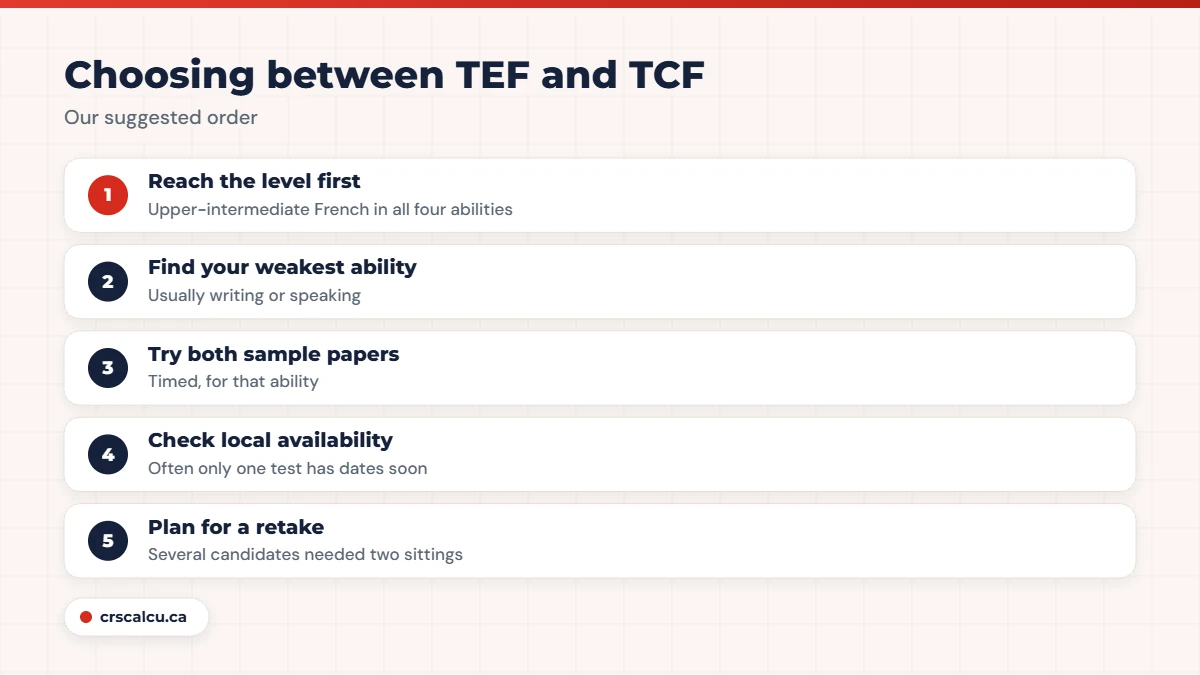
Our suggested order
You can enter French as your first or second language
The profile lets you choose which official language is your first. Points are calculated for a first and a second language, and the additional French points are on top. Run both arrangements through the CRS calculator before you submit, because the better order depends on your exact scores in each.
Five mistakes people make choosing a French test
Five mistakes from the rules and the threads
French does not replace the rest of the profile. Add your French levels to the CRS calculator and compare the total with the latest draw cut-offs. If you are also choosing an English test, see IELTS vs CELPIP for Express Entry and PTE Core for Express Entry.
Frequently Asked Questions
Is TEF or TCF better for Express Entry?
IRCC accepts TEF Canada and TCF Canada equally and awards points by NCLC level. Which is better for you depends on your weakest ability and on which test is available near you.
What TEF Canada score is NCLC 7?
310 to 348 in speaking, 249 to 279 in listening, 207 to 232 in reading and 310 to 348 in writing, according to IRCC’s conversion table.
What TCF Canada score is NCLC 7?
10 to 11 in speaking, 458 to 502 in listening, 453 to 498 in reading and 10 to 11 in writing.
How many points is French worth in Express Entry?
IRCC gives 50 additional points for NCLC 7 or higher in all four French abilities with CLB 5 or higher in all four English abilities, and 25 points if English is CLB 4 or lower. Second official language points are added separately.
Which French test has the easier reading section?
Three forum candidates who commented on reading, including one whose spouse is a native speaker, found the TCF Canada reading more manageable than the TEF Canada reading. That is their experience, not an official comparison.
Can I take both tests?
Yes. One candidate in a 2021 thread missed the level on TEF Canada and reached it on TCF Canada. You enter the results from one test report in your profile.
See what NCLC 7 adds to your score
Enter your French and English levels and compare your total with recent Express Entry cut-offs.
Final Thoughts
TEF vs TCF for Express Entry is a choice between two routes to the same NCLC levels. On IRCC’s tables NCLC 7 is 310, 249, 207 and 310 on TEF Canada and 10, 458, 453 and 10 on TCF Canada. Candidates tended to find the TCF kinder in reading and the TEF lighter in the number of writing and speaking tasks. The only reliable way to choose is to try sample papers for your weakest ability on each.
Learning French to NCLC 7 is a project of a year or more for most adults, and the points are only worth it if the rest of your profile is close. If you are weighing that against other options, such as a provincial program or more work experience, a licensed consultant can help you compare the routes for your situation.