Express Entry Guide · Updated October 2026
Canadian Work Experience Points in Express Entry: The CRS Table, the Second-Year Jump and Counting It Right (Real Cases)
One more year of work in Canada is worth 13 points on the table everyone looks at, and often another 12 to 25 on the one they do not. Here is the full count.
Canadian work experience points are the reason so many Express Entry candidates are already in Canada when they apply. A year of skilled work here opens the Canadian Experience Class, earns points in the core part of the ranking score, and then earns more in a second section that pairs it with your education and your foreign experience.
New rules, November 3, 2026: From November 3, 2026, Canadian work experience points move into a new Labour Market Integration factor: the same 40-80 points (35-70 with a spouse) for work length, plus 20, 40 or 70 more for at least 12 months (1,560 hours) in high-wage occupations. IRCC pauses rounds for up to two weeks while it recalculates profiles. Check your score under the new rules · IRCC details
It is also the factor people most often miscount. The profile asks for a month and a year, not a day. The system can credit a year you have not quite finished. Work done as a student or as a contractor looks like experience and is not scored as such. And the jump at the second year is larger than the main table suggests, which leads candidates to accept invitations a few weeks too early.
We read IRCC’s ranking criteria, its Canadian Experience Class page and a Help Centre answer, along with four public forum threads from 2017 to 2019 in which applicants watched their score change at the one-year and two-year marks and asked what they could safely claim.
Quick answer: how many Canadian work experience points do you get?
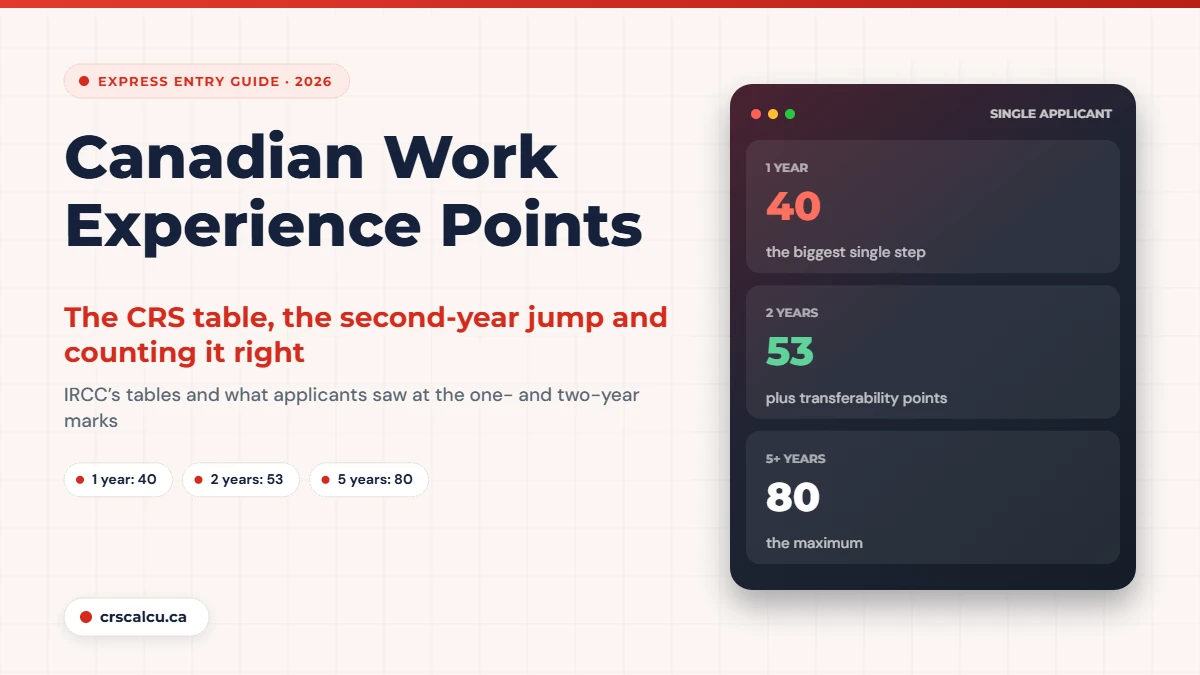
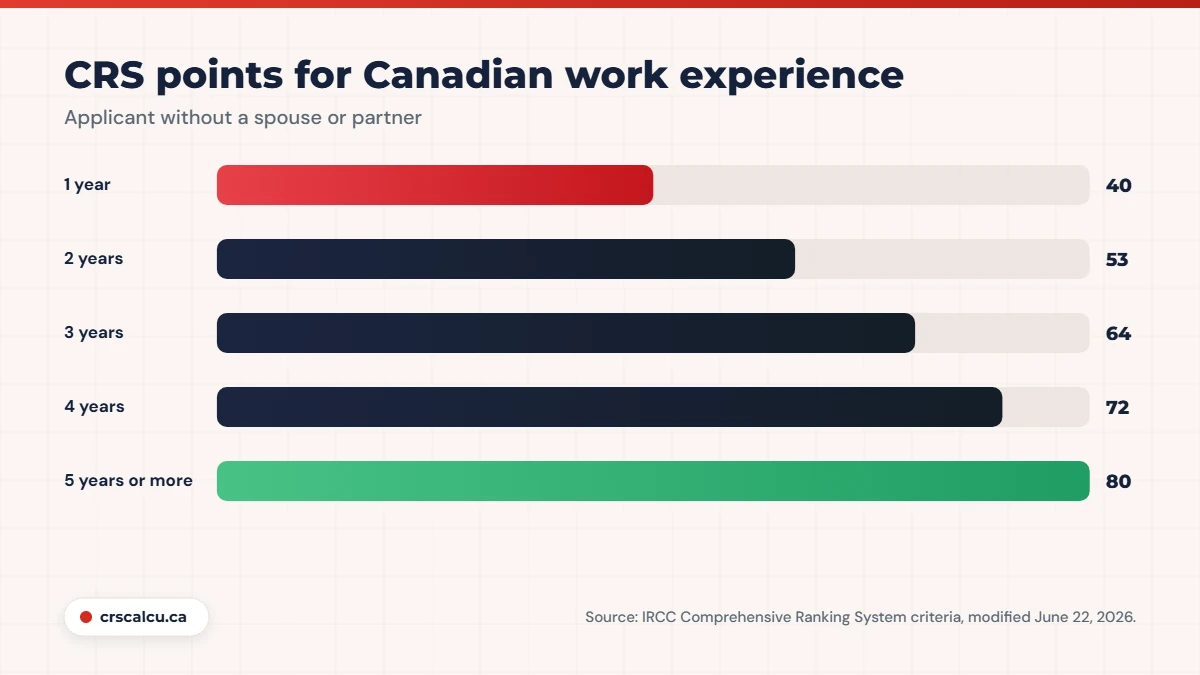
On IRCC’s core table (modified June 22, 2026), a single applicant gets 40 points for one year, 53 for two, 64 for three, 72 for four and 80 for five or more. With a spouse or partner the figures are 35, 46, 56, 63 and 70. Canadian experience then earns skill transferability points when combined with a post-secondary credential or with foreign work experience. It must be skilled work for a Canadian employer, done in Canada. How a “year” is measured is explained in 1,560 hours for Express Entry.
Key takeaways
The core table for Canadian work experience points
Canadian work experience | With a spouse or partner | Without |
|---|---|---|
None, or less than 1 year | 0 | 0 |
1 year | 35 | 40 |
2 years | 46 | 53 |
3 years | 56 | 64 |
4 years | 63 | 72 |
5 years or more | 70 | 80 |
From IRCC’s Comprehensive Ranking System criteria (modified June 22, 2026).
The first year is worth the most by far: 40 points from nothing. After that the steps shrink: 13, then 11, then 8, then 8 for a single applicant. If you are choosing between another year of work and a language retake, that shape matters. One language ability moving from CLB 8 to CLB 9 is worth 8 points by itself.
What counts as Canadian work experience
IRCC’s criteria define the term in two sentences: Canadian work experience means working for a Canadian employer in Canada, and working remotely counts if you were physically in Canada. The program page and Help Centre add the limits.
For the experience to count
Less than a year, and years that are not continuous
Below one full year the core table gives nothing. Eleven months of skilled work in Canada scores the same as none, and it does not open the Canadian Experience Class either. If you are that close, the points arrive all at once when the year completes, so it is usually worth waiting to enter the pool, or entering now under another program if you qualify and updating the profile later.
The year does not have to be continuous for this purpose. IRCC’s comparison of the programs asks the Canadian Experience Class for one year in Canada in the last three, and forum members regularly point out that the requirement for continuous work belongs to the Federal Skilled Worker Program, not to this one. Two six-month contracts with a gap between them can add up to a year, as long as each was skilled, paid and authorized.
Canadian work experience points and the second-year jump
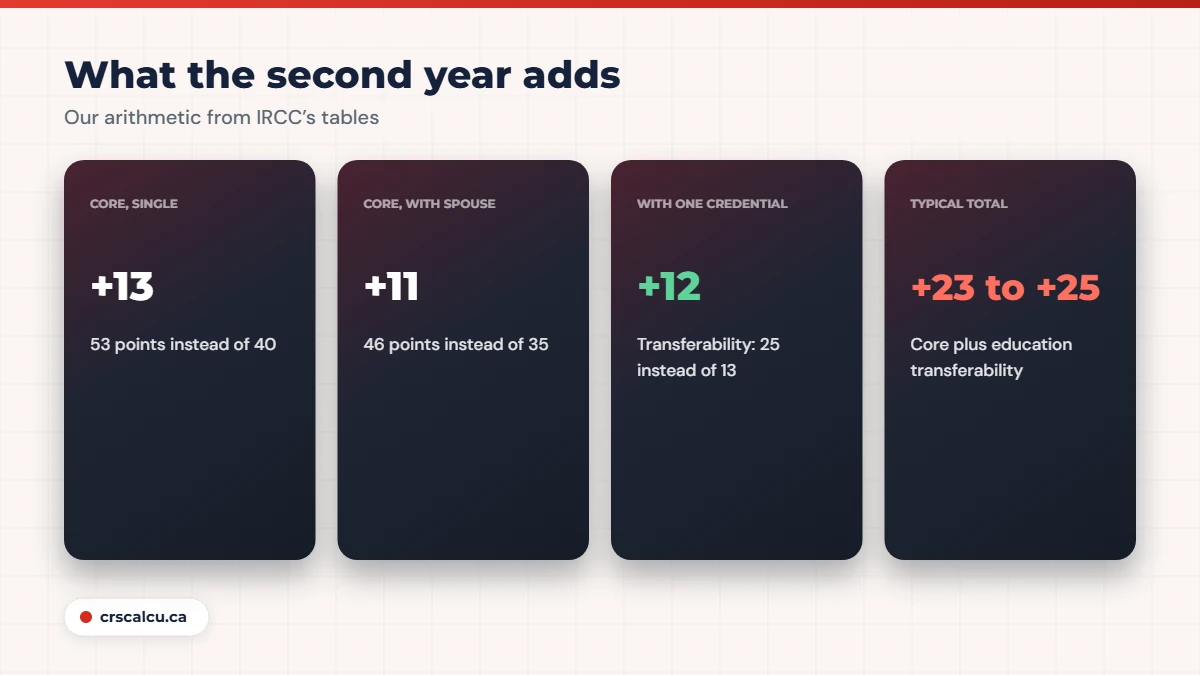
Most of the excitement in forum threads is about the day the second year completes, and the table above undersells it. The core score rises by 13 for a single applicant, or 11 with a spouse. The skill transferability section moves at the same moment.
Combined with | 1 year in Canada | 2 years or more |
|---|---|---|
One post-secondary credential | 13 | 25 |
Two or more credentials, a master’s or a doctorate | 25 | 50 |
1 or 2 years of foreign work experience | 13 | 25 |
3 or more years of foreign work experience | 25 | 50 |
From IRCC’s criteria (modified June 22, 2026). The education combinations are capped at 50 points together, the foreign work combinations at 50, and the whole section at 100.
Real case: from 451 to 474 overnight (December 2019)
A candidate saw their score rise from 451 to 474 when their second year of Canadian work was completed, and asked whether that was right. A moderator pointed them to the Canadian work experience section of the official scoring grid. No one broke the number down in the thread.
We can. A gain of 23 fits the with-spouse grid exactly: 11 more core points for the second year, and 12 more in transferability as one credential combined with Canadian work goes from 13 to 25. For a single applicant with a bachelor’s degree the same moment is worth 13 + 12, or 25. Someone who also has a year or two of foreign experience gains another 12 on top.
Month and year, not days: the timing trap
The profile records each job by start and end month. The system counts from those, and it can award the next year’s points before you have truly completed the year.
Real case: invited on two years with 22 and a half months worked (March 2017)
A Canadian Experience Class candidate was invited with a score that included two years of experience. By their own count they had worked 22 months and 15 days. They asked whether to submit straight away or wait. One member added up the months as entered and reached 24. A veteran corrected the method, saying experience is counted in weeks and that the applicant is responsible for getting it right. The practical advice was to prepare documents and submit only once two full years were complete, which fell inside the time allowed to respond.
Real case: started in mid-April, counted from the first (March 2017)
In another thread a worker who began a job on April 18 asked how the system would count their time. Members explained that it works from the month and year, so it may credit a year or two slightly early, and that if you are invited on that basis you must really have the experience on the day you submit the application. Otherwise the points are lost and the application can fail. One member added that experience counts only from the date you had authorization to work. A later commenter said their own application had been refused after their work dates overlapped with full-time study and the points were taken away.
IRCC’s page for invited candidates covers the general case: if your situation has changed, recalculate before applying, and if your score is below the lowest score in your round, decline. We explain how in declining an ITA. An invitation is valid for 60 days, which is often enough to finish the missing weeks: see Express Entry ITA deadline.
Count in weeks before you count in years
For each job, work out the actual number of weeks worked at 30 hours or more, and convert part-time weeks by hours. One year is 1,560 hours. Only when your own total passes the next threshold should you treat the points on your profile as real. Keep the calculation with your reference letters.
What Canadian experience does to foreign experience
Foreign work experience earns no core points. It only earns transferability points, in combination with language or with Canadian work. That is why a detail in one forum thread surprised people.
Real case: “one year or two, no difference” (July 2018)
A candidate noticed that entering one year of foreign work experience or two produced the same ranking score. A member confirmed it: in the ranking system, foreign experience is banded as one to two years, then three or more. The difference between one and two years does matter on the separate 67-point grid for the Federal Skilled Worker Program. The poster found that odd but accepted it.
The table above shows the bands. With one year in Canada, one or two foreign years add 13 points and three or more add 25. With two Canadian years those figures double. So a third foreign year, or a second Canadian year, can each move this part of the score. Our guide to foreign work experience has the language side of the same table, and 67 points for Express Entry covers the other grid.
Your spouse’s Canadian work
An accompanying spouse or partner’s Canadian work experience also scores, on a small scale: 5 points for one year, 7 for two, 8 for three, 9 for four and 10 for five or more. If both of you work in skilled jobs in Canada, it is worth checking which of you scores higher as the principal applicant.
Our example: one worker over three years
This is our own illustration from IRCC’s tables, for a single applicant with a bachelor’s degree and no foreign experience.
Canadian experience | Core | With education | Total |
|---|---|---|---|
1 year | 40 | 13 | 53 |
2 years | 53 | 25 | 78 |
3 years | 64 | 25 | 89 |
Our arithmetic from IRCC’s criteria. Language, age and education points are not shown.
The second year adds 25 points for this person. The third adds 11. After two years, extra time in Canada still helps, but slowly, and each birthday past 29 takes age points away at the same time. For many candidates the best moment to be in the pool is shortly after the second year completes.
Five mistakes people make counting Canadian experience
Five mistakes from the rules and the threads

Enter your real dates in the CRS calculator and compare the result with the latest draw cut-offs. If you are a few weeks short of a threshold, you will see exactly what waiting is worth.
Frequently Asked Questions
How many CRS points is one year of Canadian work experience?
40 points for an applicant without a spouse or partner and 35 with one, on IRCC’s core table. It can also earn 13 or 25 skill transferability points when combined with a post-secondary credential or foreign work experience.
How many points do I gain in my second year?
On the core table, 13 more for a single applicant (53 instead of 40) or 11 with a spouse. Transferability points for education or foreign experience combined with Canadian work also rise, typically by 12 or 25.
Does work as a student in Canada earn these points?
No. IRCC’s Help Centre says Canadian work experience gained while you were a full-time student does not count toward your ranking score.
The system gave me points for two years but I am a few weeks short. Can I apply?
You must actually have the experience when you submit your application. Forum members advised finishing the missing weeks within the 60 days of the invitation, or declining if you cannot.
Does part-time work in Canada count?
Yes, if it is skilled and paid. Part-time hours add up toward 1,560 hours for each year. Hours above 30 a week are not counted.
Does my spouse’s Canadian work experience count?
Yes, if they are accompanying you: 5 points for one year, rising to 10 for five or more.
See what your next year of work is worth
Enter your real dates and compare your total with recent Express Entry cut-offs.
Final Thoughts
Canadian work experience points come in two layers. The core table gives 40 points for the first year and smaller steps after it. The skill transferability section then pairs that experience with your education and foreign work, which is why the second year is worth far more than 13 points to most candidates. Count your own weeks, and do not rely on points the system has awarded a little early.
If your experience includes periods as a student, on maintained status, as a contractor or working from abroad, or if you were invited on a year you have not finished, speak to a licensed consultant or lawyer before you submit. The dates in a work history are among the first things an officer checks.