Express Entry Guide · Updated October 2026
Remote Work for Express Entry: When It Counts as Canadian Experience and When It Does Not (Real Cases)
Two questions decide everything: where were you sitting, and who was paying you. Get either one wrong and a year of work lands in the wrong column, or in none.
Remote work for Express Entry used to be a niche question. Since 2020 it has been one of the most common, because a large share of applicants have spent at least part of their qualifying year at a kitchen table, and some of them spent it at a kitchen table in another country.
IRCC’s answer is now written into both the program page and the scoring criteria, and it is short. What the pages do not do is walk through the combinations: Canadian employer but you were abroad for two months, foreign employer but you were in Toronto, a payroll company in the middle. Those are where applicants get hurt, and at least one has been refused over it.
We read IRCC’s Canadian Experience Class page and the Comprehensive Ranking System criteria, and six public forum threads from 2020 to 2024 covering each of those combinations, including a refusal and an applicant who was advised to decline an invitation.
Quick answer: does remote work count for Express Entry?
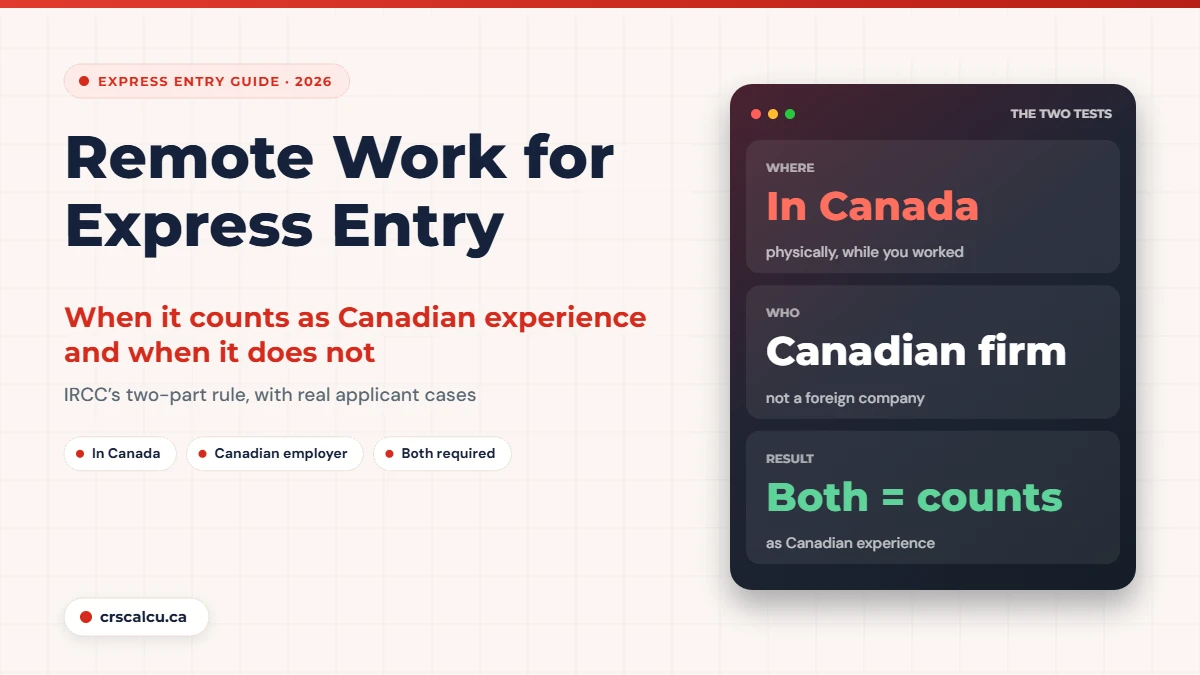
As Canadian experience, only on two conditions. IRCC’s Canadian Experience Class page (modified September 24, 2026) says that if you worked remotely, you must have been physically in Canada and working for a Canadian employer. The scoring criteria say the same: Canadian work experience means working for a Canadian employer in Canada, and remote work counts if you were physically in Canada. Remote work done outside Canada is not Canadian experience, whoever the employer is. For the hours you need, see 1,560 hours for Express Entry.
Key takeaways
The rule on remote work for Express Entry
Two official sentences set it out.
The Canadian Experience Class page says your skilled work must be gained by working in Canada while you had temporary resident status, and adds: if you worked remotely, you must have been physically in Canada and working for a Canadian employer.
The Comprehensive Ranking System criteria (modified June 22, 2026) define the term used for points: Canadian work experience means working for a Canadian employer in Canada. Working remotely counts if you were physically in Canada.
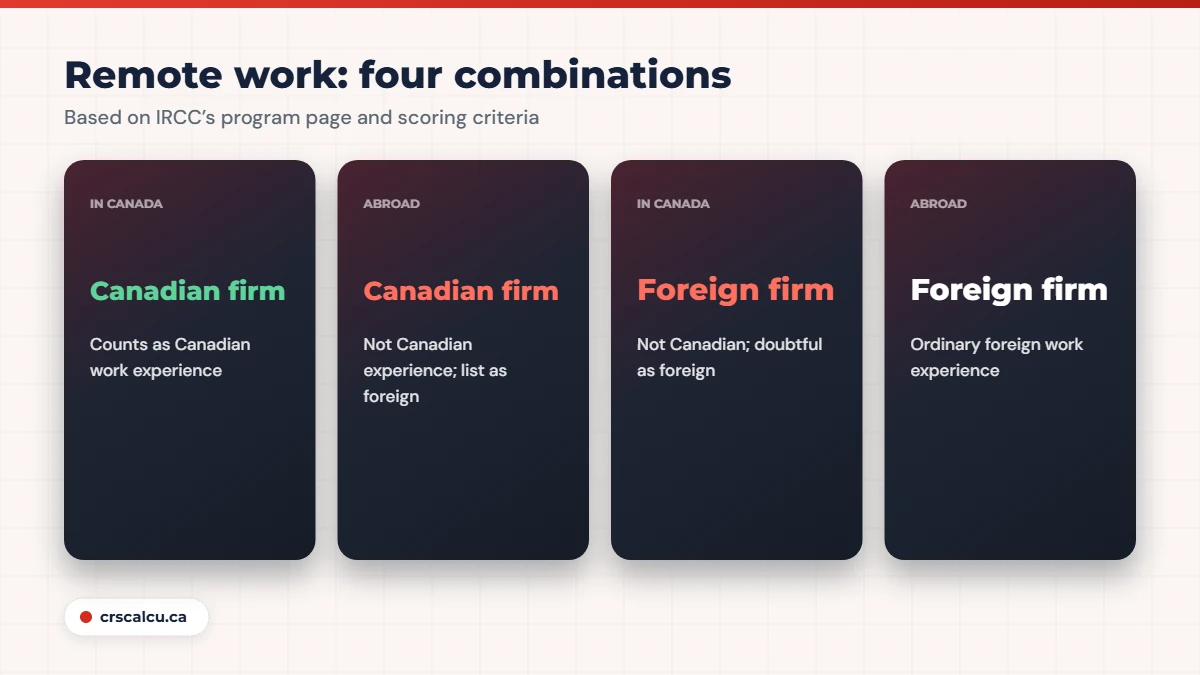
So there are two tests, and both must be met: your location and your employer. That gives four combinations.
Where you were | Employer | Canadian experience? | What applicants were told |
|---|---|---|---|
In Canada | Canadian | Yes | Counts; accepted in a 2020 case |
Outside Canada | Canadian | No | List the period as foreign work experience |
In Canada | Foreign | No | Mixed advice; one refusal when claimed as foreign |
Outside Canada | Foreign | No | Ordinary foreign work experience |
Our summary. The “Canadian experience?” column follows IRCC’s Canadian Experience Class page and scoring criteria. The last column reflects the forum threads discussed below.
In Canada, for a Canadian employer: it counts
This is the straightforward case, and it covers most people who simply worked from home during a Canadian job.
Real case: working from home in Canada on a post-graduation work permit (June 2020)
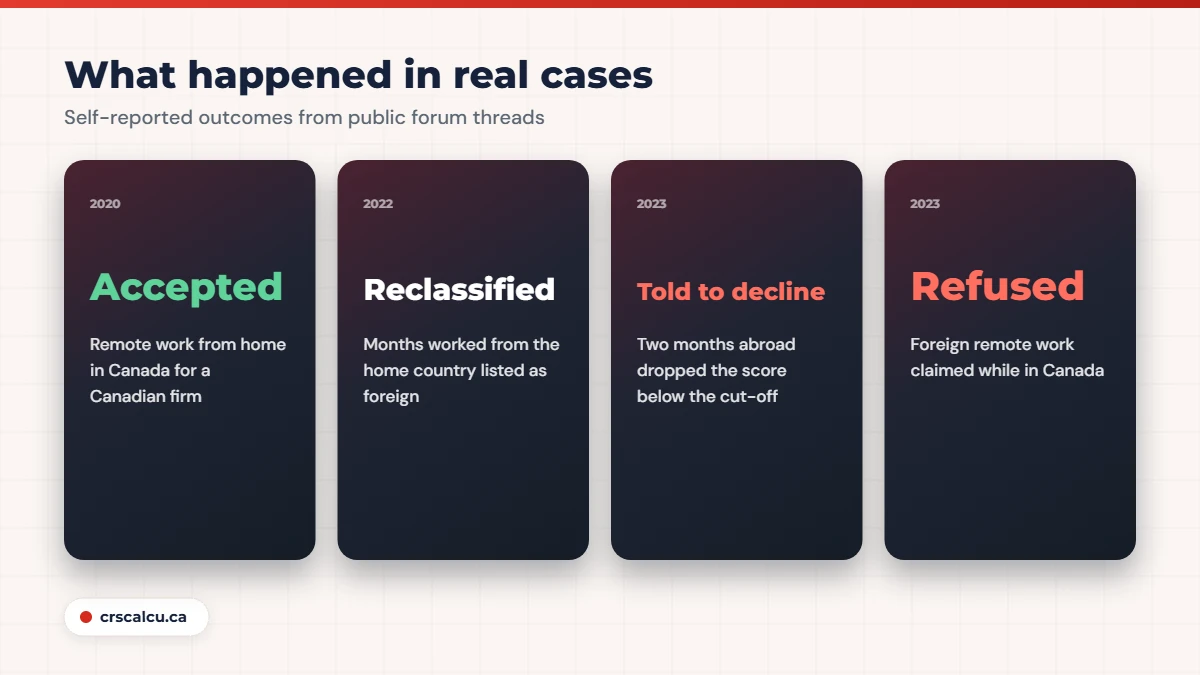
An applicant on a post-graduation work permit was working from home in Canada for a Canadian company and asked whether that would count as Canadian experience for the Canadian Experience Class. Several experienced members said yes, since the work was being done physically in Canada. They listed the usual proof: an experience letter with duties and salary, pay stubs and the year-end tax slip. A later participant in the thread reported that they had applied and their remote work was accepted as Canadian experience.
Nothing special is needed in the profile for this. It helps if your reference letter states that you worked remotely from a location in Canada, so the officer does not have to wonder.
Outside Canada, for a Canadian employer: it does not
This is the trap. You have a Canadian job, a Canadian salary and Canadian tax slips, and you spent part of the year working from your parents’ home abroad. The employer never changed. Your location did, and the rule turns on location.
Real case: seven or eight months worked from the home country (December 2022)
An applicant with two years on a post-graduation work permit had spent seven or eight months of it working remotely from their home country for the same Canadian employer. They asked whether those months counted for the Canadian Experience Class. An experienced member said only work physically performed in Canada qualifies, and told them to enter the remote period separately as foreign work experience so that they were not claiming points they were not entitled to, warning of the consequences of a false claim. The poster accepted that an invitation would take longer.
Real case: two months abroad, and an invitation that no longer fit (July 2023)
An applicant was invited under the Canadian Experience Class with two years of experience claimed. During those two years they had spent two months abroad for a family emergency, working remotely and receiving pay stubs throughout. Members said those two months could not be counted as Canadian experience and should have been listed separately as foreign. Without them, the applicant’s credited Canadian experience fell to about one year and their score dropped below the cut-off of the round that invited them. The main advice was to decline, correct the profile and wait. No outcome was reported.
The second case is the costly one. IRCC’s page on responding to an invitation says that if your recalculated score is below the lowest score in your round, you should decline. We explain how in declining an ITA. Finding the problem before you submit, as this applicant did, is far better than an officer finding it afterwards.
Count your days abroad before you count your weeks of work
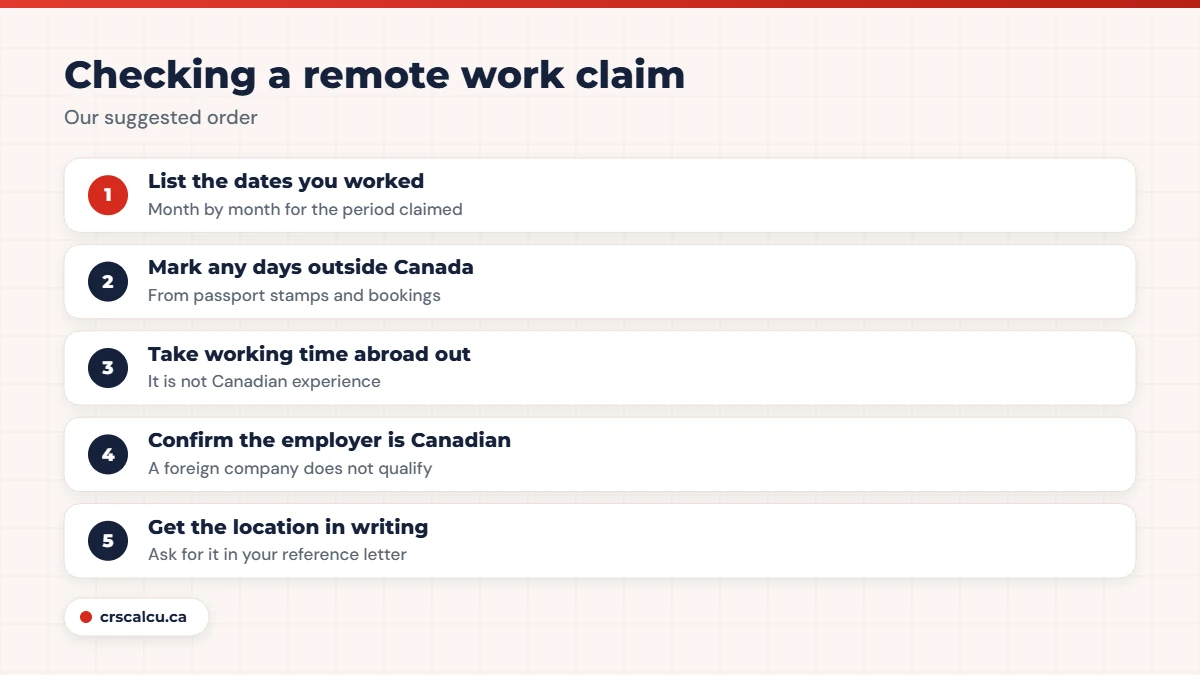
Go through your passport stamps and flight bookings for the period you are claiming. Any stretch where you were outside Canada and working is not Canadian experience. A two-week holiday where you did not work is leave. A two-month stay where you kept working is two months to take out. Our travel history guide shows how to rebuild the dates.
In Canada, for a foreign employer: the hardest case
Here the rule gives a clear “no” on one side and silence on the other. It is not Canadian experience, because the employer is not Canadian. Whether it can be claimed as foreign experience is where applicants have been caught.
Real case: refused after claiming remote foreign work done from Canada (August 2023)
An applicant under the Federal Skilled Worker Program was refused because the officer was not satisfied that they had been physically outside Canada for the foreign work experience they claimed. From 2020 to 2022 they had worked full-time abroad. From 2022 to 2023 they kept working remotely for the foreign employer while studying full-time in Canada. Members pointed to the wording of the Express Entry instructions, which describe foreign work experience as acquired outside Canada, and said that remote work done while physically in Canada does not qualify, whoever the employer is. No appeal or further outcome was reported.
Real case: a United States employer through a payroll company (March 2023)
A worker on an open work permit, already holding three years with a Canadian employer, was thinking of taking remote work for a company in the United States through a professional employer organization that would be the employer on paper in Canada. They asked how it would be classified. One member answered that it would not count toward the Canadian Experience Class but would count toward the Federal Skilled Worker Program. No outcome was reported, and a reader in the same position was still asking a year and a half later.
Those two threads point in different directions, and only one of them has a decision from an officer in it. We give more weight to the refusal. If you are physically in Canada, the safest reading is that work for a foreign company is neither Canadian nor foreign experience for points. The contractor version of this question is covered in self-employed work experience.
Outside Canada, for a foreign employer
This is ordinary foreign work experience and remote work changes nothing about it. If you worked from home in your own country for a company there, or for a company in a third country, it is foreign experience as long as it was skilled, paid and long enough. See foreign work experience for how it scores.
Whichever column a period falls in, remote work for Express Entry is still judged on the same basics as any other job: a skilled occupation in TEER 0, 1, 2 or 3, paid work, and hours you can document. Check the occupation with our NOC TEER finder before you worry about where your desk was.
Remote work for Express Entry: how to prove where you worked
Officers can compare your work dates against your travel history, your addresses and your entry records. Make it easy for them to reach the right answer.
Proof that supports a remote work claim
Five mistakes with remote work for Express Entry
Five mistakes from the rule and the threads
Once you have sorted each period into the right column, enter the figures in the CRS calculator and compare the result with the latest draw cut-offs. A slightly lower score that is accurate will get you further than a higher one that is not.
Frequently Asked Questions
Does remote work count for Express Entry?
As Canadian work experience, only if you were physically in Canada and working for a Canadian employer. IRCC states this on both the Canadian Experience Class page and the scoring criteria page.
I worked remotely from my home country for a Canadian company. Does it count?
Not as Canadian experience. IRCC requires that you were physically in Canada. Forum members advise entering that period separately as foreign work experience.
I live in Canada and work remotely for a foreign company. What is it?
It is not Canadian work experience, because the employer is not Canadian. Whether it counts as foreign experience is doubtful: in a 2023 forum case an applicant was refused after claiming remote foreign work done while physically in Canada.
I was abroad for a few weeks during my Canadian work year. Does that matter?
If you kept working while abroad, that time is not Canadian experience and should come out of your count. In a 2023 case, two months abroad reduced an applicant’s experience enough to drop them below the cut-off.
How do I prove I worked remotely from inside Canada?
Ask your employer to state your work location in the reference letter, and keep pay stubs, tax slips, a lease or address records, and a travel history that matches.
Does a hybrid job count?
Yes, if you were in Canada and the employer is Canadian. IRCC’s rule is about your physical location and your employer, not about whether you were in an office.
Sort your experience, then check your score
Put each period in the right column and see how your points compare with recent Express Entry cut-offs.
Final Thoughts
Remote work for Express Entry comes down to two facts: where you physically were and who employed you. In Canada for a Canadian employer, it is Canadian experience. Anywhere else, it is not, and the most a period abroad can be is foreign experience. The cases that went wrong all involved someone treating the employer’s location as their own.
If part of your qualifying year was spent abroad, if you work from Canada for a foreign company, or if you have already submitted a profile that counts those periods, speak to a licensed consultant or lawyer before you accept an invitation. Correcting a profile is simple. Correcting an application is not.