Express Entry Guide · Updated October 2026
TEER 4 and 5 in Express Entry: Why These Jobs Do Not Qualify and What Your Options Are (Real Cases)
Retail, caregiving, delivery, warehouse and many service jobs sit in TEER 4 or 5. Express Entry only counts TEER 0 to 3. Here is what that means and what you can still do.
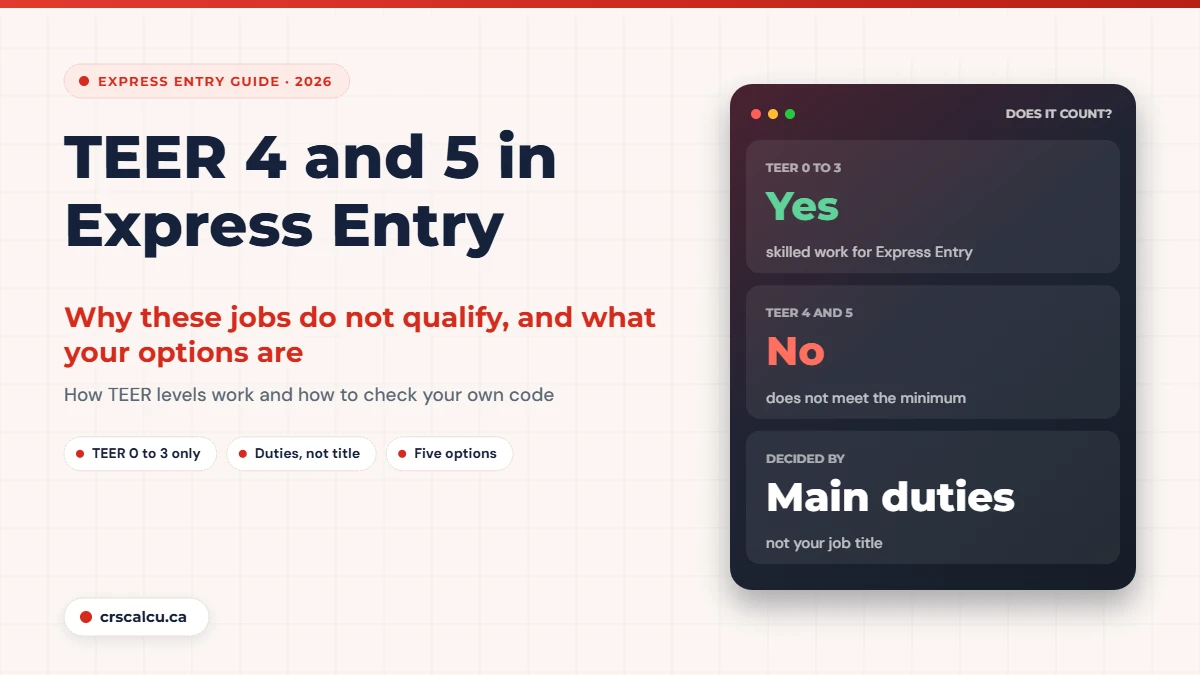
TEER 4 and 5 are the two categories of Canada’s occupation classification that Express Entry does not accept as skilled work. If your job falls in one of them, a year of it does not make you eligible for any of the three Express Entry programs, however hard the work is or however long you have done it.
That is a blunt rule, and it hits people who are already in Canada especially hard: caregivers, retail supervisors who are not classified as supervisors, delivery drivers, food counter staff, warehouse workers. Many of them only find out when they open a profile and the system tells them they are not eligible.
We read IRCC’s page on finding your occupation code, its comparison of the three programs and their eligibility pages, along with three public forum threads from 2022 to 2025 in which workers discovered their job’s category or tried to work out which code applied. This post explains the rule, shows how to check your own code properly, and sets out the options that are real.
Quick answer: can I use TEER 4 and 5 work experience for Express Entry?
No. IRCC’s program comparison (modified June 22, 2026) says the Canadian Experience Class and the Federal Skilled Worker Program need work experience in TEER 0, 1, 2 or 3, and the Federal Skilled Trades Program needs experience in specific trade groups. Work in TEER 4 or 5 does not meet any of those minimums. Before you give up, confirm your code using your main duties, not your job title, with our NOC TEER finder. Then look at the options below: other experience you may have, your spouse’s profile, a move into a TEER 3 role, or a provincial program.
Key takeaways
What TEER 4 and 5 mean
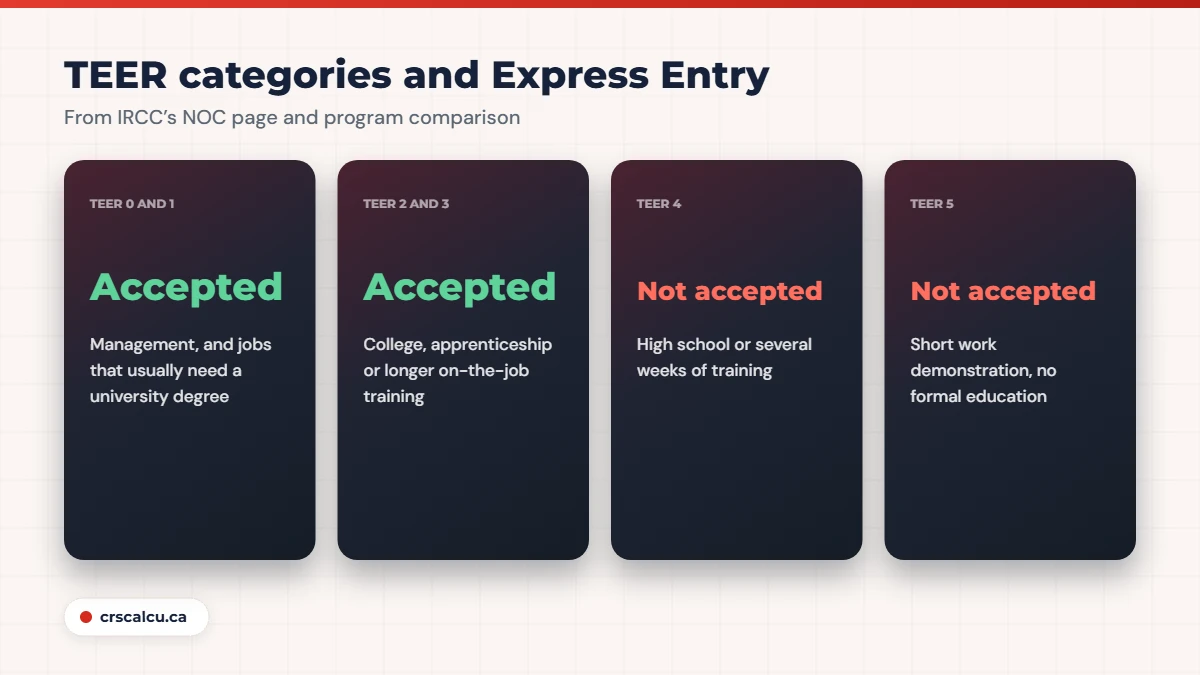
Canada’s National Occupational Classification sorts every occupation into one of six categories based on the training, education, experience and responsibilities it normally requires. IRCC’s page “Find your National Occupational Classification” (updated June 27, 2025) describes them with examples.
TEER | What it usually requires | IRCC’s examples | Express Entry? |
|---|---|---|---|
0 | Management occupations | Advertising managers, financial managers | Yes |
1 | A university degree | Financial advisors, software engineers | Yes |
2 | A college diploma, apprenticeship of 2 or more years, or supervisory role | Computer technicians, medical laboratory technologists | Yes |
3 | A college diploma, apprenticeship under 2 years, or more than 6 months of on-the-job training | Bakers, dental assistants | Yes |
4 | A high school diploma, or several weeks of on-the-job training | Retail staff, child care providers | No |
5 | A short-term work demonstration and no formal education | Landscaping labourers, delivery drivers | No |
Our summary of IRCC’s “Find your National Occupational Classification” page (updated June 27, 2025). The last column follows IRCC’s program comparison (modified June 22, 2026).
A practical tip for reading a code: in the current five-digit codes, the second digit is the TEER category. A code such as 64409 is TEER 4. A code such as 73300 is TEER 3. That one digit decides whether the job can be used for Express Entry.
Why Express Entry stops at TEER 3
All three programs define the work they accept in the same way. The comparison page says the Canadian Experience Class needs Canadian work experience in one or more of TEER 0, 1, 2 or 3. The Federal Skilled Worker Program needs experience in one of those same categories. The Federal Skilled Trades Program needs two years in listed trade groups. There is no route inside Express Entry for a principal applicant whose only work is in TEER 4 or 5.
The category also sets the language bar for the Canadian Experience Class: Canadian Language Benchmark 7 for TEER 0 or 1 occupations, and benchmark 5 for TEER 2 or 3. Our CLB calculator converts test scores.
Real case: the job that used to look eligible (November 2022)
When the classification changed in November 2022, a worker who believed they qualified under the Federal Skilled Worker Program found their occupation listed as TEER 4 and asked whether they could still submit a profile. One reply suggested simply trying. Another said TEER 4 would not be eligible and asked for the old code. It turned out to be a customer and information service role, which a senior member pointed out had been in the lower skill level under the old system too, and so mapped to TEER 4. The conclusion was that the occupation did not qualify. No further update was posted.
That thread is a reminder that the 2022 change did not create most of these exclusions. Jobs that were below the skilled levels before generally stayed below them. What changed is the labels.
Check your code properly: duties, not title
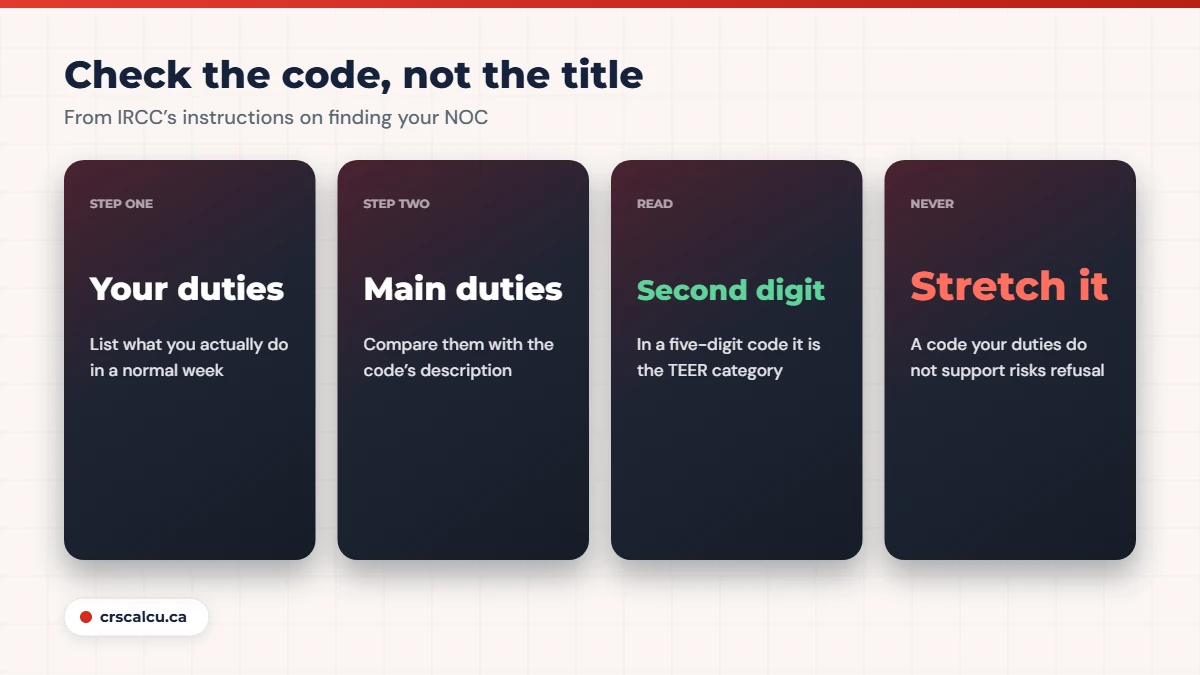
Before you accept that your job is TEER 4 or 5, check it the way IRCC tells you to. The page’s instructions are: search your job title, then make sure the main duties listed match what you did. If they do not, you need to find a different title with duties that match yours.
This cuts both ways. Some people are under-classified by a casual job title: a “team member” who in fact supervises staff, schedules shifts and handles cash reconciliation may be doing a TEER 2 supervisory job. Others reach for a higher code that the duties cannot support.
Real case: support worker, two possible codes (February 2024)
A direct support worker in group homes for people with disabilities asked whether they could use a nurse aide code, which is TEER 3, and whether the job title or the duties mattered more. Members said duties matter more than the title, and one suggested they also look at the home support worker code, which is TEER 4, warning that claiming a healthcare code they did not fit would be a mistake. The poster felt their duties matched each description about 60%. The thread ended without a decision, and a later reader asking how it turned out got no reply.
A 60% match to two codes is the worst place to be. An officer compares the duties in your reference letter with the lead statement and main duties of the code you chose. If most of them belong to another occupation, the experience can be rejected. We explain the consequences in wrong NOC code.
How to check your own code
Not everything that sounds unskilled is TEER 4 or 5
Some occupations people assume are excluded are in fact TEER 3 or 2.
Real case: a long-haul truck driver and some bad advice (January 2025)
Someone asked on behalf of a relative driving long-haul trucks in the Middle East, with no Canadian experience, whether Express Entry or a provincial program was the better route. One reply pasted an answer from an AI chatbot describing several provincial pathways. The original poster checked the details against official sources and found parts of it wrong, including a province’s requirement for experience inside the province. They then put together their own summary of seven provincial routes, each with its own language, experience and job offer rules. No outcome was reported.
Two lessons from that thread. Transport truck driver is code 73300, which by its second digit is TEER 3, so it is skilled work for Express Entry purposes. And second-hand summaries of provincial rules, from a chatbot or from a stranger, go out of date quickly. Check each province’s own website.
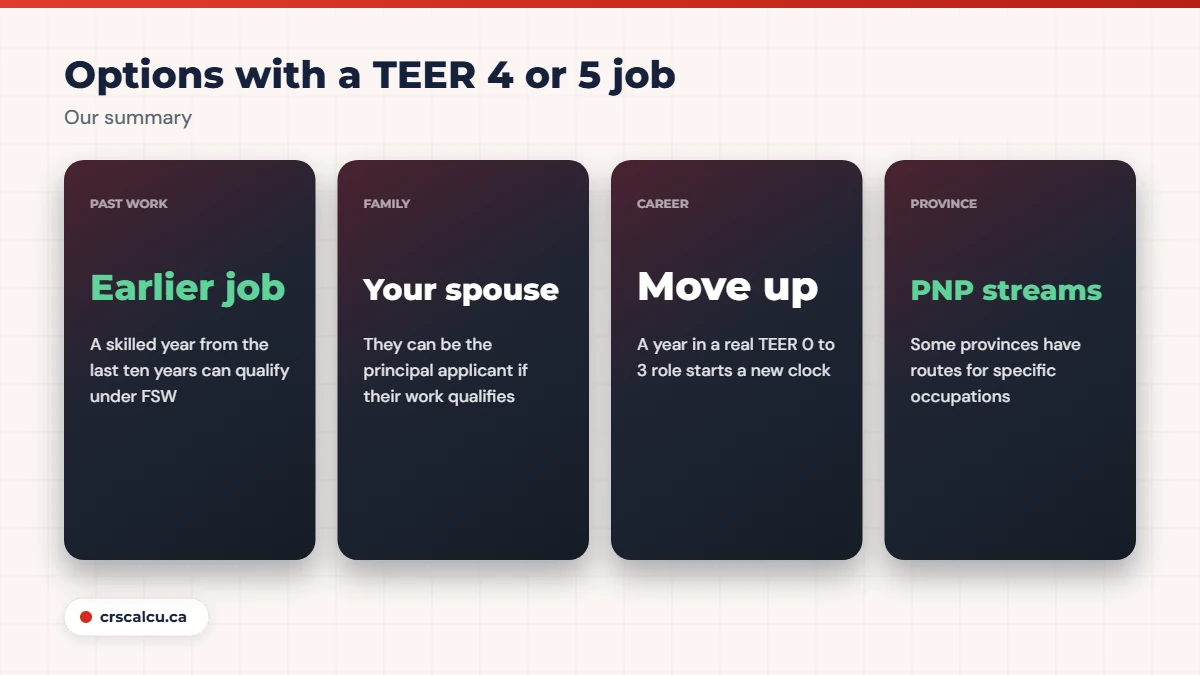
Five options if your job is TEER 4 or 5
Options that are real
A promotion on paper is not a promotion
If your title changes and your duties do not, your code has not changed. If your duties change and your title does not, it has. Ask your employer for a letter that describes the new responsibilities and the date they began, and keep pay records that show the change.
Here is how the first option plays out, in our own illustration. Someone works in Canada as a home support worker, a TEER 4 occupation. Before moving, they worked for three years as a registered nurse abroad, within the last ten years. The Canadian job does not open the Canadian Experience Class. The nursing years may still meet the Federal Skilled Worker minimum, as long as they were paid and continuous, the nursing occupation is the primary one in the profile, and the person has the language scores, the credential assessment and the 67 points that program asks for. The Canadian job is listed in the history and simply not counted as skilled work.
What to do with TEER 4 or 5 work in your profile
List it. Your work history and personal history must be complete, with no gaps, and leaving a job out creates a problem where there was none. Enter the correct code. The system will not treat it as skilled experience, and that is the accurate result.
Mistakes to avoid
If one of the options gives you a qualifying year, enter it in the CRS calculator and compare your score with the latest draw cut-offs.
Frequently Asked Questions
Can I apply for Express Entry with TEER 4 and 5 work experience?
Not on that experience alone. IRCC says the Canadian Experience Class and Federal Skilled Worker Program need work in TEER 0, 1, 2 or 3, and the Federal Skilled Trades Program needs experience in listed trade groups.
How do I know my job’s TEER category?
Find your occupation in the National Occupational Classification by matching your main duties, then read the code. In the current five-digit codes the second digit is the TEER category.
My job title sounds skilled but the code is TEER 4. Which counts?
The code that matches your duties. IRCC’s instructions say that if the main duties do not match, you need to find a different title with duties that match yours.
Can I choose a TEER 3 code if my duties partly match?
Only if you actually perform most of that occupation’s main duties and your employer’s letter will say so. A code your duties do not support can lead to refusal.
Does a year in TEER 4 count toward the 1,560 hours?
No. The hours must be in skilled work, meaning TEER 0, 1, 2 or 3. Time in a TEER 4 or 5 job does not count toward the minimum.
What are my options with a TEER 4 or 5 job?
Use earlier skilled experience under the Federal Skilled Worker Program, apply through a spouse whose work qualifies, move into a skilled role and build a year there, look at provincial programs, or retrain.
Found a qualifying year? See what it scores
Enter your skilled experience and compare your points with recent Express Entry cut-offs.
Final Thoughts
TEER 4 and 5 jobs are real work, and Express Entry still does not count them. Start by checking your code against your actual duties, because some people are in a higher category than they think and some are in a lower one. If the answer is TEER 4 or 5, the realistic routes are earlier skilled experience, a spouse’s profile, a move into a skilled role, a provincial program or new training.
If your duties sit between two codes, or your eligibility would depend on which one an officer accepts, speak to a licensed consultant or lawyer before you create a profile. The choice of code is the foundation of the whole application, and it is much easier to get right at the start.