Express Entry Guide · Updated October 2026
CRS Score Dropped After ITA: When It Matters and When It Does Not (Real Cases)
You were invited on one number and now your account shows a lower one. Whether that is a problem depends entirely on why it fell.
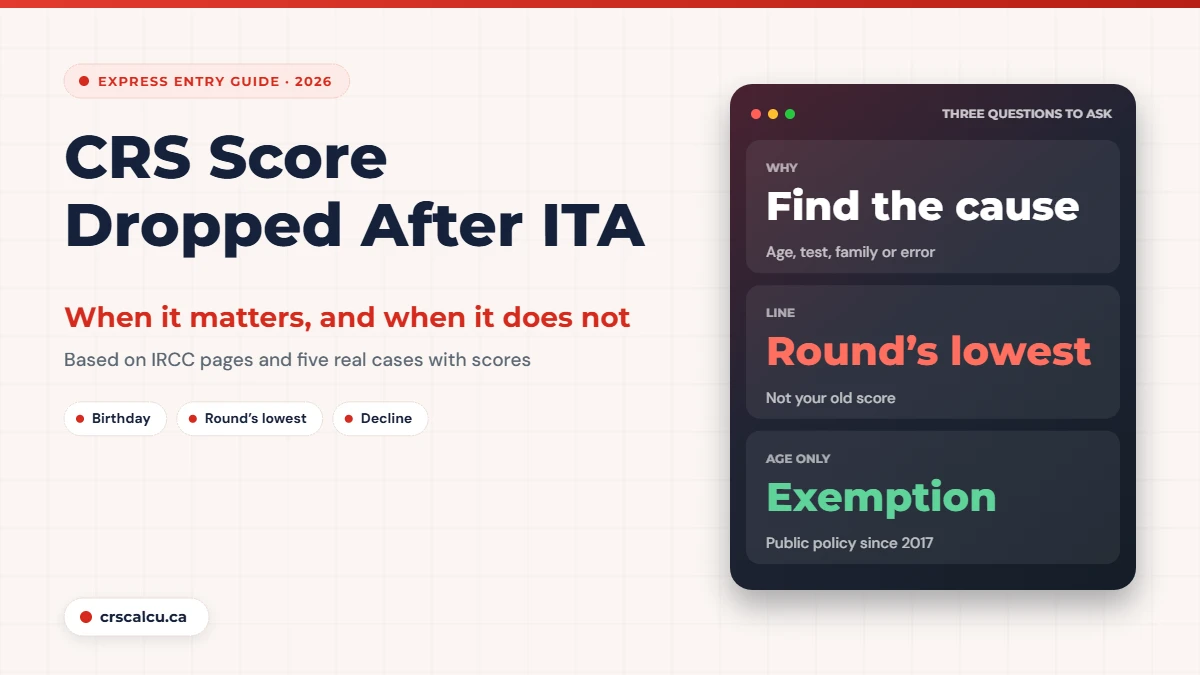
Seeing that your CRS score dropped after ITA is alarming, because the invitation was issued on the higher number and the application will be judged against the round you were invited in. Some drops are harmless. One kind has a written exemption. Others mean you should not apply at all.
The forum advice on this is a mess. “Points are locked at ITA” is repeated everywhere, and it is not what IRCC’s pages say. What IRCC says is to re-calculate when your situation changes, and to decline if you fall below the lowest score invited in your round. Alongside that sits a public policy from 2017 that deals with one specific cause: a birthday.
We read IRCC’s respond-to-invitation and application pages, the CRS criteria (all modified in 2026) and the public policy on age-based requirements, plus five public forum threads from 2017 to 2024 with real scores in them. This is general information, not legal advice.
Quick answer: what if your CRS score dropped after the invitation?
First find the cause. If the only cause is a birthday after the invitation, IRCC has a public policy that exempts applicants from the age-based points requirement between invitation and application. If the cause is anything else (an expired language test, a lost nomination, a change in family, or experience you counted wrongly), IRCC’s respond-to-invitation page applies: re-calculate, and if you are below the lowest score in your round, decline. Applying anyway can mean a refusal with no refund. Re-run your number in our CRS calculator before you decide.
Key takeaways
CRS score dropped after ITA: what IRCC’s pages say
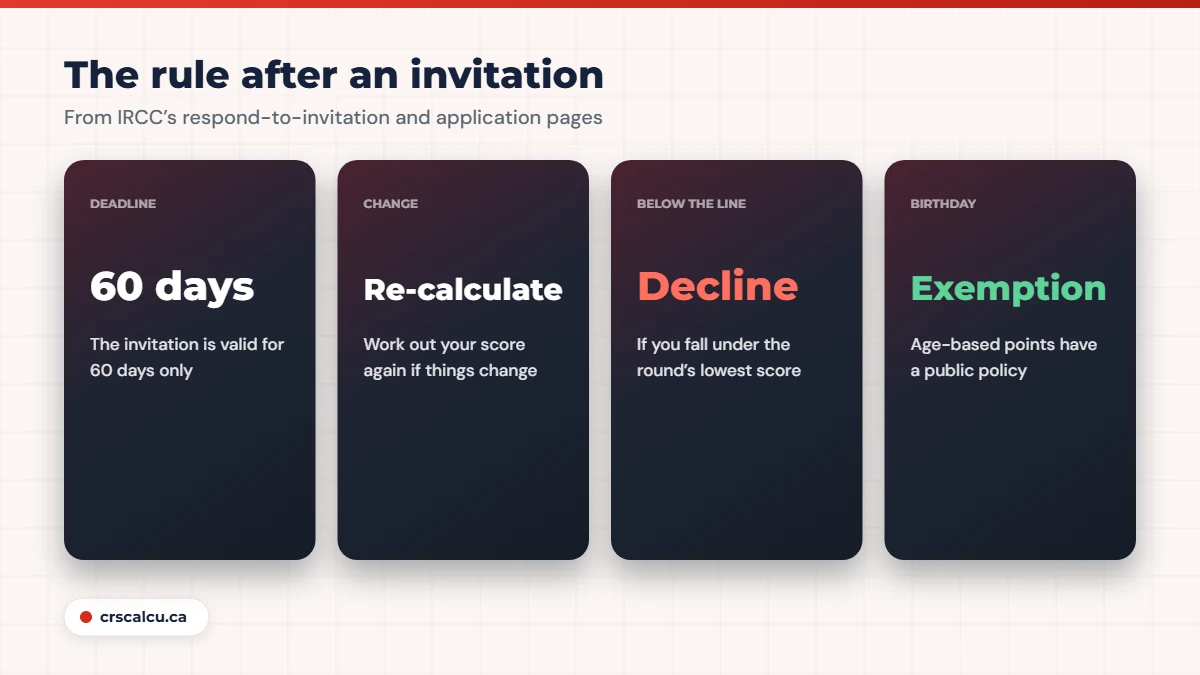
IRCC’s page on responding to an invitation (modified June 22, 2026) gives the general rule. An invitation is valid for 60 days only. If your situation changes, you should re-calculate your score. If the recalculated score is lower than the lowest score invited in your round, the page says you should decline the invitation. Declining puts you back in the pool, and it does not affect whether you are invited again.
The page on applying for permanent residence (modified June 22, 2026) explains why. It warns that certain changes can lower your score and lead to your application being refused without a refund of the fees, and it names three examples: a job offer that is no longer valid, a provincial nomination you have lost, and language test results that have expired.
So the comparison that matters is not “my score now against my score on invitation day”. It is “my score now against the lowest score invited in my round”.
Why the score fell: four causes, four different answers
Cause of the drop | What IRCC’s pages say | Our reading |
|---|---|---|
Birthday after the invitation | Public policy exempts age-based points requirements between invitation and application | Covered, but apply early if you can |
Language results expired | Named as a change that can lead to refusal with no refund | Not covered; retest or decline |
Provincial nomination lost | Named as a change that can lead to refusal with no refund | Not covered; 600 points gone |
Family change (spouse added, marriage, separation) | Re-calculate; decline if below the round’s lowest score | Depends on the new number |
Profile claimed more than you had | False or missing information can lead to refusal and a five-year bar | Not a drop; decline and correct |
Our summary of IRCC’s respond-to-invitation and application pages (modified June 22, 2026), create-profile page (September 24, 2026) and the public policy on age-based requirements (effective July 28, 2017). The third column is our reading.
The birthday case and the 2017 public policy
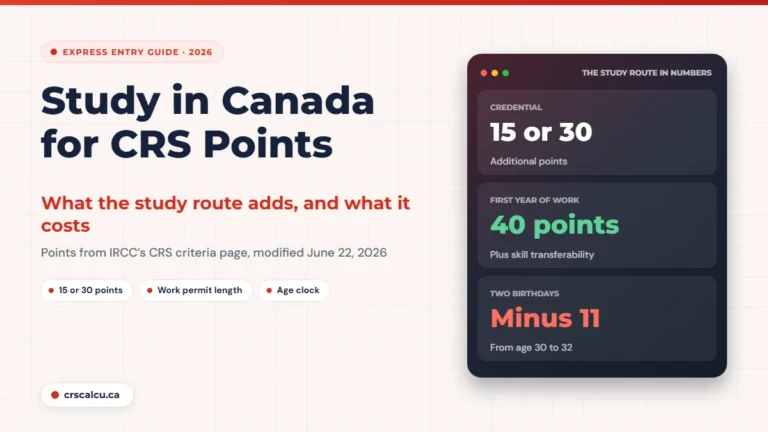
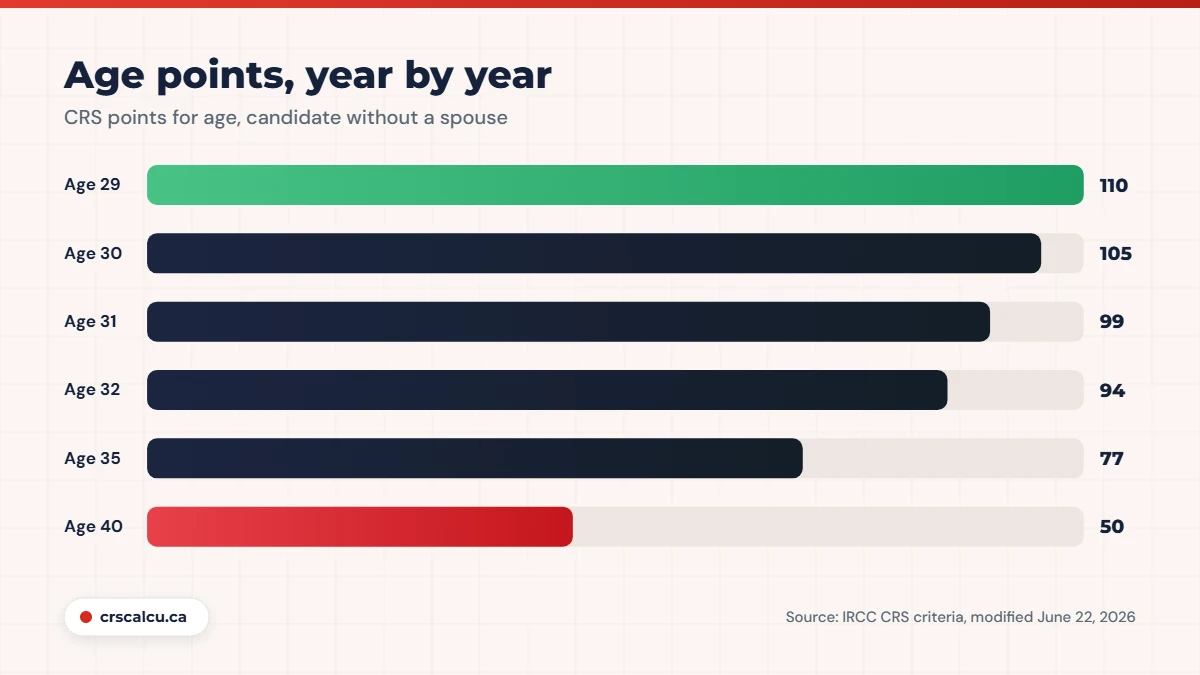
Age points fall on your birthday, every year from 30 onward. The CRS criteria page (modified June 22, 2026) gives a candidate without a spouse 110 points from age 20 to 29, then 105 at 30, 99 at 31, 94 at 32 and so on down to zero at 45. For a candidate in their thirties, a birthday inside the 60 days takes five or six points off, and for someone invited right at the cut-off, that is enough to slip under it.
IRCC dealt with this in a public policy that took effect on July 28, 2017. The policy page (last modified August 24, 2017) says it exempts applicants from the provisions that set the number of points required on the basis of age. It applies to people who applied for permanent residence after receiving an invitation and who no longer meet the age-based points requirement because their birthday came after the invitation was issued. It adds that they remain subject to all other criteria and obligations.
Two cautions. The page we read does not say whether the policy has been reviewed since 2017; it carries no end date and we found no notice withdrawing it. And forum replies that quote IRCC’s officer instructions describe the wording as officers “should consider” applying it, which is why experienced members still tell people to submit before the birthday when they can. We did not read those instructions ourselves for this post.
Real case: invited at 445, turning 31 inside the 60 days (October 2018)
A candidate was invited with 445 points, exactly the cut-off of the round, and would turn 31 before the deadline, which would bring the score to 440. The first replies said age is locked at invitation and nothing would happen. A later, more detailed reply said that is not quite right: the score is assessed again when the application is submitted, but a public policy exists for exactly this situation and officers are told to consider it. The advice was to submit before the birthday to keep things simple, because an exemption an officer considers is not the same as one that is automatic. No outcome was reported.
Real case: 525, then 511, then 506 against a cut-off of 509 (November 2024)
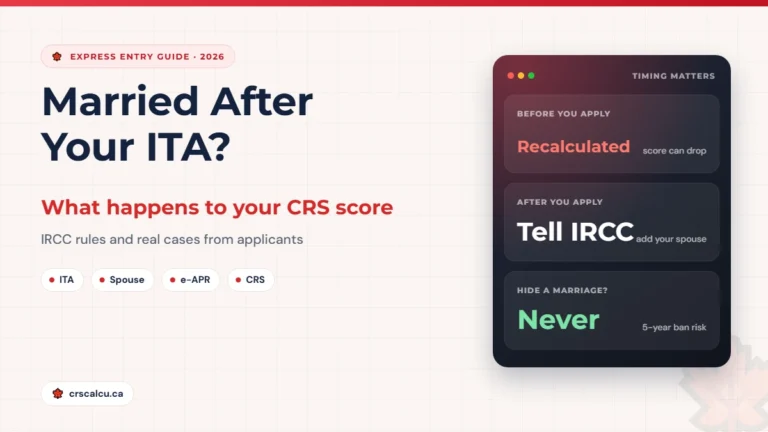
A Canadian Experience Class candidate was invited on September 19, 2024 with 525 points. When completing the application they added their spouse as accompanying, which brought the score to 511. A birthday between the invitation and submission took it to 506, three under the round’s cut-off of 509. They applied anyway with a letter of explanation pointing to the age policy. Replies thought that was the right step and advised against sending the same explanation again by web form. No final outcome was reported.
That second case is worth reading twice. The drop from 525 to 511 had nothing to do with age, and at 511 the applicant was still above 509. Only the last five points came from the birthday. If the spouse change alone had taken them below 509, the age policy would not have helped, because it exempts age-based requirements and nothing else.
Real case: score fell after the acknowledgment of receipt (August 2017)
An applicant invited in February with 449 points, in a round with a cut-off of 447, applied in April and got an acknowledgment that month. Checking the account in August, they saw 443, with nothing changed in their details. Replies worked out that a March birthday explained the six points, and a senior member said drops due to age between invitation and acknowledgment are usually disregarded. Another said that with the acknowledgment already in hand there was nothing to do. The applicant decided to wait and see. No outcome was reported.
When the drop is not about age
Everything else falls under the general rule, and the general rule is unforgiving.
Language results that expire
IRCC’s language page says test results must be less than two years old when you complete your profile and when you apply. Results that expire inside the 60 days are one of the three examples on IRCC’s application page. We cover the options in IELTS expired after ITA.
A nomination or a family change
A provincial nomination is worth 600 points; lose it and no ordinary profile survives the comparison. If the nomination depended on an employer, see lost job after ITA. Family changes cut both ways. Adding a spouse moves you to the lower “with a spouse” column, as the November 2024 applicant found, while a spouse who is not coming is scored differently; see non-accompanying spouse, common-law partner in Express Entry and divorce during Express Entry.
Experience you counted wrongly
Real case: 514 on the profile, 501 in reality (August 2024)
A candidate was invited with 514 points after claiming two years of Canadian work experience. Going through the documents, they realized they could only show one year, which put the true score at 501. They asked whether the application would be refused. The replies were blunt: if the real score is below the round’s cut-off, do not submit, and decline the invitation. One reply added a nuance: if the two years were only days away from being complete, check the exact dates before giving up. No outcome was reported.
This is not really a drop. The score was never 514. IRCC’s create-profile page (modified September 24, 2026) warns that false information or missing details can lead to refusal, a finding of inadmissibility and a five-year bar. An honest counting error caught before you apply costs you one invitation. The same error submitted as fact can cost far more. Our posts on 1,560 hours and how we calculate your score show how to count properly.
Real case: “does it matter?” (February 2017)
Before the public policy existed, a candidate invited at 445 asked whether an upcoming birthday that would take them to 440 would hurt. Replies said it would not and that they could still apply. In 2018, later posters in the same thread were told that points are locked after the invitation and that no letter of explanation is needed for a birthday. The original poster thanked the group; no outcome was reported.
That thread shows where “locked at ITA” comes from. It is a simplification of the age policy, stretched to cover every kind of drop. For a birthday it is close to true. For an expired test or a miscounted year it is wrong.
What to do in the 60 days
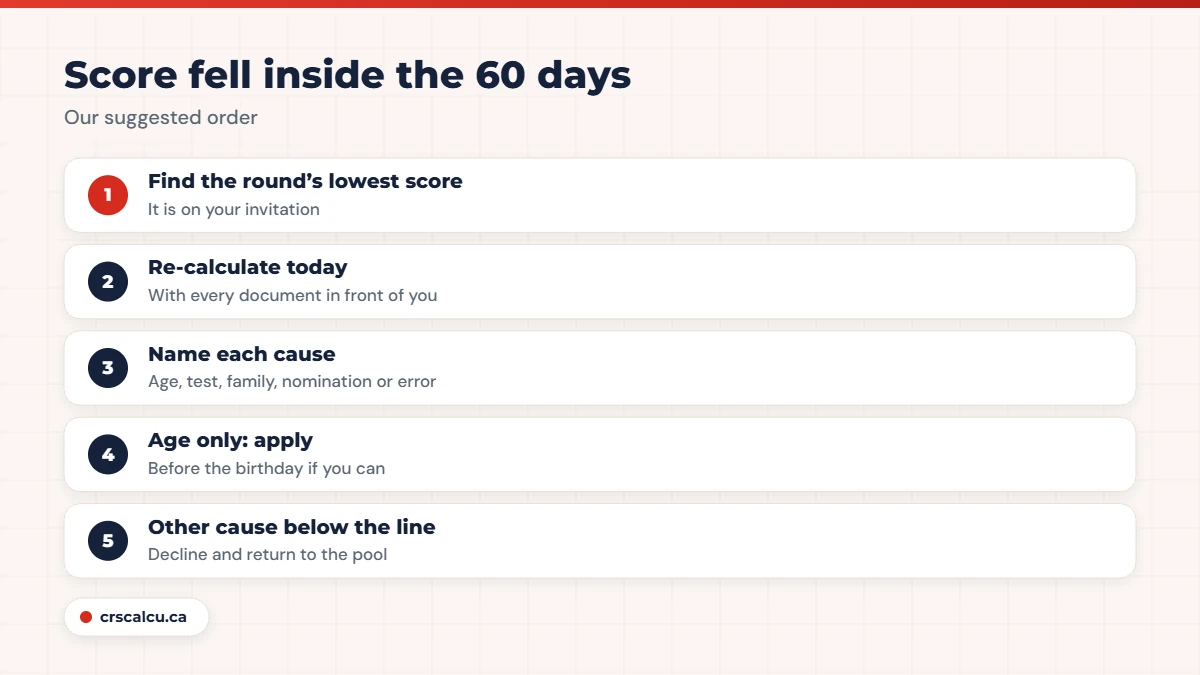
Our suggested order
Declining is not a penalty
IRCC’s respond-to-invitation page says that if you decline, you go back into the pool and it does not affect whether you are invited again. Letting the invitation expire without answering is different: the profile is removed and you have to start a new one.
CRS score dropped after ITA: five mistakes to avoid
Avoid these
What IRCC does not say
The public policy page does not say how often officers apply the exemption, and IRCC does not publish outcomes for applicants whose score fell for mixed reasons, such as a birthday plus a family change. We also did not find a public statement on what the account score shown after you apply means for the decision. If you want context for where your number sits, see what CRS score you need.
Frequently Asked Questions
My CRS score dropped after ITA because of my birthday. Will I be refused?
A public policy effective July 28, 2017 exempts applicants from age-based points requirements when the birthday falls after the invitation. Forum replies say officers are told to consider it, so applying before the birthday is the safer route when possible.
Are CRS points locked when I get the invitation?
Not according to IRCC’s pages. The respond-to-invitation page says to re-calculate if your situation changes and to decline if you fall below the lowest score of your round. Age is the one factor with an exemption.
My score fell but I am still above the cut-off. Is that a problem?
IRCC’s test is whether your recalculated score is below the lowest score invited in your round. If you are at or above it, the page does not tell you to decline. Apply with the true figures.
My language test expires during the 60 days. What happens?
IRCC’s application page names expired language results as a change that can lower your score and lead to refusal with no refund. Results must be valid when you apply.
Should I decline or just let the invitation expire?
Decline. IRCC says a declined candidate returns to the pool and that it does not affect later invitations. If the invitation simply expires, the profile is removed.
Do I need a letter of explanation for a birthday drop?
IRCC does not require one on the pages we read. In one 2024 case the applicant included a short letter citing the age policy, and replies thought that was sensible when the score had fallen below the cut-off.
Re-calculate before you submit
Enter today’s facts and compare the result with the lowest score invited in your round.
Final Thoughts
When a CRS score dropped after ITA, the cause is the whole question. A birthday has a written exemption. A drop that leaves you above your round’s lowest score is not a reason to decline. Anything else that takes you under that line is a reason to decline and try again.
If your score fell for more than one reason, if you have already applied on figures you now doubt, or if the deadline is days away, speak to a licensed immigration consultant or an immigration lawyer before you submit.