Express Entry Guide · Updated October 2026
Express Entry Application Refused: Reasons, Refunds and How to Apply Again (Real Cases)
A refusal is not always the end, and not all refusals are the same. The first job is to work out which kind you have.
Having an Express Entry application refused after months of tests, documents and fees is a hard day. The letter is usually short, and the first instinct is to argue with it. Before you do, read it for one thing: the reason. What you can do next, whether you can apply again, and which fees you get back all follow from it.
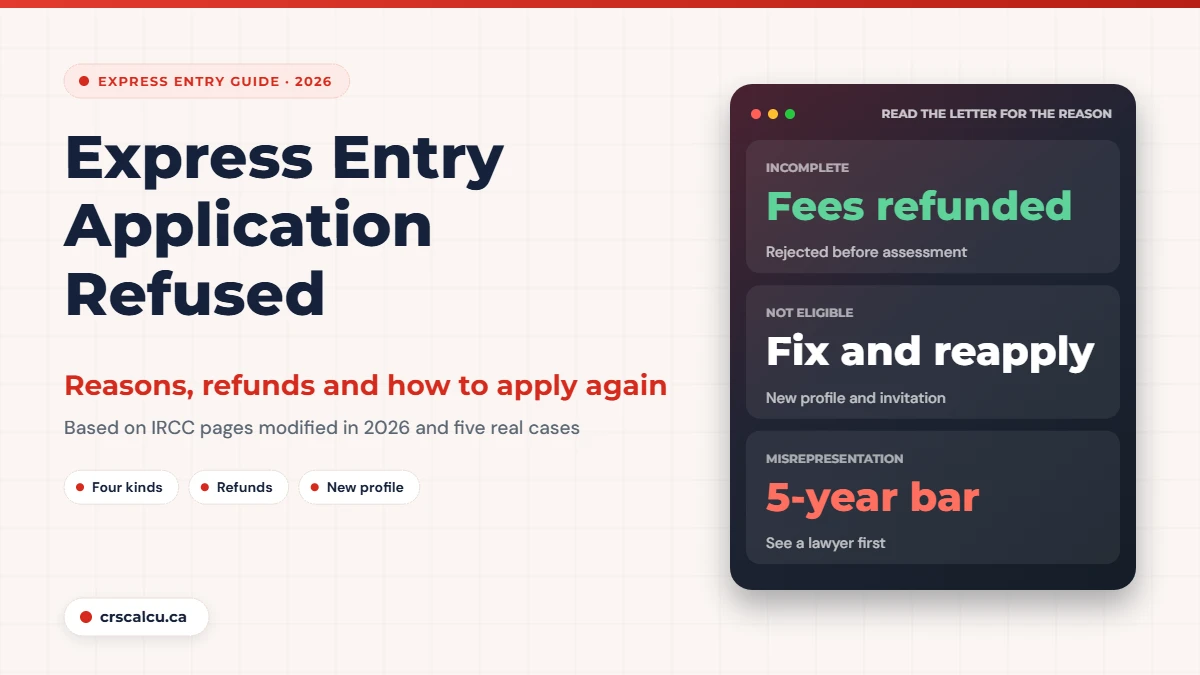
Some applications are turned away before anyone assesses them, because a document was missing. Some are refused because the officer was not satisfied that the applicant met the program’s requirements. Some fail on admissibility. And a small number end with a finding of misrepresentation, which carries its own penalty. These are four different situations.
We read IRCC’s page on how it assesses Express Entry applications (modified August 4, 2026), its Help Centre answer on refunds and its fee list, plus five public forum threads from 2015 to 2022. This is general information, not legal advice.
Quick answer: what happens if your Express Entry application is refused?
IRCC’s assessment page says that if your application is rejected or refused, you have to fill out and submit a new Express Entry profile, meet the eligibility criteria again and be accepted into the pool again to be considered for a new invitation. If the application was incomplete, IRCC rejects it and refunds the processing fees. If it was processed and refused, the processing fee is not refunded, but the Help Centre lists the right of permanent residence fee as refundable. A finding of misrepresentation can bring a five-year bar. Check your score before you re-enter with our CRS calculator.
Key takeaways
Express Entry application refused: four kinds of “no”
IRCC’s page on how it assesses applications (modified August 4, 2026) describes three stages. First a completeness check: that you filled in the application completely and correctly, paid the fees and included all the documents. Then eligibility: whether you qualify for the program, based on what you declared in your profile. Then admissibility, based on the results of your medical exam, police certificates and background checks. An application can fail at any of them.

Kind | What it means | Fees | Applying again |
|---|---|---|---|
Rejected as incomplete | Failed the completeness check; not assessed | Processing fees refunded | New profile, pool and invitation |
Refused: not eligible | Officer not satisfied you met the program requirements | Processing fee kept; RPRF refundable | Possible, with the gap fixed |
Refused: inadmissible | Medical, criminal or security grounds | Processing fee kept; RPRF refundable | Depends on overcoming the ground |
Refused: misrepresentation | False information or withheld facts | Processing fee kept; RPRF refundable | Possible five-year bar |
Our summary of IRCC’s assessment page (modified August 4, 2026), Help Centre answer on refunds (modified April 17, 2026) and create-profile page (modified September 24, 2026). The last column is our reading. RPRF is the right of permanent residence fee.
Express Entry application refused: what IRCC says happens next
The assessment page is brief about the aftermath. If your application is rejected or refused and you want to try again, you must fill out and submit a new Express Entry profile, meet the eligibility criteria, and be accepted into the pool again. There is no shortcut back to the stage you had reached. You need a new invitation, which means your score has to clear a future round.
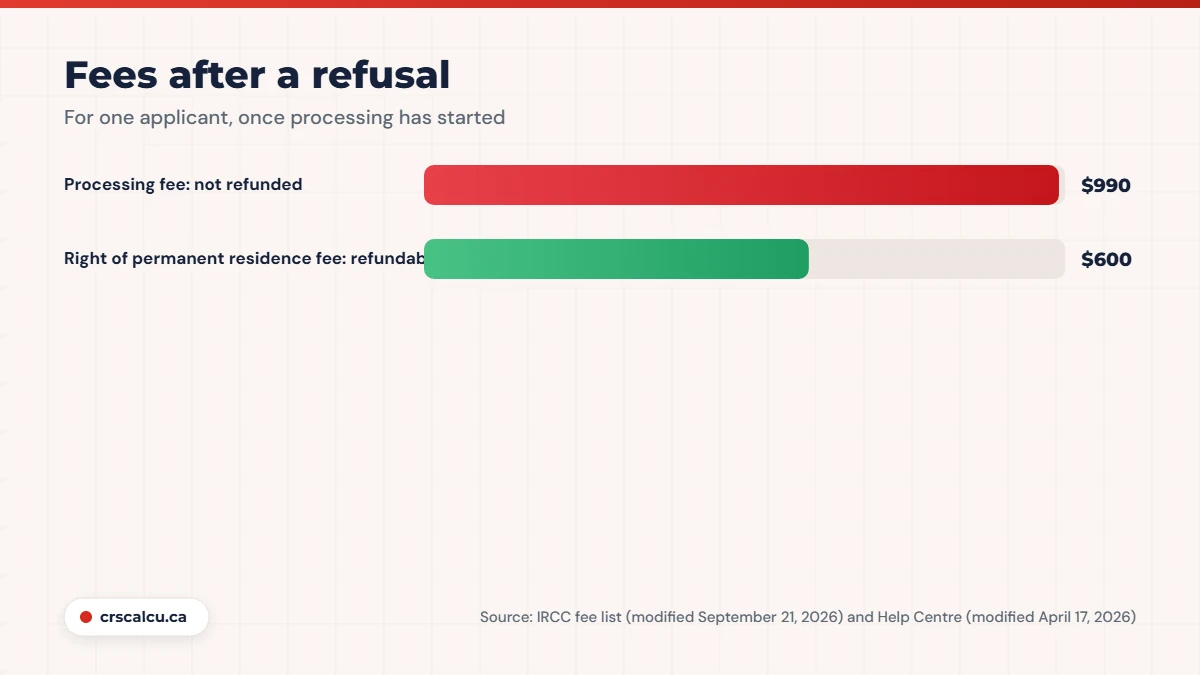
On money, the Help Centre (modified April 17, 2026) says application fees cannot be refunded once processing has started, and lists the exceptions, which include the right of permanent residence fee. IRCC’s fee list (modified September 21, 2026) puts the processing fee at $990 and the right of permanent residence fee at $600 for an applicant.
Rejected as incomplete
This is the mildest outcome and the most frustrating, because the applicant often had the missing document all along.
Real case: cancelled for one missing certificate (August 2021)
An applicant learned that their application had been cancelled as incomplete because a Canadian diploma certificate was missing. They had submitted on time and had even received a biometrics update a week earlier, and asked why nobody had simply requested the document. Experienced members explained that an application missing a mandatory document is rejected at the completeness check without a request for it, and that the fees are refunded. They said a web form asking for the decision to be reconsidered could be tried but rarely succeeds when the omission was the applicant’s, and that the realistic path was a new profile and another invitation. The poster thanked them and did not report what they did. A similar case was posted in May 2025.
That matches IRCC’s wording: if your application is not complete, it is rejected and the processing fees are refunded. The lesson is to treat the document checklist in your account as absolute. If a document cannot be obtained in time, IRCC’s pages allow an explanation with proof of your efforts for some items, such as police certificates; a blank is not an explanation.
Refused on eligibility: the reference letter problem
Among the threads we read, the refusals that could have been avoided mostly came down to one document.
Real case: duties missing from the employer letter (December 2018)
A Canadian Experience Class applicant, invited at 487 points, applied in August 2018 and was refused in October. The officer was not satisfied that they had performed the main duties of the occupation they had declared. The applicant admitted the reference letter had been thin: no salary and no detailed duties. They asked for reconsideration and were turned down. Forum members said a second request would achieve nothing, and that the way forward was a new application with a full letter. A bridging work permit they had applied for before their permit expired was then refused in late January 2019; they had to stop working and had 90 days to restore their status. A second application for permanent residence was already in process.
Real case: “no job duties provided” (December 2022)
An applicant with 571 points, working in Canada since April 2021 and invited on July 6, 2022, was refused under the Canadian Experience Class. The refusal said no information on job duties had been provided for the position claimed; the applicant said they had uploaded a two-page employer letter setting out their responsibilities. Members first suggested asking for reconsideration through the web form, since the refusal looked like it might be an error. The discussion then turned to whether something else was missing from the file. The applicant said they would consider professional help. No outcome was reported.
Two applicants with high scores, both refused over proof of duties. Points get you invited. Documents get you approved. IRCC’s Federal Skilled Worker and Canadian Experience Class pages tie eligibility to work in a specific occupation, and the officer decides from the employer’s letter whether your duties match it. Our post on the reference letter for Express Entry lists what the letter has to contain, and wrong NOC code in Express Entry covers the other half of the same problem.
Other eligibility refusals in the threads involved settlement funds that could not be shown and experience that fell short when counted. See proof of funds.
Refused on admissibility or for misrepresentation
Admissibility refusals follow from the medical exam, police certificates and background checks. We cover the two main grounds separately: criminal record and Express Entry and medical inadmissibility in Express Entry. In both, there are defined ways to overcome the problem, and in the medical case a letter and a chance to respond before any refusal.
Misrepresentation is different in kind. IRCC’s create-profile page says that if it finds you gave false information or left out important details, it can refuse your application, find you inadmissible and bar you for five years from applying to come to Canada.
Real case: refused for wrong codes and gaps (December 2018)
An applicant abroad had relied on a consultant who delayed for weeks and finally submitted the application just before the deadline. On December 21, 2018 it was refused for misrepresentation, with the refusal pointing to incorrect occupation codes and gaps in the travel history. The applicant, who had not prepared the forms personally, created a new profile on their own afterwards and was anxious about how the earlier file, with its conflicting information, would affect them. No further outcome was reported.
Real case: “can I apply again?” (June 2015)
An applicant whose application had been refused after three months asked whether they could reapply. Members said it depended entirely on the reason and asked what the letter said. They set out the possibilities: a refusal for misrepresentation would mean a five-year bar; one for inadmissibility might also block a new application until it was resolved; one for missing documents would leave the way open to a new profile. Later posters added their own refusals, including one over an employer’s missing financial documents and one where an officer was not satisfied a job offer was permanent. The original poster did not come back with the reason.
If your refusal letter mentions misrepresentation, do not create a new profile and carry on as if nothing happened. See an immigration lawyer first. For how errors arise and how to correct them before they reach this point, see mistake in Express Entry profile; for choosing help, immigration representative for Express Entry.
Can the decision be changed?
IRCC’s Express Entry pages, as we read them, describe applying again. They do not describe an appeal. Two other routes come up in the forums.
The first is a request for reconsideration, sent through the web form, asking the office to look at the decision again. In the cases above it was suggested where the refusal looked like a plain error, such as a document the applicant says was uploaded, and it failed where the officer had made a judgment on the evidence. There is no published rule on it that we found, and no guarantee of a reply.
The second is asking a court to review the decision. That is a legal process with strict time limits, and it is a question for a lawyer, promptly. We have not covered it here.
Before either, find out what the officer actually recorded. You can request the notes on your file through an access to information request, and they often say more than the refusal letter does.
Your status in Canada after a refusal
For applicants in Canada, a refusal can pull other things down with it. The December 2018 case shows the sequence: permanent residence refused, bridging permit refused, work stopped, 90 days to restore status. IRCC’s bridging open work permit page ties that permit to an application for permanent residence, and does not say what happens to it after a refusal. If you are in this position, read bridging open work permit and PGWP expiring, and get advice on your status before anything else.
Applying again
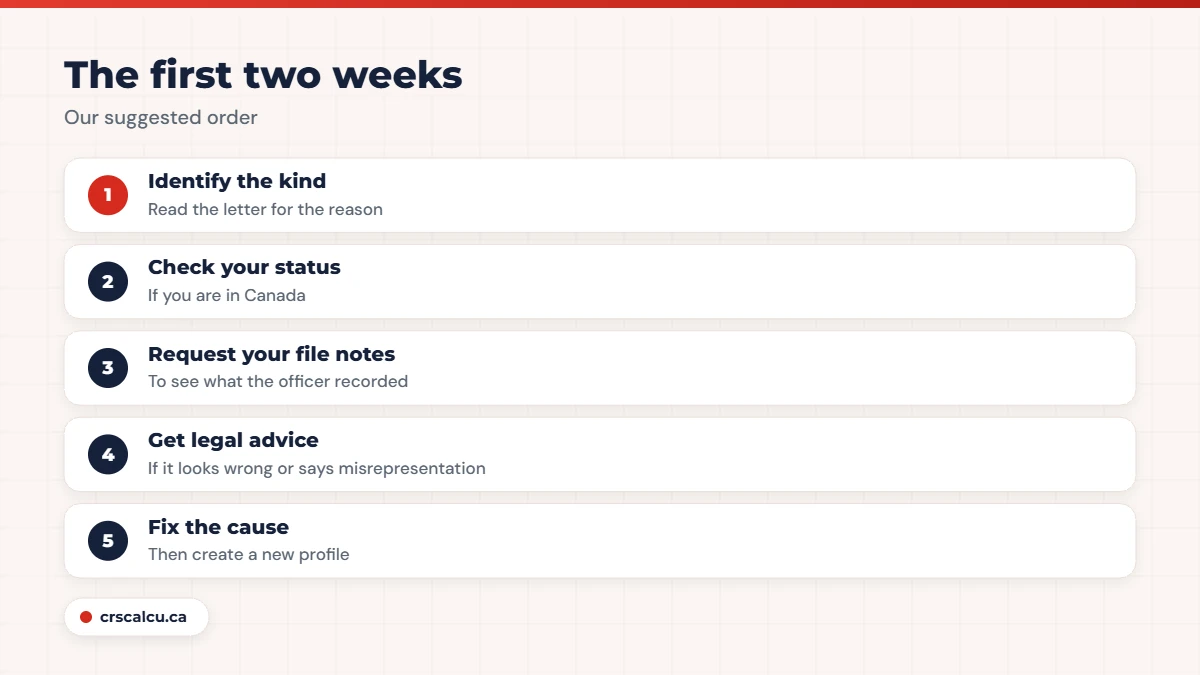
The first two weeks after a refusal (our suggested order)
A new profile after a refusal is allowed; IRCC’s page says it is the way back in. Do not open it while an old one is still active, though; see two Express Entry profiles. And remember that the new profile is ranked on today’s facts: your age, your language results if they are still valid, and current rounds. Check the latest draw cut-offs.
Express Entry application refused: five mistakes to avoid next
Avoid these
What IRCC does not say
The pages we read do not set out a reconsideration process, do not say how long a refund takes, and do not explain how a previous refusal is weighed in a new application. Refusal letters give reasons briefly; the fuller record is in the file notes.
Frequently Asked Questions
Express Entry application refused: can I apply again?
IRCC says you must submit a new Express Entry profile, meet the eligibility criteria and be accepted into the pool again. Whether that is realistic depends on the reason: a missing document is easily fixed, inadmissibility has to be overcome, and misrepresentation can bring a five-year bar.
Do I get my fees back?
If the application was rejected as incomplete, IRCC refunds the processing fees. If it was processed and refused, the processing fee is not refunded, but the right of permanent residence fee is on IRCC’s list of refundable fees.
What is the difference between rejected and refused?
In the cases we read, “rejected” or “cancelled” was used for applications that failed the completeness check and were not assessed. “Refused” was used for applications that were assessed and turned down on eligibility or admissibility.
Can I ask IRCC to reconsider?
Applicants do, through the web form. In the threads we read it was suggested where the refusal looked like a clear error and did not succeed where the officer had weighed the evidence. IRCC publishes no process for it that we found.
Why are applications refused over reference letters?
Because eligibility depends on having worked in a specific occupation, and the officer decides from the employer’s letter whether your duties match. Letters without duties, hours or dates leave the officer unable to be satisfied.
Will a refusal affect a future application?
You will be asked about previous refusals and must answer truthfully. IRCC does not say how a past refusal is weighed. A new application should fix the cause and be consistent with the earlier one.
Check your score before you re-enter
A new profile is ranked on today’s facts. See where you stand now.
Final Thoughts
An Express Entry application refused for a fixable reason is a setback measured in months: fix the cause, enter the pool again, and be invited again. One refused on admissibility or for misrepresentation is a legal problem first and an immigration problem second. The letter tells you which you have.
If the refusal looks wrong, mentions misrepresentation, or puts your status in Canada at risk, speak to an immigration lawyer straight away, because some remedies have deadlines that start on the day of the decision.