Express Entry Guide · Updated October 2026
Provincial Nomination in Express Entry: 600 Points, 30 Days and the Traps (Real Cases)
Six hundred points settle any round. Getting them, accepting them in time and keeping them until you land are three separate jobs.
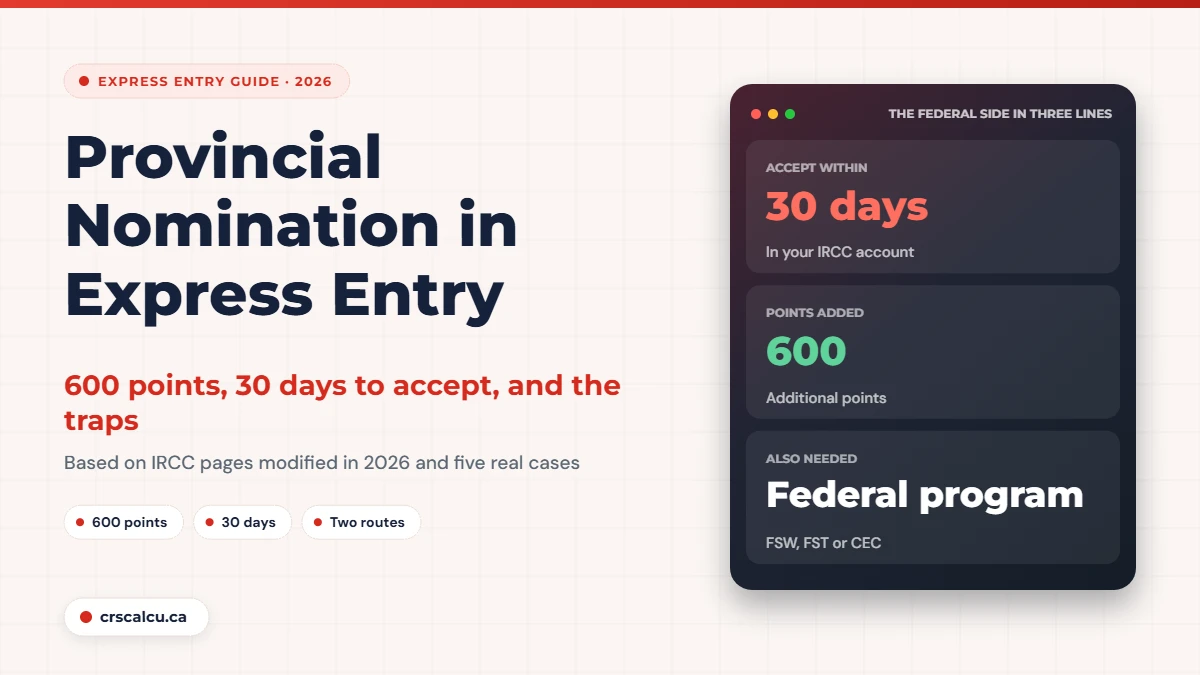
A provincial nomination is the single largest thing that can happen to an Express Entry profile. It adds 600 points, more than six times everything else on the additional points list put together, and it turns a candidate who was nowhere near the cut-off into one who will be invited in the next round that includes nominees.
It is also the part of the system you control least. A province decides whether to nominate you, under rules that differ from one province to the next and change often. What you do control is narrower: responding to a notification in time, accepting the nomination properly, and not doing anything afterwards that causes the province to take it back.
We read IRCC’s pages on getting and confirming a nomination and on eligibility (modified in 2026), the CRS criteria, and five public forum threads from 2016 to 2023. Province-specific rules quoted in the cases are as the posters reported them. This is general information, not legal advice.
Quick answer: how does a provincial nomination work in Express Entry?
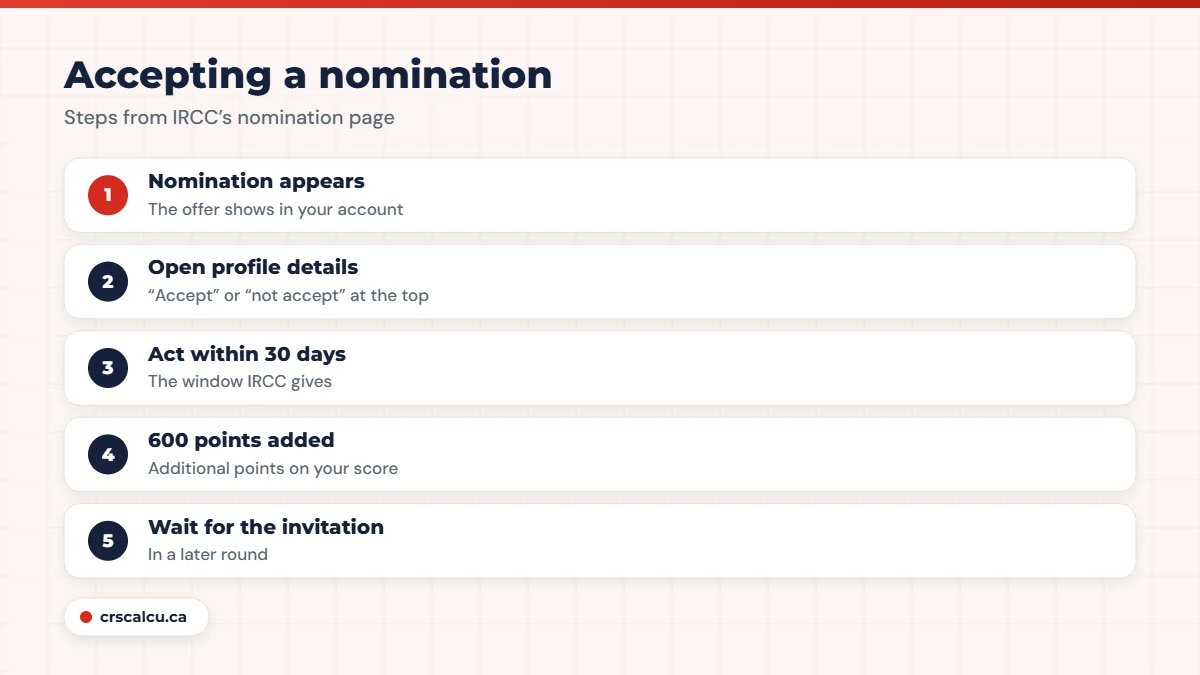
A province or territory nominates you through one of its Express Entry streams, either because you applied to it or because it found your profile and sent a notification of interest. When the nomination appears in your account you have 30 days to accept it. Once you accept, IRCC adds 600 points to your score. You still have to be eligible for one of the three Express Entry programs. If the nomination is withdrawn before you are invited, IRCC says you must withdraw your profile and submit a new one. See your base score in our CRS calculator.
Key takeaways
What a provincial nomination is worth
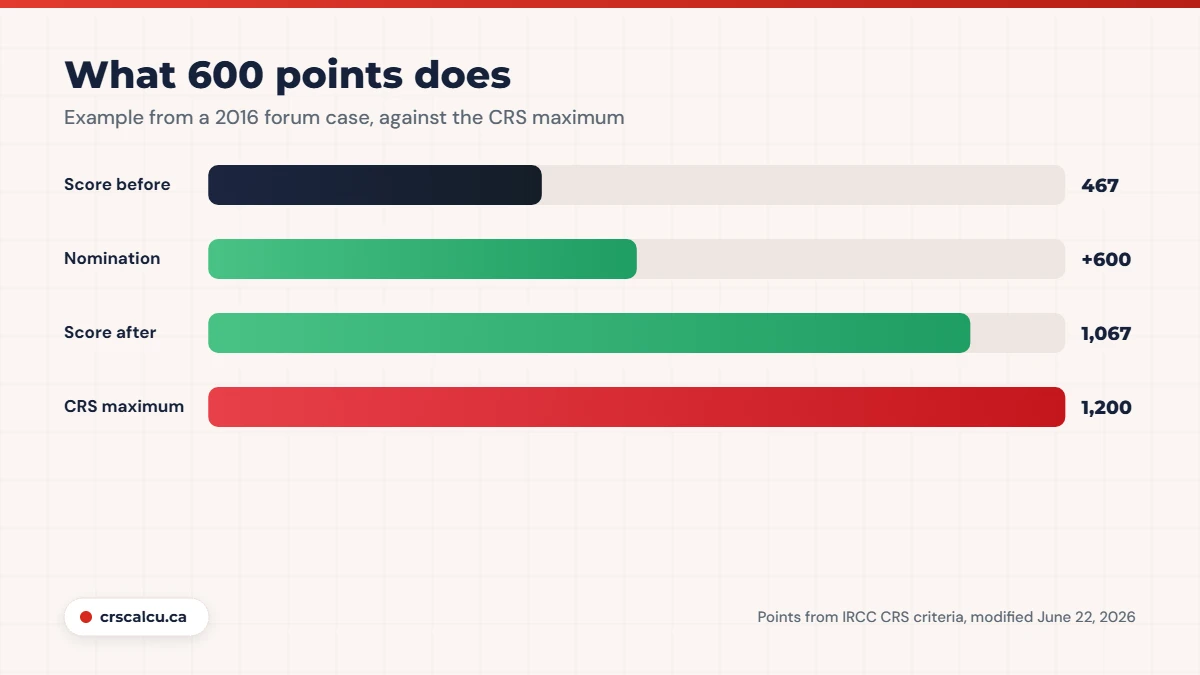
On IRCC’s CRS criteria page (modified June 22, 2026), a nomination from a province or territory adds 600 additional points. The table as a whole has a maximum of 1,200: up to 600 for the core, spouse and skill transferability sections together, and up to 600 in additional points. A nomination fills that second half in one step.
Nothing else comes close. French adds up to 50, Canadian study up to 30, a sibling 15. A nominated candidate’s rank no longer depends on age or language scores in any practical sense.
Who can be nominated through Express Entry
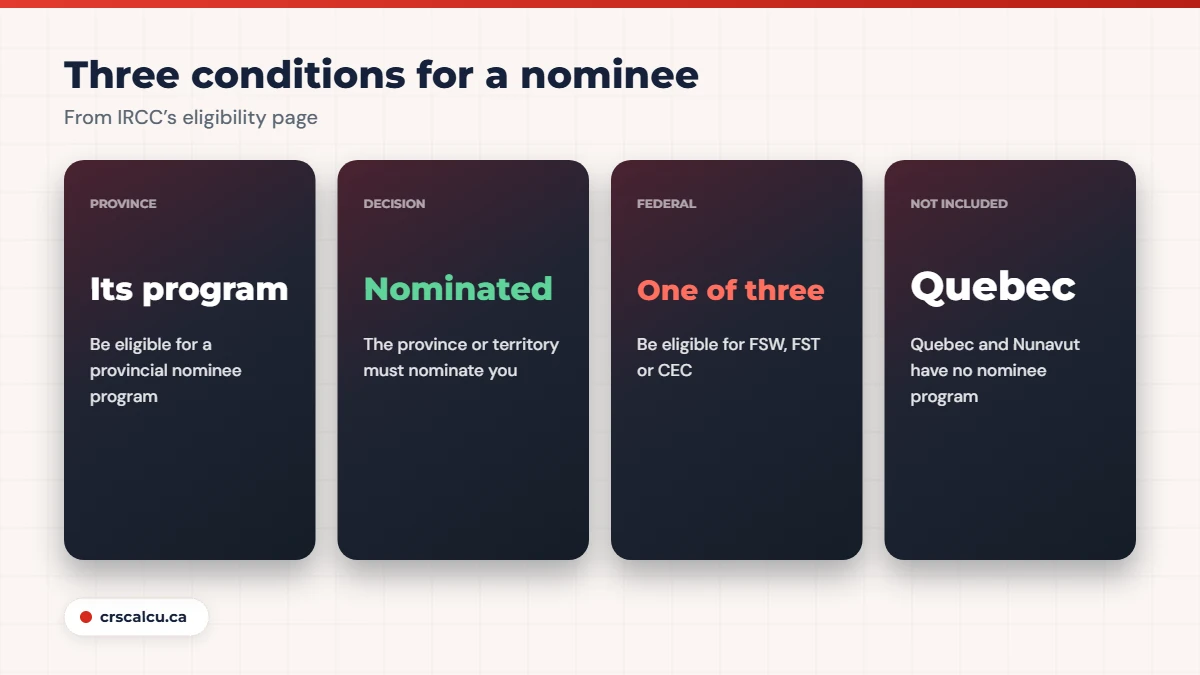
IRCC’s eligibility page for the Provincial Nominee Program through Express Entry (modified May 21, 2026) sets three conditions. You must be eligible for one of the province or territory’s nominee programs. The province or territory must nominate you. And you must be eligible for one of the three Express Entry programs. The same page notes that Quebec and Nunavut do not have a provincial nominee program.
The third condition is the one people forget. A nomination does not replace the federal minimums. A candidate who lacks the language level or the qualifying year of skilled work for any of the three programs cannot use an Express Entry nomination, however keen the province is. Compare the federal rules in FSW vs CEC.
Two routes to a provincial nomination
Route | What IRCC’s page says | What it means in practice |
|---|---|---|
You go to the province | Check the province or territory’s website for its program requirements and apply | You choose a stream and meet its rules |
The province comes to you | It sends a “notification of interest” message to your account | You are invited to apply to the province, with a deadline it sets |
Either way | A notification does not guarantee you will be nominated | The province still assesses a full application |
Our summary of IRCC’s page on getting or confirming a nomination (modified March 24, 2026). The third column is our reading.
A notification of interest is an opening, not a result. The province gives you a window to submit its own application, checks it, and only then decides. Each province sets its own window and its own completeness rules.
Real case: missed the province’s deadline (May 2017)
A candidate received a notification of interest on April 12 and did not submit the full provincial application within the window the province allowed, which they gave as 14 days. Checking later, they found the file marked as withdrawn by the province although they had never asked for that. A member with experience said the route back was a new application within the window after a new notification, with a letter explaining the earlier lapse. Later posters in the same thread described other causes of the same status, including applications missing a required document. The original poster did not report an outcome.
Real case: a birthday inside the province’s window (February 2023)
An applicant got a notification of interest from a province with a 45-day window to apply. A birthday in mid-February would cost them points, while their spouse would reach a Canadian work milestone in mid-March and add some back. They asked whether age was fixed at the notification. A member first said age locks at the invitation to apply, then, realizing this was a provincial notification and not a federal invitation, corrected course: the protection for age applies only at the federal invitation stage. No decision was reported.
The two windows in those cases, 14 days and 45 days, are what the posters reported for one province at different times. Check the current figure on the province’s own site. The correction in the second case is worth keeping: the public policy on birthdays that we describe in CRS score dropped after ITA is about the federal invitation, not a provincial notification.
Our BC PNP and Alberta calculators show how two provinces rank candidates before they nominate.
How to accept a provincial nomination in your account
Once a province nominates you, the nomination shows up in your IRCC account. IRCC’s page says you choose “accept” or “not accept” at the top of the application or profile details section, and that you have 30 days to do it.
Accepting a nomination (from IRCC’s page)
Real case: 467 points and a nomination letter (March 2016)
A candidate with 467 points received a nomination letter and asked how many points it added and how to update the profile. Replies explained that the nomination adds 600, that the step is to accept it in the account, and that the score then updates by itself, in their experience within about a day; no manual edit is needed. That would take 467 to 1,067. In later years other posters in the same thread described trouble after trying to edit the profile by hand following a nomination: fields greyed out, and in some accounts a profile that turned ineligible. Some said the 600 points appeared automatically regardless.
IRCC’s page describes accepting, not editing, and the later posts in that thread are a reason to leave the profile alone while the nomination is being attached. If you do need to change something else, see update Express Entry profile and take care with anything that could affect eligibility.
If you choose “not accept”, IRCC’s page says you will not be eligible for the Provincial Nominee Program unless another province or territory nominates you.
Keeping the nomination until you land
A nomination is conditional on whatever the province based it on, and provinces can withdraw it. IRCC’s page says that if a nomination is withdrawn before you are invited to apply, you must withdraw your profile from the pool and submit a new one. After an invitation, IRCC’s application page lists a lost provincial nomination among the changes that can lower your score and lead to refusal with no refund.
When | What IRCC says | What follows |
|---|---|---|
Before an invitation | Withdraw your profile and submit a new one | You are back in the pool on your base score |
After an invitation, before applying | Re-calculate; decline if below the round’s lowest score | Without 600 points you will be below it |
After applying | A lost nomination can lead to refusal with no refund | Tell IRCC; get advice immediately |
Our summary of IRCC’s nomination page (modified March 24, 2026), respond-to-invitation page and application page (both modified June 22, 2026).
The most common trigger is a change of job, where the nomination was tied to an employer. We cover that in lost job after ITA. If you have to step back, declining an ITA explains how.
When a federal invitation arrives first
Candidates with decent scores sometimes hold a pending provincial application and then get a federal invitation on their own points.
Real case: invited federally while the province was deciding (January 2021)
A candidate was invited in a Canadian Experience Class round while their application to a province sat at the final decision stage. They asked whether the invitation would stop the provincial file and whether they could wait for the province and then decline. An experienced member advised taking the federal route as the faster one. Later posters who had been in the same position found the province’s own statement on it: once a candidate receives a federal invitation while the provincial application is in process, the profile is no longer available for the province to nominate, so the candidate has to either decline the invitation or withdraw the provincial application.
Real case: federal application rejected, provincial file closed (May 2023)
An applicant with a pending provincial application was invited federally and applied. That application was rejected over a problem with a police certificate, which left them without an active Express Entry profile. Forum members first thought a new profile would fix it. On May 11, 2023 the province wrote to say it was closing the provincial application as incomplete, because registration in the Express Entry system is a requirement for nomination, and that a new notification of interest would be needed before applying again. Another poster reported the same in August 2023.
Both cases come from one province’s practice as posters described it, and other provinces may differ. The general lesson holds: an Express Entry nomination hangs from a live Express Entry profile. If the profile goes, through an invitation, an expiry or a withdrawal, the provincial file can go with it. Keep the province informed of your profile number, and do not run a second profile as a workaround; see two Express Entry profiles.
Five mistakes people make with a provincial nomination
Avoid these
What IRCC does not say
IRCC’s pages do not list each province’s streams, deadlines or conditions; they send you to the provinces. They do not say how soon after acceptance an invitation follows. And the pages we read contain no statement about living in the nominating province. For candidates still waiting on their own points, see no ITA in Express Entry, improve CRS score and the latest draw cut-offs.
Frequently Asked Questions
How many points is a provincial nomination worth?
600 additional points on IRCC’s CRS criteria page. The table’s maximum is 1,200, so a nomination supplies half of it.
How long do I have to accept a nomination?
30 days, according to IRCC’s page on getting or confirming a nomination. You choose “accept” or “not accept” at the top of the profile details in your account.
Is a notification of interest the same as a nomination?
No. IRCC says a notification of interest does not guarantee you will be nominated. It invites you to apply to the province, which then decides.
Do I still need to qualify for Express Entry?
Yes. IRCC’s eligibility page says you must be eligible for one of the three Express Entry programs as well as for the province’s program.
What happens if my nomination is withdrawn?
Before an invitation, IRCC says to withdraw your profile and submit a new one. After an invitation, a lost nomination can lower your score and lead to refusal with no refund.
Does Quebec nominate through Express Entry?
No. IRCC’s page says Quebec does not have a provincial nominee program and has its own immigration programs. Nunavut does not have one either.
Know your base score first
A nomination adds 600 to whatever you have. See the number the province will be looking at.
Final Thoughts
A provincial nomination changes everything about a profile’s rank, and the mechanics on the federal side are short: accept within 30 days, receive 600 points, wait for the invitation. The risk sits on the provincial side, in deadlines, completeness rules and conditions that differ everywhere.
If a province has contacted you, if your nomination depends on an employer, or if a federal invitation has arrived while a provincial file is open, speak to a licensed immigration consultant or an immigration lawyer before you click anything.