Express Entry Guide · Updated October 2026
Category-Based Selection Eligibility: All 10 Categories and Their Tests (Real Cases)
Ten categories, three kinds of test, and one profile. Here is how to tell which rounds can reach you.
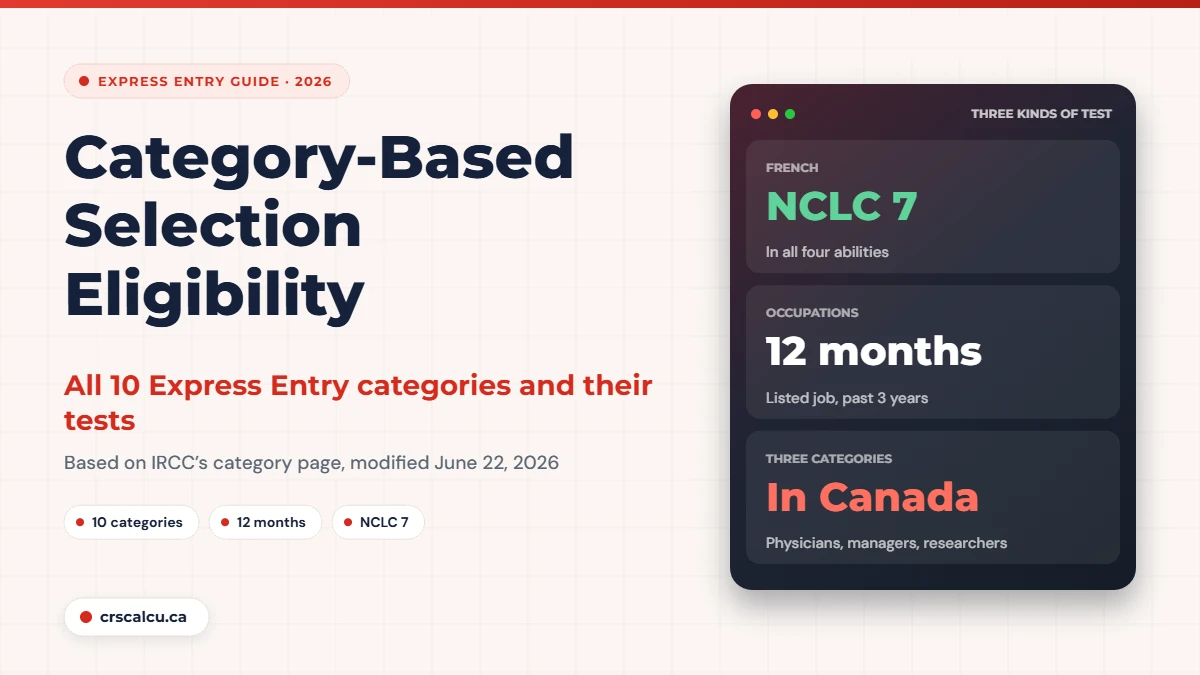
Category-based selection changed how Express Entry invitations are distributed. Alongside general rounds, IRCC now holds rounds for candidates who fit a defined category, and those rounds have their own cut-offs. A candidate who would wait indefinitely for a general round can be invited in a category round, and a candidate with a high score can be passed over in one.
The eligibility rules are compact, but they have been revised since the first rounds, and forum threads from 2023 still describe a six-month test and categories that are no longer on the list. This post sets out the rules as they stood on IRCC’s page when we read it, category by category.
Our source is IRCC’s category-based selection page (modified June 22, 2026), read in full, plus five public forum threads from 2018 to 2026. We have separate posts on three of the categories, linked below. This is general information, not legal advice.
Quick answer: how do you become eligible for a category round?
Two conditions. First, you must be in the pool as eligible for an Express Entry program. Second, you must meet the category’s own test. For the French category that is NCLC 7 in all four abilities. For the occupation categories it is at least 12 months of full-time work experience, or the part-time equivalent, in a listed occupation within the past 3 years; three categories require that experience to be in Canada. There is no separate application. IRCC ranks the candidates who meet the test and invites the top scores. Know your number first: use our CRS calculator.
Key takeaways
How category-based selection works
IRCC’s page (modified June 22, 2026) describes it this way: in a category-based round, IRCC invites candidates in the Express Entry pool who are eligible for a specific category established by the Minister to meet an identified economic goal. Candidates must meet all of the requirements in the instructions for that round. IRCC ranks the candidates in the pool who meet the category requirements and invites the top-ranking ones.
So nothing about the pool changes. You have one profile and one score. For a category round, the system draws a smaller circle around the candidates who meet that category’s test and invites from the top of that circle.

Real case: one profile, or a separate one for French? (April 2026)
A candidate with a projected score of 536 under the Canadian Experience Class and French results at the required level asked whether the system would recognize them for French rounds automatically or whether a separate profile was needed. A senior member answered that there is only one profile. Another explained that French proficiency works as a filter on top of the ordinary programs: the system compares your score with whichever round is being held. A later reply confirmed that you declare the French test results in the normal profile and the system identifies you from there. The poster accepted the answer, and nothing further was reported through August 2026.
That matches IRCC’s rule against multiple profiles, which we cover in two Express Entry profiles. Recent results by round type are on our latest draw cut-offs page, with background in category-based draws.
The ten categories and their tests
Category | Test | Where the experience can be |
|---|---|---|
French-language proficiency | NCLC 7 in all four French abilities | Not applicable |
Healthcare and social services occupations | 12 months in a listed occupation, past 3 years | Canada or abroad |
Science, technology, engineering and math occupations | 12 months in a listed occupation, past 3 years | Canada or abroad |
Trade occupations | 12 months in a listed occupation, past 3 years | Canada or abroad |
Education occupations | 12 months in a listed occupation, past 3 years | Canada or abroad |
Transport occupations | 12 months in a listed occupation, past 3 years | Canada or abroad |
Physicians with Canadian work experience | 12 months in a listed occupation, past 3 years | In Canada |
Senior managers with Canadian work experience | 12 months in a listed occupation, past 3 years | In Canada |
Researchers with Canadian work experience | 12 months in a listed occupation, past 3 years | In Canada |
Skilled military recruits | Serving in a recognized foreign military with long continuous service; see IRCC’s page | Not applicable |
Our summary of IRCC’s category-based selection page (modified June 22, 2026). “12 months” means full-time, or an equal amount of part-time. Read the page for the exact wording of each category.

The occupation categories
Each has its own list of five-digit NOC codes. We go through three of them in detail: the healthcare category, the trades category and the education category. The other two are shorter.
Category | Occupations (NOC code) |
|---|---|
STEM: engineering | Civil engineers (21300), mechanical engineers (21301), electrical and electronics engineers (21310), industrial and manufacturing engineers (21321), geological engineers (21331) |
STEM: technologists | Civil engineering technologists and technicians (22300), mechanical engineering technologists and technicians (22301), electrical and electronics engineering technologists (22310) |
STEM: other | Architecture and science managers (20011), cybersecurity specialists (21220), insurance agents and brokers (63100) |
Transport | Aircraft mechanics and aircraft inspectors (72404), air pilots, flight engineers and flying instructors (72600), aircraft instrument, electrical and avionics mechanics (22313), automotive service technicians, truck and bus mechanics (72410) |
From IRCC’s category-based selection page (modified June 22, 2026), as we read it. Check the live list before relying on it.
Two things about those lists surprise people. The STEM list we read is much narrower than the name suggests: software developers, data analysts and most information technology roles were not on it. And transport is mostly aviation and vehicle mechanics; truck drivers were not on the list we read. Do not assume from a category’s name. Look up your own code in the NOC and TEER finder and compare it with the list.
The “with Canadian work experience” categories
Three categories add a location condition. Physicians (codes 31100, 31101 and 31102), senior managers (00012 to 00015) and researchers, meaning university professors and lecturers (41200) and post-secondary teaching and research assistants (41201), need their 12 months to have been accumulated in Canada. Foreign experience in the same occupation does not meet the test for these three, although it can still count toward program eligibility and points.
French
The French category has no occupation list. The test is French-language test results showing at least level 7 in all four abilities on the Niveaux de compétence linguistique canadiens. Convert your scores with our CLB calculator.
Real case: would CLB 4 or 5 in French do? (November 2024)
A candidate with a score of about 500 on English alone, just starting French, asked whether reaching level 4 or 5 would make them eligible for French rounds. Members replied that level 7 in all four abilities is the minimum, quoting the official wording. A senior member added that level 7 from scratch is possible with sustained effort, suggesting about a year with immersion. The poster acknowledged the requirement. No progress was reported.
Real case: points, or a separate round, or both? (May 2024)
Another candidate, at 490 or so, could not tell whether learning French would simply add points or would put them into a different round with a lower cut-off. Replies said both: French at the required level raises the score, and it also makes you eligible for French rounds automatically, while you remain eligible for general rounds. One reply estimated 12 to 24 months to get there, depending on commitment. The poster said that cleared it up.
The points side is on the CRS criteria page: NCLC 7 in all four abilities adds 25 additional points, or 50 if your English is CLB 5 or higher, on top of second-language points. We rank that against other options in improve CRS score. The time estimates are forum opinions.
What changed from the older rules
If you read forum threads from the first year of category rounds, you will meet a different test.
Real case: six months, or a year? (May 2023)
When the categories were announced, a poster asked whether a candidate needed only six months in a priority occupation within three years, or a full year of experience of which six months were in such an occupation. Replies quoted the rule of the day, six months of continuous experience in a listed occupation within the past three years, and noted that a year of skilled work was still needed to enter the pool at all. The fields mentioned then included agriculture. One later reply said the occupation code has to match what appears on the work permit.
Three parts of that thread no longer hold. The test on IRCC’s page today is 12 months, not six. The page’s description of the occupation categories says the experience does not need to be continuous. And agriculture was not among the ten categories we read. The remark about work permits was never right as a general rule: an open work permit names no occupation, and IRCC’s guidance on finding your code is about the duties you performed. See wrong NOC code in Express Entry.
Your work history is what the system reads
Because there is no category application, everything depends on the jobs and codes in your profile. The listed occupation does not have to be your current job or your primary occupation, but it has to be there.
Real case: which jobs to enter (August 2018)
Long before categories existed, a candidate with eleven years across several roles asked whether to enter only the seven years they could document under one occupation code, or everything. The advice then was to list the experience you are claiming points for and can prove, to pick codes by duties and not titles, and to give the full history at the application stage. Participants said they would do that.
That advice made sense when work history only fed points and eligibility. With category rounds, a job you leave out cannot make you eligible for anything. IRCC’s Help Centre also says to include your work experience for the last 10 years. Enter each skilled job with the code that fits its duties, and if you need to add one to an existing profile, update Express Entry profile shows how without losing your place.
Checking every category in ten minutes

Our suggested order
If more than one category fits you, you are eligible for rounds in each. Among candidates tied at the lowest score in any round, the tie-breaking rule still applies.
Five mistakes people make with category-based selection
Avoid these
What IRCC does not say
IRCC does not publish a calendar of category rounds, the number of invitations each category will receive in a year on the page we read, or how it decides which occupations are listed. It does not explain to an individual why a round passed them by; for that, see no ITA in Express Entry.
Frequently Asked Questions
What is category-based selection in Express Entry?
It is a type of invitation round in which IRCC invites candidates who are eligible for a specific category, such as French-language proficiency or healthcare occupations, ranked by CRS score among themselves.
How many categories are there?
Ten on IRCC’s page as we read it: French-language proficiency; healthcare and social services; STEM; trade; education; transport; physicians, senior managers and researchers with Canadian work experience; and skilled military recruits.
How much work experience do I need for an occupation category?
At least 12 months of full-time work, or an equal amount of part-time, in a listed occupation within the past 3 years.
Do I need to apply separately for a category?
No. You have one profile. The system identifies eligible candidates from the language results and work history in it.
Can I be invited in a general round and a category round?
You remain eligible for general rounds while being eligible for a category. Whichever round reaches your score first results in an invitation.
Does French have to be my first official language?
IRCC’s test is NCLC 7 in all four French abilities. It does not say French must be your first official language.
Find your score, then your category
Calculate your CRS and compare it with the cut-offs for each round type you are eligible for.
Final Thoughts
Category-based selection rewards candidates who can show one of a few specific things: strong French, or a year of recent work in an occupation Canada has decided it needs. The eligibility rules fit on a page. The care goes into the code you choose, the months you count and the work history you enter.
If your job sits between a listed and an unlisted code, or you are unsure whether your experience falls inside the window, a licensed immigration consultant or an immigration lawyer can check your profile before a round does.