Express Entry Guide · Updated October 2026
Misrepresentation in Express Entry: What Counts, the 5-Year Bar and Fixing Errors Early (Real Cases)
A wrong date, a forgotten visa refusal, a family member left off a form. Here is what IRCC says it can do about false or missing information, and what applicants did when they found their own errors.
Misrepresentation in Express Entry is the one topic on this site we will not try to make sound smaller than it is. Most paperwork problems cost you time. This one can cost you the application and five years. IRCC says so in plain words on the same page where you create your profile.
It is also a topic where people panic over the wrong things. Applicants write about a typing slip in the family size box in the same tone as others write about a hidden refusal. Those are not the same situation, but IRCC’s public pages do not sort them into neat boxes for you. What the pages do make clear is that you are expected to give true and complete information, to keep it current, and that you answer for it even when someone else typed it.
We read four IRCC pages on false information, fraud and profile updates, and public forum threads from 2017 to 2023 where applicants described an error, a missed declaration or a fairness letter. We could not read every page we wanted for this article, and we say where that happened.
Quick answer: what happens if IRCC finds misrepresentation in Express Entry?
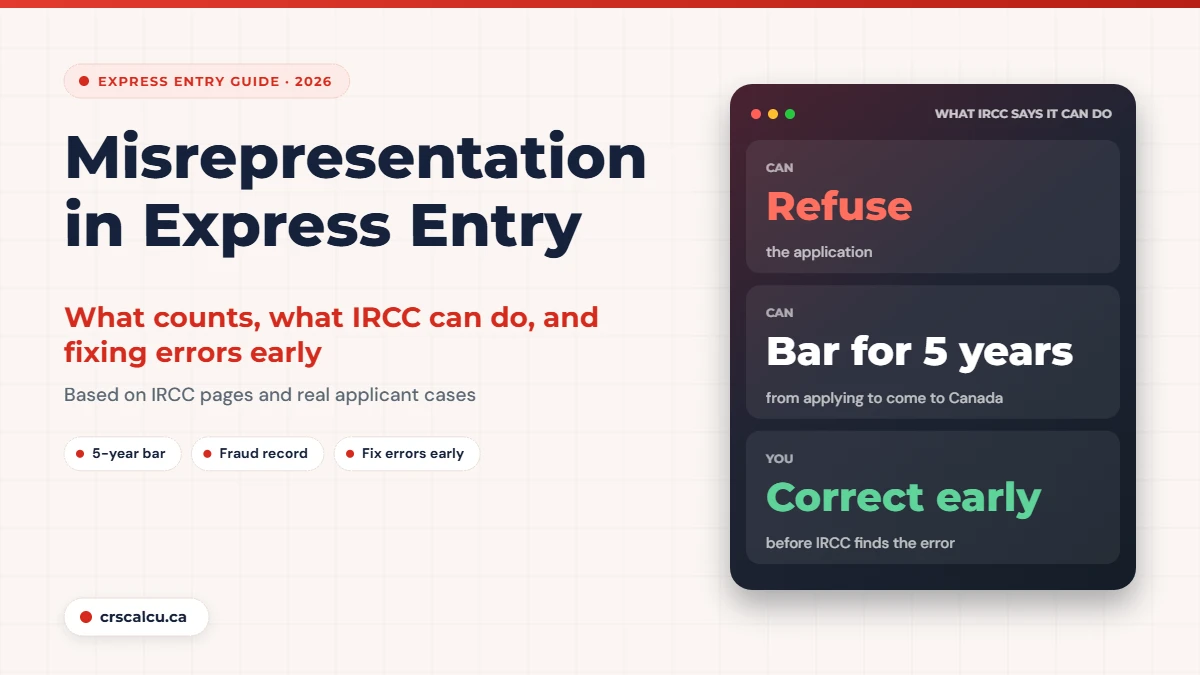
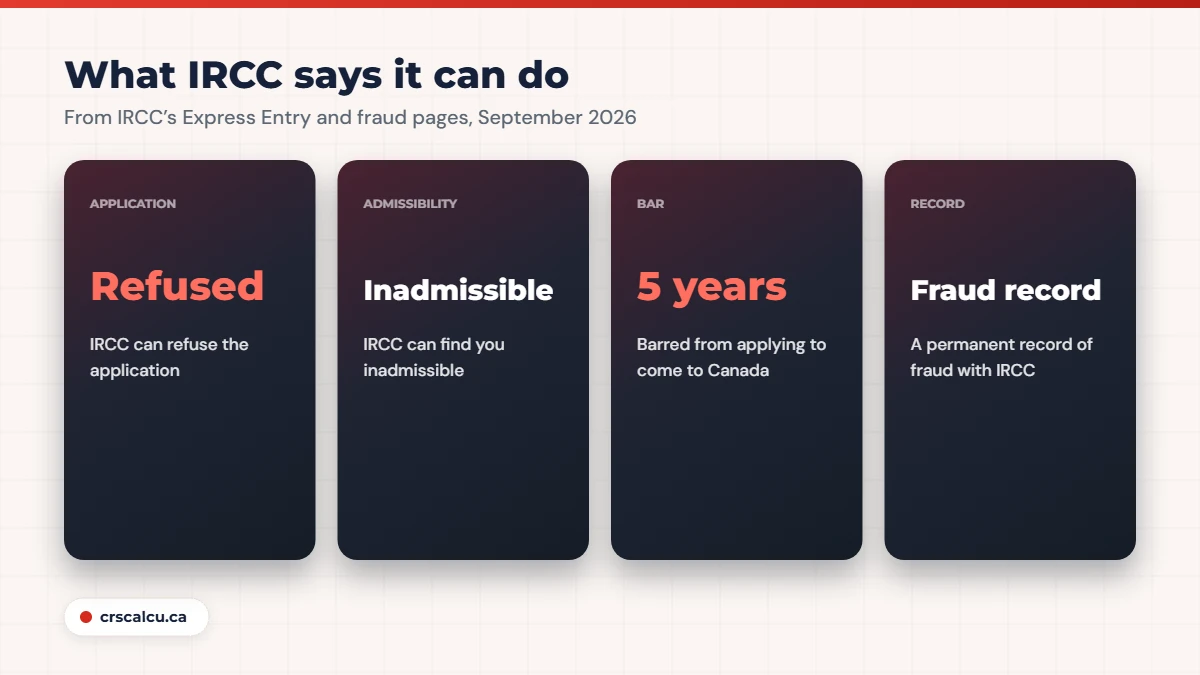
IRCC’s Express Entry profile page says that if it finds you gave false information or left out important details about your history or experience, it can refuse your application, find you inadmissible and bar you for 5 years from applying to come to Canada. Its fraud page adds a permanent record of fraud. You are responsible for everything in the file, even if a representative completed it. If you find an error yourself, correct it before IRCC finds it, starting with a line-by-line check of your personal history.
Key takeaways
What IRCC says counts as misrepresentation
IRCC’s public pages describe the behaviour and its results in everyday terms. Three official pages carry the weight here, and they are short enough to read in ten minutes.
The first is the Express Entry page “Create your profile and enter the pool” (modified September 24, 2026). It says that if IRCC finds you gave it false information, or “left out important details about your history or experience”, it can refuse your application, find you inadmissible and bar you for 5 years from applying to come to Canada. Notice the second half. Leaving something out is treated in the same sentence as stating something false.
The second is “Consequences of immigration and citizenship fraud” (modified September 1, 2026). It deals with false or altered documents and names the kinds it means. Nearly every item on that list is something an Express Entry applicant uploads.
Documents IRCC names on its fraud page
The third is a Help Centre answer on whether it is legal to give false information because a representative told you to (modified April 17, 2026). The answer is no, and it says representatives who give that advice are breaking the law.
So, in the words of the pages we read, misrepresentation in Express Entry covers three things: saying something false, sending a false or altered document, and leaving out an important detail.
Situation | What IRCC says | Where it is written |
|---|---|---|
False information, or important details left out | IRCC can refuse the application, find you inadmissible and bar you for 5 years from applying to come to Canada | Express Entry: Create your profile (September 24, 2026) |
False or altered documents or information | Application refused; banned for at least 5 years; permanent record of fraud; status could be removed; possible removal from Canada | Consequences of fraud page (September 1, 2026) |
A representative completed the application | You are responsible for all the information in it | Consequences of fraud page |
A representative advises false information | That advice is against the law, and the application will be refused | Help Centre (April 17, 2026) |
Your circumstances change while in the pool | You must update your profile | Express Entry: Create your profile |
Profile already submitted | If it was found eligible, you can still update it with the “Update form” button | Help Centre, Express Entry profile updates |
Our summary of the IRCC pages listed under Sources, read on October 5, 2026. The middle column follows the official wording closely but is not a full quotation.
The consequences IRCC lists, in its own terms
The three pages do not use identical language, and the differences are worth seeing side by side. The Express Entry page speaks of being barred for 5 years from applying to come to Canada. The fraud page says banned from Canada for at least 5 years. The Help Centre answer says IRCC may forbid you from entering Canada for at least 5 years. People usually shorten all of this to “the five-year ban”.
Beyond refusal and the ban, the fraud page and the Help Centre answer list these outcomes:
Other consequences on IRCC’s fraud pages
Two things follow from that list. The risk does not end on the day you become a permanent resident, because loss of status is on it. And a record of fraud is described as permanent, which is longer than five years.
We could not find, on the pages we read, a published scale that says which errors lead to which result. IRCC states what it can do. It does not publish what it does in each kind of case.
You are responsible, even if someone else filled it in
This is the line that surprises people who paid for help. The fraud page (modified September 1, 2026) says you are responsible for all the information in your application, even if a representative completes it for you. It also frames the consequences as applying when you or your representative submit false documents or information.
In practice that means reading every screen before it is submitted in your name. Ask for a copy of the full profile and of every form. Check work dates against your letters, check every country and trip, and check each yes or no answer about past refusals. If a representative suggests leaving something out to keep things simple, the Help Centre is direct: that advice is against the law, and the refusal lands on you.
Honest mistake or misrepresentation in Express Entry?
Applicants draw a firm line between an honest mistake and a lie. It is a natural line to draw. We looked for it on the IRCC pages we read and did not find it. None of them sets out an exception for an honest mistake, and the Express Entry page’s wording about details that were left out does not say “on purpose”.
That does not mean every slip ends in a ban. It means IRCC does not promise, on those pages, that it will not. What applicants report is mixed. In one thread, a long-time member summed up the range after a fairness letter: the file can be refused without a ban, refused with a ban, or approved. The case below shows the hard end of that range.
Real case: “I misread the question” and a five-year ban (March 2023)
This was a temporary visa application, not an Express Entry file, but the pattern matters. An applicant applied a second time and did not declare a refusal received only weeks earlier. A fairness letter arrived alleging misrepresentation. The applicant explained that they had misread the question about a previous visa refusal and had not meant to hide anything. Replies said results vary and that an answer can take days or months. Three days after the first post, the applicant reported the decision: a five-year ban.
The refusal in that case was in IRCC’s own records. Saying “no” to a question IRCC can answer from its own system is the weakest position an applicant can be in, and an explanation after the letter did not change the result for that person.
Typing slips are a different kind of problem
At the other end are errors that contradict the rest of the file so plainly that nobody gains from them.
Real case: “5” family members instead of “1” (May 2017)
A single applicant typed 5 instead of 1 for the number of family members in an Express Entry profile, noticed after submitting, and found the form could only be viewed, not edited. Everything else in the profile showed a single person. A senior member suggested writing to IRCC through its online enquiry form with a short, factual note that it was a typing error, and asking for the entry to be corrected or the form unlocked. The poster thanked them. No final outcome was reported in the thread.
One detail from today’s Help Centre fits that story. IRCC says that if a submitted profile only shows “View form” and not “Update form”, the profile was not found eligible and you will have to submit a new one. We cannot say that is what happened in 2017, but it is the first thing to check now. A wrong family size also changes the settlement funds you need, which our proof of funds guide explains.

How to correct an error before IRCC finds it
Every thread we read gave the same advice: tell IRCC yourself, quickly, and tell the truth. The right way to do it depends on where your file is. We are not going to suggest wording that makes a false answer look accidental. Correcting means putting the true fact on the record.
In the pool, before an invitation
This is the easy stage, and the official pages cover it. The Express Entry profile page (modified September 24, 2026) says you must update your profile if your circumstances change, and gives examples: starting or losing a job, new language test results, and a change in marital or family status. The Help Centre adds that a profile found eligible for the pool can still be updated after it is submitted, section by section, with the “Update form” button.
The same page removes the usual reason for delay. Updating does not change the date and time IRCC received your profile, so you keep your place in a tie-breaker. If the corrected facts lower your score, that lower score is your real one. Calculate your CRS score again with the true numbers and compare it with the latest draw cut-offs. An invitation earned on points you do not have is where the worst cases begin.
After an invitation, before you submit
The full application is your chance to make every form true before anything is sent. We did not read an IRCC page that sets a rule for a profile error discovered at this stage, so we will not invent one. If the corrected facts mean you no longer have the points you were invited on, read our guide to declining an invitation and get licensed advice before you submit.
After you have submitted
IRCC has a page titled Update your application (submit new information we didn’t request) and an online web form. We were not able to read that page in full for this article, so we are not going to paraphrase its instructions. Open it and follow what it says for your type of application.
What we can report is what applicants did. In the threads we read, people who found an undeclared item after submitting wrote to IRCC through the web form (older threads call it a case-specific enquiry), stated the correct fact, said how the error happened, and attached proof.
Real case: spouse’s old visa refusal left off a PR application (July 2018)
An applicant whose permanent residence application was already in process realized they had not declared a 2014 visitor visa refusal that another country had given their spouse, who was listed as not accompanying. They feared refusal and a ban. A senior member advised disclosing it right away through IRCC’s online enquiry form, with supporting documents, and gave a personal view that an old refusal on its own is rarely what decides a file. The poster sent the disclosure about twelve days later and had no reply yet. No final outcome was reported in the thread.
That member’s view is forum opinion, not an IRCC statement. The case is also a reminder that a spouse’s history belongs in the file even when the spouse is not coming with you. Our guide to a non-accompanying spouse covers what still has to be declared.
Real case: a refusal from twenty years ago (June 2023)
This one was a spousal sponsorship file, not Express Entry. The applicant answered “no” to the question about past refusals, then remembered a visa refusal by another country about twenty years earlier. They had since been granted that country’s visa and travelled widely. Members told them to send IRCC a web form immediately, before an officer found the gap. The poster did so, explained the mistake and received confirmation that the form was submitted. Others in the thread with a forgotten study permit or visitor visa refusal got the same advice. No final decision on the application was reported.
Our suggested order if you find an error yourself
What a procedural fairness letter is, as applicants describe it
In the threads, a procedural fairness letter is a message from the officer saying there is a concern that could lead to refusal, often naming misrepresentation, and giving the applicant a chance to respond before a decision is made. That is how applicants describe it. Our searches of canada.ca turned up officer manuals and committee notes, not a plain-language page for applicants, and we did not rely on those manuals. We also could not confirm a standard number of days to reply on any IRCC page. The letter you receive states its own deadline.
A fairness letter is not the same as a routine additional document request. A document request asks for something missing. A fairness letter says the officer already doubts something you sent.
Real case: a fairness letter about work experience (September 2022)
A relative of the poster had applied for permanent residence as a provincial nominee in October 2020. Almost two years later, fairness letters arrived questioning whether the minimum work experience was met. The officer could not find the employer through an open web search and asked for proof linking several companies that ran restaurant franchises. Employment letters, tax documents, pay stubs and bank statements were already on file. Members said officers may ask for documents beyond the usual list and that a complete reply mattered most, with a lawyer if the file was refused. The family found provincial food licensing records connecting the companies. The reply was still pending three days later. No final outcome was reported in the thread.
Nobody in that thread suggested the applicant had lied. The officer simply could not verify the job, and the letter still put the whole application at stake. Work experience that cannot be checked from outside is a risk worth reducing early, with a detailed reference letter and third-party records. Our guides to foreign work experience and the wrong NOC code cover the duties and dates officers compare.
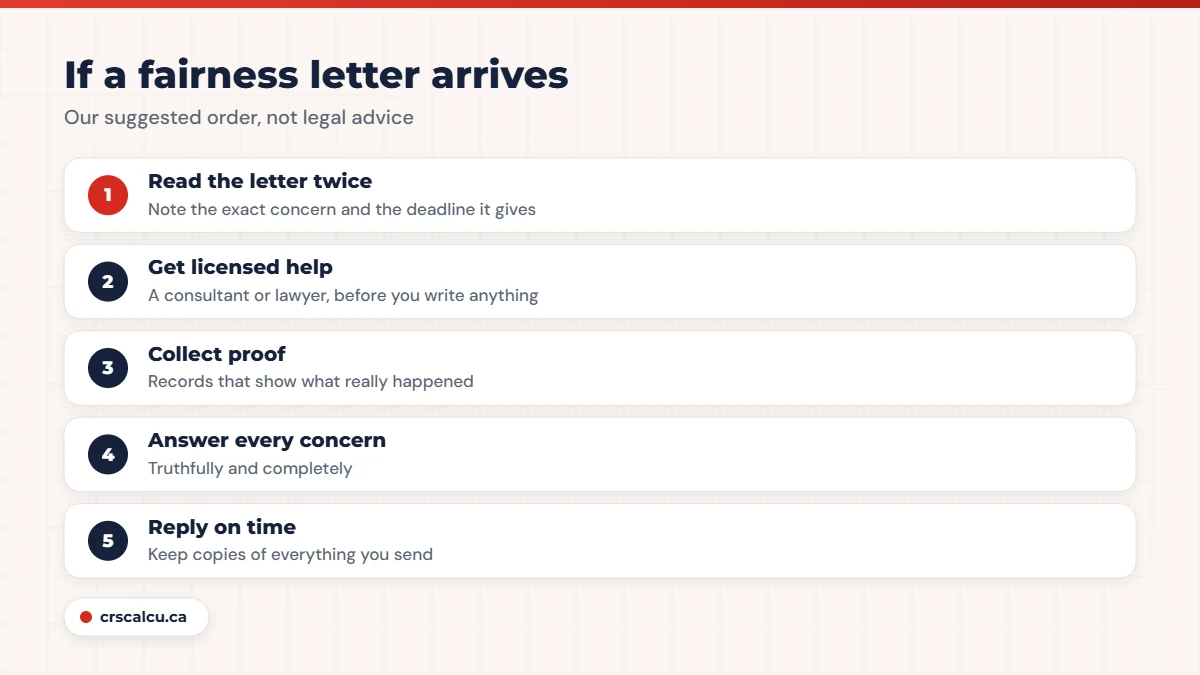
If the letter has arrived, stop writing and get help
A reply to a fairness letter is the last thing an officer reads before deciding, and the March 2023 case shows that “it was a mistake” may not be enough. We strongly recommend a licensed immigration consultant or a lawyer before you answer. Bring the letter, your full application and every document you sent. Do not send new documents that are not true to fix old ones.
Where these problems usually start
The cases above and the IRCC document list point to the same handful of places. Go through them before you submit, not after.
When | Type of file | What went wrong | Outcome reported |
|---|---|---|---|
May 2017 | Express Entry profile | Typed 5 family members instead of 1 | None reported |
July 2018 | Permanent residence application | Spouse’s old visa refusal not declared | Disclosed to IRCC; no result posted |
September 2022 | Provincial nominee PR application | Officer could not verify the employer | Reply pending; no result posted |
March 2023 | Temporary visa application | Recent refusal not declared | Five-year ban |
June 2023 | Spousal sponsorship | Twenty-year-old refusal not declared | Web form sent; no decision posted |
Our summary of five public forum threads, read on October 5, 2026. Only two concern Express Entry or economic-class files directly. We could not read a thread on wrong work dates or a wrong NOC in time for this article, so no such case is included.
Final check before you submit anything
For the full list of what gets uploaded after an invitation, use our Express Entry document checklist.
Frequently Asked Questions
What counts as misrepresentation in Express Entry?
IRCC’s Express Entry profile page (modified September 24, 2026) refers to giving false information or leaving out important details about your history or experience. Its fraud page adds false or altered documents, and names passports, visas and stamps, language results, proof of employment, education documents, relationship certificates and police certificates.
How long is the ban for misrepresentation?
The Express Entry page says IRCC can bar you for 5 years from applying to come to Canada. The fraud page says banned from Canada for at least 5 years. The fraud page also lists a permanent record of fraud, which does not expire after five years.
My consultant filled in my profile. Am I still responsible?
Yes. IRCC’s fraud page says you are responsible for all the information in your application, even if a representative completes it for you. A Help Centre answer adds that a representative who advises you to give false information is breaking the law, and that the application will be refused.
I forgot to declare a previous visa refusal. What should I do?
Correct it yourself, quickly and truthfully. In the pool, update the profile. After applying, IRCC has an “Update your application” page and a web form. In the threads we read, applicants disclosed the refusal through the web form with a short explanation and proof. If the refusal affects eligibility, or was a refusal by Canada, get licensed advice first.
Is an honest mistake treated as misrepresentation?
We did not find an exception for an honest mistake on the IRCC pages we read. Forum reports are mixed: members describe refusals without a ban, bans and approvals. In one March 2023 case, an applicant who said they misread the question still received a five-year ban.
What is a procedural fairness letter and how long do I have to answer?
Applicants describe it as a letter in which the officer sets out a concern that could lead to refusal and invites a response before deciding. We could not confirm a standard deadline on an IRCC page; the letter states its own. Speak to a licensed consultant or lawyer before you reply.
Check your score with the true numbers
If a correction changes your work experience, family size or language scores, your points change too. Run the corrected profile through the calculator before you update it.
Final Thoughts
Misrepresentation in Express Entry is not only about forged papers. On IRCC’s own pages it includes important details that were left out, and it reaches files a representative prepared. The applicants who came through best in the threads we read were the ones who found the error first and told IRCC the truth without being asked.
If you have received a procedural fairness letter, if the error affects your eligibility or your points, or if a past application to Canada said something different from this one, do not handle it alone. Speak to a licensed immigration consultant or a lawyer before you send IRCC another word.